
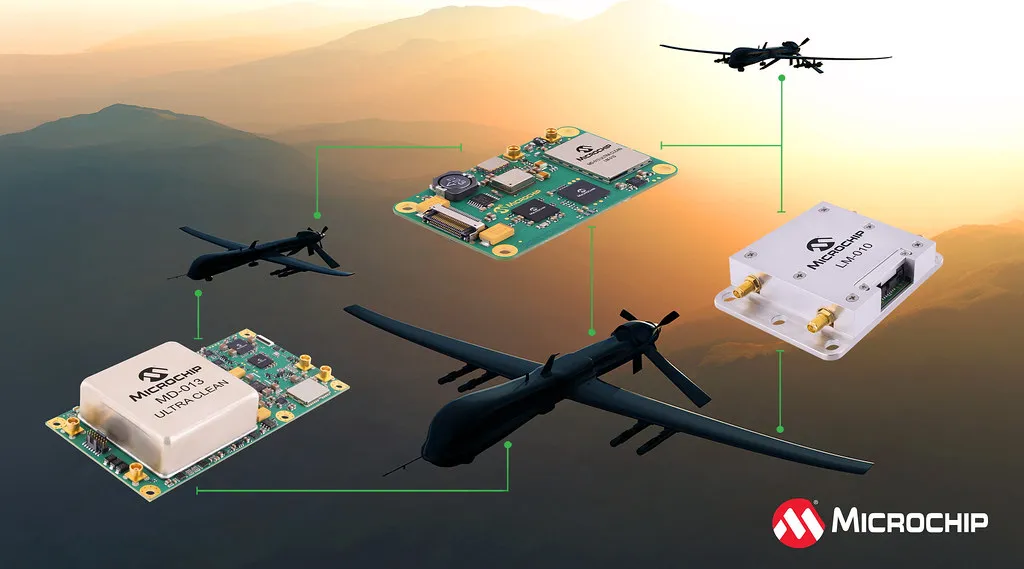
 Position, Navigation and Timing (PNT) technology underpins virtually every mission-critical defence system, from radar and satellite communications to tactical radios and vehicle platforms. Building a reliable PNT subsystem requires deep expertise in oscillator design, atomic clock integration, and ruggedisation. In environments where GNSS signals may be disrupted or denied, the demands on system designers increase further.
Microchip has introduced a portfolio of GNSS Disciplined Oscillator (GNSSDO) modules designed to simplify this process. By combining embedded atomic clock technology, high-stability oscillators, and control logic into compact modules, the company offers engineers a route to precise timing performance without the need to engineer each element individually.
Detailed Module Capabilities
Each module uses a local oscillator disciplined by reference signals from GNSS or an external clock source. This delivers stable frequency and timing outputs with holdover capability that maintains accuracy when GNSS is unavailable. The modules integrate Microchip’s own oscillators, including Chip-Scale Atomic Clocks (CSAC), Miniature Atomic Clocks (MAC), and Oven-Controlled Quartz Crystal Oscillators (OCXOs), alongside on-board microcontrollers and SmartFusion 2 FPGAs.
Three modules form the core of the release:
-
MD-013 ULTRA CLEAN A high-performance platform supporting GPS, Galileo, BeiDou, and NavIC signals, or an external reference. Built around a precision OCXO, it achieves ultra-low phase noise of −119 dBc/Hz at 1 Hz offset and a noise floor of −165 dBc/Hz. Frequency stability is characterised by Allan Deviation values of 3E-13 at 1s tau, 6E-13 at 10s tau, and 9E-13 at 100s tau. The module provides 1 PPS TTL, 10 MHz sine wave, and 10 MHz square wave outputs, all disciplined by a 72-channel GNSS receiver with options for dual-band upgrades.
-
MD-300 Measuring only 1.5 × 2.5 inches, this module targets systems where size, weight, and power are critical. It incorporates MEMS OCXO or TCXO options that withstand shock, vibration, and thermal transients, while generating high-quality 10 MHz and 1 PPS outputs. With its resilience and compact footprint, the MD-300 is suited to drones, portable radios, and manpack platforms.
-
LM-010 Aimed at Low Earth Orbit missions, this module combines radiation tolerance with precise timing capability. Using digitally corrected OCXOs or Microchip’s CSAC, it provides disciplined PPS and 10 MHz outputs with holdover stability for space environments where continuous GNSS coverage cannot be guaranteed.
Engineering Value in Real-World Applications
The key advantage for engineers is the ability to integrate subsystem-level solutions with predictable performance characteristics. Instead of combining oscillators, reference inputs, and control hardware separately, these modules provide a platform that has already been engineered and qualified for demanding environments.
For radar systems, phase noise and frequency stability directly affect coherence and detection accuracy. In SATCOM networks, stable timing ensures signal quality and secure links. Portable radios and drone platforms benefit from modules with low power consumption and resilience against shock and vibration. In orbit, radiation tolerance and reliable holdover make the difference between continuous operation and system failure.
Development Tools and Ecosystem Support
The modules share a common serial communication protocol and are supported by Microchip’s VDOM3 software with a graphical user interface for configuration. Engineers can adjust input and output selection, holdover parameters, and GNSS tracking behaviour, as well as monitor observables through the serial interface.
Evaluation hardware, including the MD-01X kit, is available for rapid prototyping and system testing. These tools are designed to reduce integration effort and help designers qualify timing performance early in the development cycle.
The GNSSDO portfolio also complements Microchip’s wider aerospace and defense product range, which includes radiation-tolerant MCUs and FPGAs, Ethernet PHYs, RF components, and power devices. This allows engineers to build timing solutions that integrate cleanly with other Microchip technologies while benefiting from a single supply chain.
Conclusion
As defence and aerospace systems evolve, precise timing has become as fundamental as processing power or data bandwidth. The introduction of GNSSDO modules gives engineers access to subsystem-level performance that has been engineered and validated, reducing design risk while meeting the demands of radar, SATCOM, drones, and LEO platforms. In environments where GNSS signals are unreliable or unavailable, these modules provide the resilience and accuracy that modern missions demand.
Learn more and read the original article on www.microchip.com
You may also like