A New Chapter for Intelligent Edge Computing
The race to make devices more autonomous and context-aware is transforming how silicon is designed. Synaptics has entered that race decisively with the launch of its Astra SL2600 Series, a family of multimodal processors built to deliver high performance at low power. The series brings together open-source tools, RISC-V architecture, and Google’s Coral NPU, setting a new direction for developers working at the intelligent edge.
The Engine Behind Astra: Torq Edge AI Platform
At the centre of the SL2600 series is Torq, Synaptics’ new Edge AI platform. It combines Arm Cortex-A55 and Cortex-M52 CPUs, a Mali GPU, and a Google RISC-V Coral NPU that supports dynamic operator loading. This means neural networks can be updated and expanded without redesigning the hardware. Developers can also work directly with Synaptics’ open-source IREE/MLIR compiler and runtime, making it easier to train, port, and deploy AI models across devices.
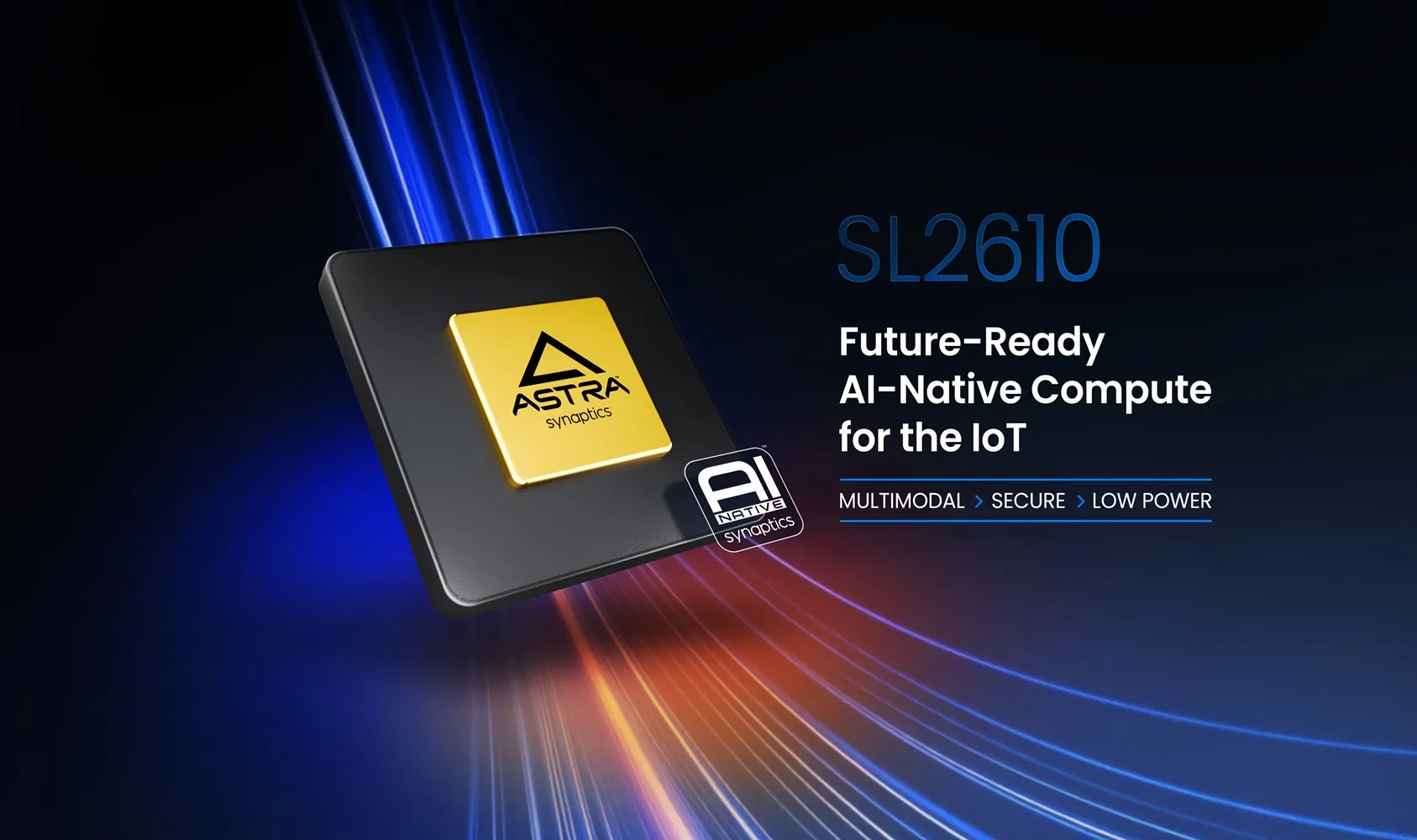
The first product line, SL2610, includes five pin-to-pin compatible processor families: SL2611, SL2613, SL2615, SL2617, and SL2619. This range supports everything from low-power battery devices to high-performance vision systems. Each chip integrates seamlessly with Veros Connectivity, offering Wi-Fi 6, 6E, and 7, Bluetooth, BLE, Thread, and UWB.
Designed for Real-World Intelligence
The SL2610 is engineered for use across a wide variety of products, including smart appliances, healthcare systems, home and factory automation, retail terminals, robotics, UAVs, and even portable gaming devices. Security has been built into the silicon, from an immutable root of trust to real-time threat detection and a dedicated crypto coprocessor that manages AI-related encryption workloads.
Early partner feedback points to strong real-world potential. Moonshine AI has already confirmed native transformer model support for multilingual and conversational processing on constrained IoT devices. Sonos and Cisco praised Synaptics for its ability to combine audio, connectivity, and AI processing, while Deutsche Telekom highlighted the platform’s role in bringing privacy-first intelligence to the home.
Industry Backing and Broader Context
Support from Google and Arm adds weight to the launch. Google’s Yossi Matias described the collaboration as a step toward simplifying Edge AI development, while Arm’s Paul Williamson said the platform “combines low-power compute and high-performance graphics to enable richer user experiences.” This combination of openness and security places Synaptics in a strong position against more closed ecosystems.
Why It Matters
The SL2600 marks a shift in how Edge AI processors are designed. It blends the flexibility of open-source tools with RISC-V hardware freedom and the efficiency of purpose-built NPUs. For developers, it means shorter design cycles and the ability to deploy multimodal intelligence directly at the device level without relying on cloud compute.
Sampling is underway now, with general availability expected in Q2 2026. Synaptics is also inviting developers to apply for early access to its Astra Machina SL2610 Development Kit, which provides a full toolchain for rapid prototyping and benchmarking.
Learn more and read the original article on www.synaptics.com
You may also like