
 Accurate current sensing is one of those tasks that seems simple until the numbers get large. As battery systems, chargers and motor drives climb past the hundred-amp mark, analog sensors can struggle to maintain linearity and stability. Heat, electrical noise and isolation all become limiting factors. The result is that engineers either oversize components or accept small errors that accumulate into lost efficiency.
Higher Accuracy at Higher Currents
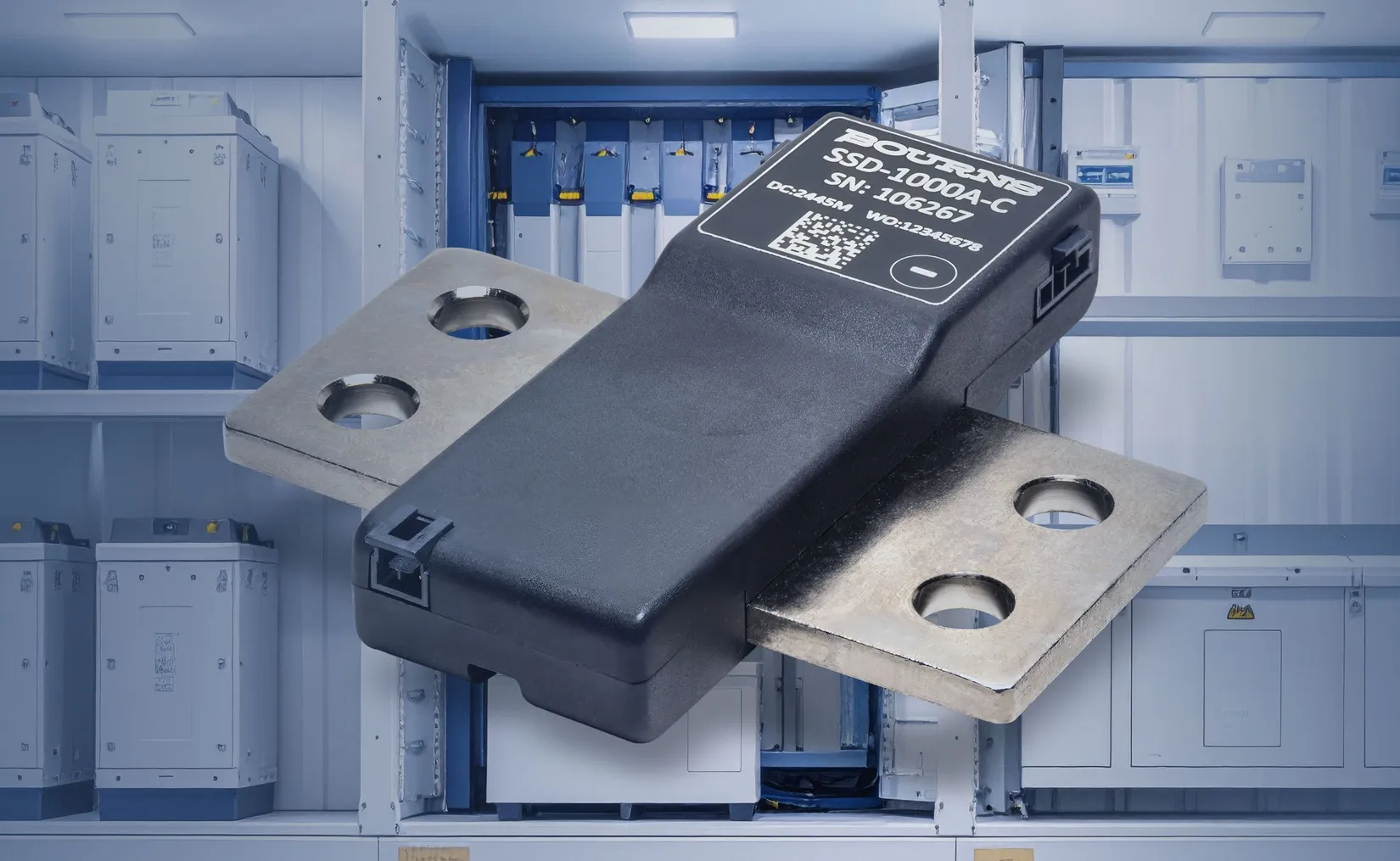
Bourns has expanded its digital sensing portfolio with the SSD-1000A Series, a new range of shunt-based current sensors capable of measuring up to 1000 A. Each device combines a low-resistance precision shunt with onboard signal processing, turning raw current into calibrated digital data. The approach improves repeatability and simplifies integration in designs that already use serial communications for system monitoring.
At its core is a 16-bit microcontroller with a 24-bit ADC, giving a typical full-scale accuracy of ±0.1%. By digitising the signal at the source, Bourns reduces the analog noise and drift that often affect high-current measurements. This also removes the need for external ADCs, helping engineers drop the device straight into new or existing systems with minimal redesign.
Digital Interfaces and Design Flexibility
Two variants are available: one with an RS-485 interface that supports MODBUS RTU, and another with CANbus for distributed control networks. Both maintain full performance across –40 °C to +115 °C, with an optional 120-ohm termination resistor to simplify wiring in bus topologies. The sensors provide electrical isolation between the measurement path and communication interface, a key factor for safety and noise immunity in multi-module systems.
The series has been built to handle demanding environments such as EV chargers, solar and wind power systems, and industrial drives where reliability under load and temperature extremes is essential.
Simplified Power Monitoring
Digital current sensing helps engineers collect cleaner, timestamped data for analysis or control. It supports predictive maintenance, fault detection and more accurate efficiency tracking without introducing the offset drift common to analog approaches. With the SSD-1000A, Bourns offers a practical way to retrofit precision monitoring into existing architectures or streamline measurement in new ones.
Learn more and read the original announcement on www.bourns.com
You may also like