
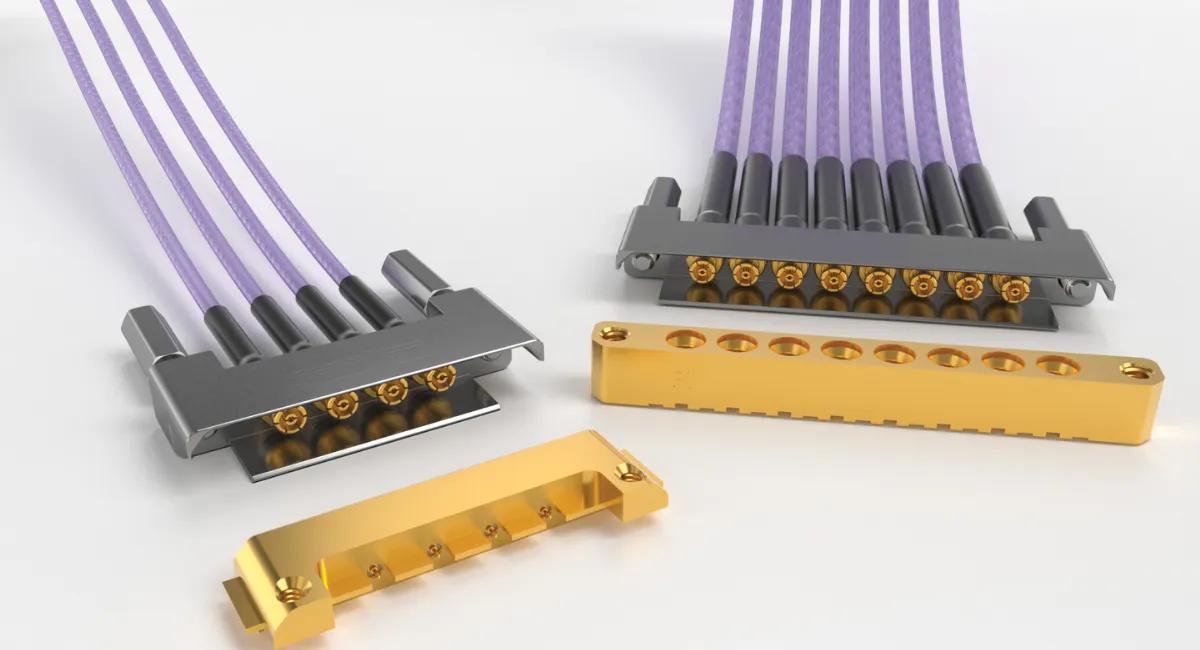
 RF systems used in aerospace, defence and high-performance communication platforms often push connectors to their limits. Engineers working in these areas need interconnects that hold alignment under vibration, survive rapid thermal cycling and still deliver consistent performance at millimetre-wave frequencies. Samtec’s new threaded SMPM solutions address exactly that challenge by combining high-frequency capability with a mechanical interface built for harsh environments.
RF Interconnect Demands in Harsh Environments
Applications such as radar front ends, aircraft communication modules and compact test equipment operate under conditions that can easily degrade standard SMPM interfaces. Quick-disconnect styles are convenient, but their tolerance to vibration and repeated shock varies widely. By adopting a threaded coupling method, the new SMPM variants improve retention and stability without significantly increasing size. This gives engineers a path to maintain signal integrity up to 65 GHz in environments where connectors cannot loosen or shift.
Electrical and Mechanical Performance
The threaded SMPM products fall under Samtec’s Magnum RF line and come paired with cable assemblies using either .047 inch or .086 inch low-loss flexible cable. The smaller GC47 cable offers higher maximum operating frequency and a very tight 0.125 inch minimum bend radius, which is useful in densely packed modules where cable routing spaces are limited. The GC86 option trades some frequency range for reduced insertion loss, a balance that suits longer runs or applications sensitive to attenuation. On the board side, Samtec provides both stub launch surface mount terminations and edge mount options. These variants help engineers match the connector style to their preferred layout method and allow consistent launch geometry across different board configurations.
Integration and Density Advantages
As RF systems move toward modular, multi-channel architectures, connector density becomes a limiting factor. Samtec addresses this by offering in-line channel counts ranging from two to ten on a tight 0.140 inch pitch. Housing multiple channels in a single structure improves positional alignment and reduces assembly time compared to handling separate connectors. The approach also results in smaller cable bundles, which improves airflow for cooling and helps maintain predictable thermal behaviour inside enclosed modules. These details are often overlooked but make a meaningful difference when working with compact, high-power RF assemblies.
Considerations for Future RF Designs
Threaded SMPM interfaces offer an interesting middle ground between compact microwave connectors and more specialised ruggedised formats. As equipment designers push toward higher operating frequencies and greater channel counts, reliable mechanical coupling becomes increasingly important. Samtec’s decision to prioritise retention, vibration tolerance and a clean high-frequency launch makes these connectors a practical option for both new designs and upgrades to legacy systems. Ready availability of samples, 3D models and documentation further supports early-stage evaluation and accelerates the design-in cycle.
Learn more and read the original announcement at www.samtec.com
You may also like