
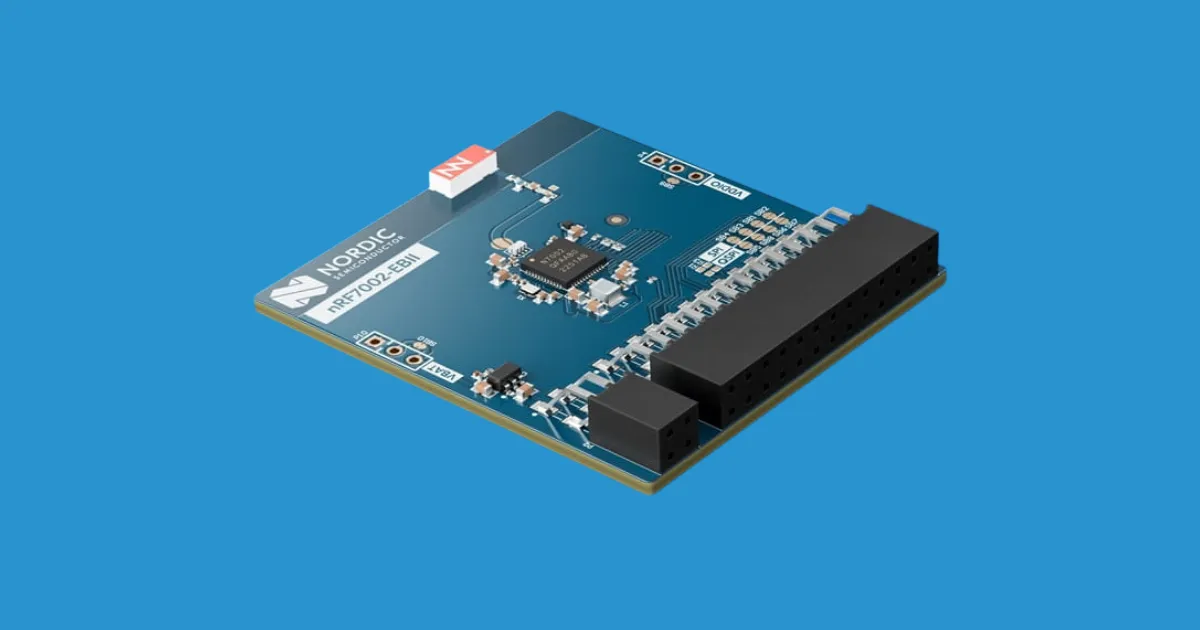
 Developers working on next generation IoT products often hit the same hurdle. They want multiprotocol capability and low power operation, yet still need reliable high throughput connectivity for dense networks or data heavy tasks. Wi Fi 6 has become a practical answer to those requirements, but adding it cleanly to an existing SoC workflow can be harder than it looks. Nordic’s new nRF7002 EBII expansion board is intended to close that gap by extending the nRF54L Series kits with native Wi Fi 6 support while keeping the power and integration model familiar.
Why Wi Fi 6 Matters For Developers
IoT designs increasingly sit in environments crowded with access points, competing devices and strict power budgets. Many battery driven products now expect to support Wi Fi directly rather than relying on bridges or hubs. That creates a need for more efficient scheduling, higher throughput when bursts occur and predictable sleep intervals. Wi Fi 6 addresses these issues through features such as Target Wake Time, OFDMA and BSS Coloring. Nordic’s aim with the nRF7002 EBII is to make these capabilities accessible to engineers already building on the nRF54L platform. In practice this lets development teams add Wi Fi without rethinking the entire RF architecture.
Core Technical Capabilities
The board is built around the nRF7002 companion IC, which already supports dual band Wi Fi, including both 2.4 and 5 GHz operation. That dual band approach allows designers to choose lower power channels for routine traffic while still taking advantage of the wider 5 GHz spectrum when throughput matters. Nordic has retained support for earlier 802.11 protocols, which helps in long lived installations where infrastructure may lag behind the latest standards. A small but important detail is the integrated dual band antenna, which simplifies validation during prototyping and reduces early RF layout headaches.
The board supports both STA and SoftAP modes, making it suitable for direct device provisioning and standalone network creation during commissioning. Communication with the host SoC can run over SPI or QSPI, which means developers can tailor the data path based on throughput and firmware structure. Nordic has also included headers for power profiling, which helps engineers tune power behaviour under real workloads. For platforms targeting long battery life, that visibility can be a deciding factor in final product tuning.
Design Considerations And Use Cases
The nRF7002 EBII connects directly to nRF54L Series Development Kits through a dedicated expansion header. This avoids the typical friction of setting up a new RF subsystem and instead feels like a natural extension of the existing development flow. The board integrates cleanly with the nRF54L15 and nRF54LM20 kits, both of which already handle multiprotocol applications such as Bluetooth LE, Thread or Matter. Adding Wi Fi 6 on top of those radios makes the overall system more flexible and supports a broader set of IoT architectures.
Use cases range from smart home devices that need stable connectivity in noisy RF environments, to medical devices where low power Wi Fi can reduce the load on limited batteries, to industrial sensors that join large infrastructure networks. Wearables and health monitors also benefit from predictable low power scheduling that Wi Fi 6 offers, especially when sensors periodically upload data rather than streaming continuously.
Implications For Future Designs
As more IoT devices merge multiple radios into a single platform, modular approaches like this expansion board will become more common. Engineers can experiment with multiprotocol combinations without committing to a full redesign, and product teams can iterate on network behaviour long before final hardware is built. Nordic’s choice to integrate the board fully within the nRF Connect SDK reinforces that direction. It lets developers focus on application logic while staying within a single software environment.
For engineers, the takeaway is that Wi Fi 6 is becoming easier to add to constrained products. When paired with low power SoCs like the nRF54L family, it enables connected designs that balance performance, efficiency and reliability without inflating system complexity.
Learn more and read the original announcement at www.nordicsemi.com
You may also like