Diodes’ AP53781 and AP53782 Bring Flexible USB-C Power Delivery to Portable Systems
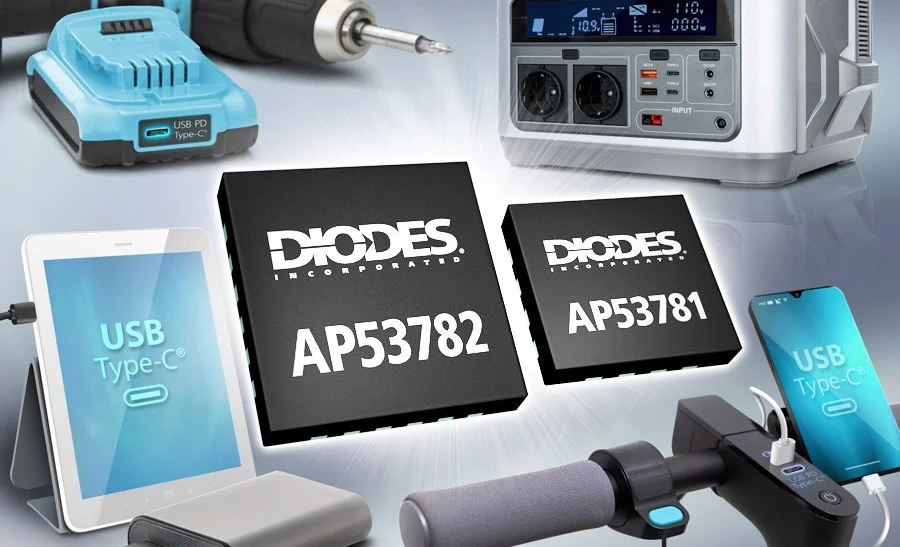 Designing power paths for portable devices used to be relatively simple. A system charged its battery from an adaptor and that was the end of it. USB Type C changed that dynamic by turning the connector into an intelligent power port that can both draw and provide energy depending on the situation. Once features like fast charging, power sharing and multi device support enter the picture, the controller responsible for managing those negotiations becomes a central part of the system architecture. Diodes Incorporated is targeting that space with its AP53781 and AP53782 dual role power delivery controllers.
Both devices are built to support USB PD3.1 extended power range, which means they can negotiate up to 140 W in either direction. In practice, this allows a power bank, tool battery or portable display to request high power charging when needed, then release energy back to another device when acting as a source. That flexibility is becoming more important as manufacturers try to reduce the number of proprietary chargers while still offering high performance charging behavior.
Why Dual Role Power Matters in Portable Electronics
Portable systems increasingly act as both loads and supplies. A drill battery might power the tool, top up a phone or be charged from a Type C adaptor. A display might run from a laptop one day and charge from a wall adaptor the next. Implementing that behavior reliably is not trivial. The controller must understand which role to take, negotiate a safe profile and protect against faults without relying heavily on firmware.
That is the challenge the AP53781 and AP53782 are designed around. They handle sink and source negotiation automatically, including scenarios where the system battery is fully discharged. Dead battery support ensures the controller behaves as a sink until energy is restored, which prevents lock out situations that frustrate users and complicate system design.
Technical Behavior Behind Power Negotiation
Diodes approaches the problem in two different ways depending on how much flexibility the designer needs. The AP53781 includes preloaded power data object and request data object tables for sourcing and sinking power. External resistors select between eight source profiles and eight voltage and current combinations when acting as a sink. This hardware based configuration is helpful in simpler designs where cost, firmware complexity or development time are constraints.
The AP53782 moves the control path to an I2C interface. Here the host MCU determines which PDOs and RDOs should be used, allowing the system to adapt power levels on the fly. This can be useful in devices that change behavior under different loads, have multiple operating modes or need to coordinate charging with thermal management routines. Greater control also helps with power sharing between subsystems inside the device.
Both controllers include CC pins rated to 34 V to protect against accidental shorts to VBUS, an event that can occur during connector wear or cable damage. That tolerance becomes important near the end of product life when mechanical stress on the port increases.
Integration Factors for Portable Designs
Form factor matters in compact products. The AP53781 is supplied in a 3 mm by 3 mm package, while the AP53782 uses a slightly larger 4 mm by 4 mm footprint. Both devices support operation from industrial temperature ranges, allowing them to sit close to batteries or power electronics without derating.
For many engineers the main appeal will be avoiding a full microcontroller based PD stack in simpler products. Hardware defined profiles reduce firmware overhead and eliminate a class of bugs associated with protocol edge cases. Where tighter integration is needed, the I2C enabled variant provides a path to more sophisticated power decisions without changing the core architecture.
These devices are not trying to redefine USB PD. They are aimed at making dual role power practical in systems where space, cost and reliability are competing constraints. As USB Type C continues to replace proprietary connectors, having a predictable controller that handles both directions cleanly can simplify product development.
The Direction of Portable Power Systems
Portable electronics are moving toward shared charging ecosystems where a single connector handles charging, power sharing and peripheral operation. That increases the importance of PD controllers that behave consistently across different sources and loads. Diodes’ AP53781 and AP53782 reflect that shift by giving designers a choice between fixed profile hardware configuration and host driven flexibility.
For engineers balancing cost, firmware complexity and user expectations, these controllers offer a straightforward way to implement dual role power without introducing unnecessary overhead. The broader trend points toward more devices acting as both sinks and sources, making reliable negotiation and protection behavior a central design concern rather than an afterthought.
Learn more and read the original announcement at www.diodes.com
You may also like