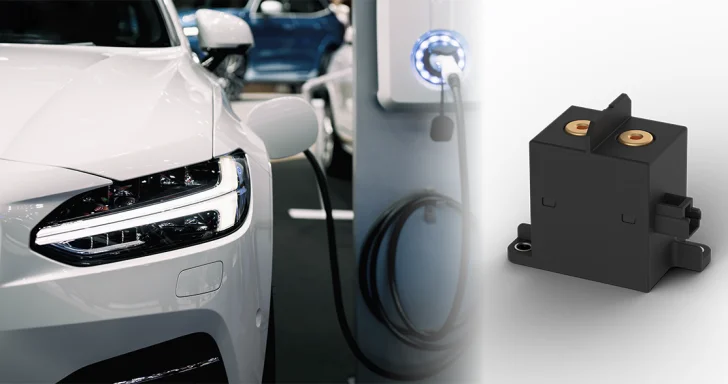
 High voltage switching in electric vehicles has become less about raw current ratings and more about how easily a component fits into a platform that is constantly evolving. As battery packs grow, power paths multiply and drive cycles diversify, the contactor has shifted from a simple relay-style device into a part of the electrical architecture that shapes thermal behavior, safety margins and even manufacturing choices. Sensata’s STEV high voltage contactor series enters that landscape with a focus on practical scalability, giving EV designers a switching platform that behaves predictably whether it sits in a passenger car or a heavy-duty truck.
At its core, the STEV family is built to move with the industry rather than forcing each OEM to redesign around unique variants. Sensata is pitching it as a way to reduce fragmentation across BEV and PHEV programs, keeping switching performance stable while the rest of the powertrain becomes more diverse.
How Standardized Switching Helps EV Engineers
Every EV designer eventually discovers that contactors affect far more than the point where they physically sit. Their resistance determines how much waste heat builds in the junction box. Their opening speed influences how cleanly a system disconnects under load. Their reliability dictates how often diagnostic routines must be triggered to validate safe operation. In practice, the contactor governs battery isolation, inverter protection and overall system behavior during both normal driving and abnormal fault conditions.
The challenge is that not all vehicles place the same stresses on the switching hardware. A plug in hybrid running a modest battery pack does not stress its contactors like a Class 8 truck climbing under load. Sensata’s approach with STEV is to offer a family that stretches across those environments without changing the fundamental switching characteristics. That consistency reduces second order engineering work and allows more reuse of validated architectures.
Electrical Behavior That Supports Real Load Cycles
Instead of leaning on headline specifications, Sensata highlights behavior that matters once the vehicle is out of the lab. Continuous current capability spans 150 A to 600 A, supported by low contact resistance intended to keep temperature rise under control during sustained operation. That detail becomes important in trucks, where higher duty cycles and repeated charging events can push components toward thermal limits.
Short circuit withstand ratings above 20 kA give the STEV devices enough headroom for real-world faults rather than theoretical scenarios. Internal isolation follows suit, with coil-to-contact dielectric strength up to 3.0 kV and insulation resistance around 1000 MΩ at 1000 VDC. These figures matter because isolation performance often drifts over the lifetime of a vehicle, especially when power electronics are packed densely into shared enclosures.
Hermetic ceramic sealing is another practical decision, containing arc energy and helping the device maintain performance across humidity, vibration and shock exposure common in automotive environments.
Packaging and Integration Designed for Vehicle Constraints
The STEV series supports both single and dual assembly configurations, reflecting how switching elements are distributed once the vehicle leaves the CAD environment and enters real packaging constraints. Junction boxes, battery enclosures and inverter housings rarely offer generous space. A modular contactor helps engineers place switching hardware where it fits rather than redesigning the enclosure.
Some variants support bidirectional current, a helpful trait for architectures that route energy in multiple directions during regenerative braking or load balancing. Optional IP67 protection provides another layer of flexibility, allowing contactors to sit closer to environmental exposure without relying entirely on the vehicle enclosure for protection.
These decisions do not appear as headline features, but they directly reduce late design compromises and the ripple effects that follow from challenging packaging issues.
The Bigger Picture for EV Platform Development
As OEMs expand electrified portfolios, the real challenge is not designing one high performance EV but designing ten variants that share as much underlying architecture as possible. A switching platform that behaves consistently across regions and vehicle sizes can help reduce requalification cycles and streamline the validation burden.
Sensata’s global manufacturing footprint reinforces that idea by providing in-region supply options, which becomes increasingly important as battery supply chains tighten and regional compliance rules grow stricter.
The STEV family is not attempting to redefine contactor technology. Its value lies in giving engineers a switching solution that stays stable even as the rest of the vehicle changes around it. For teams balancing safety, efficiency and long-term platform reuse, that predictability is often more important than any single electrical specification.
Learn more and read the original announcement at www.sensata.com
You may also like