
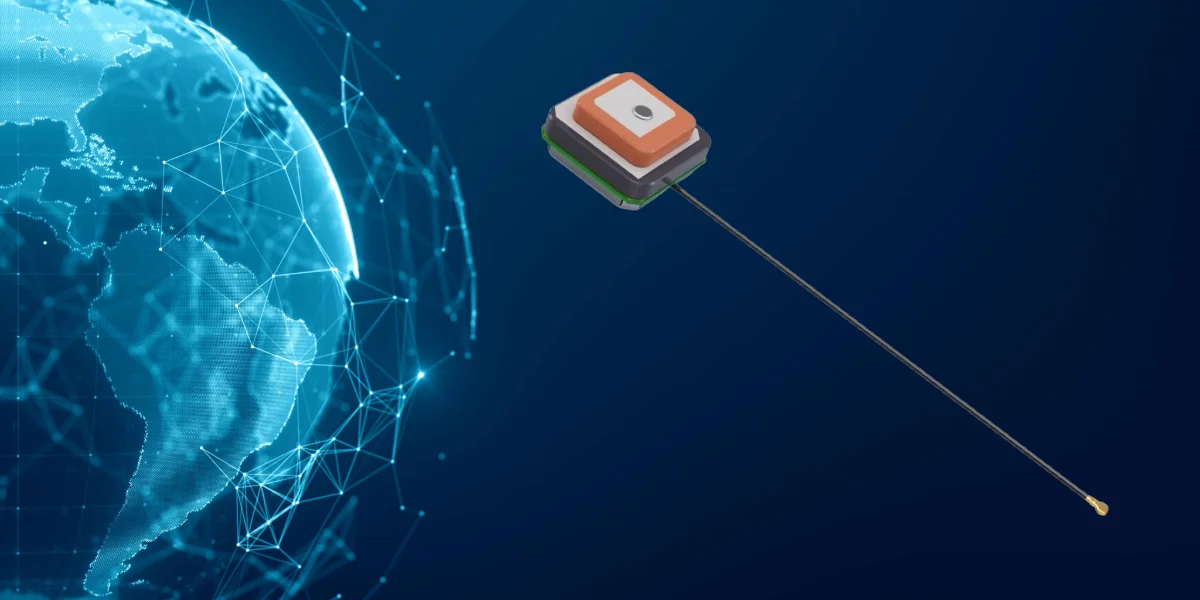
 GNSS receivers are gradually shifting toward multi band operation as applications demand faster fixes and better resilience in busy RF environments. Devices that used to rely on a single L1 antenna now need to handle L2 and L5 as well, which normally pushes designers toward larger modules or complex antenna arrangements. YAGEO Group’s new GNSSL125182530S patch antenna is built with that problem in mind. It combines a stacked ceramic structure with an active front end so that multi band performance can be added to compact hardware without reworking the whole RF section.
Rather than focusing on maximum size or gain, the antenna aims to give smaller devices a predictable way to receive L1, L2 and L5 signals while keeping coexistence with nearby radios under control.
Why Multi Band GNSS Is Becoming Necessary in Compact Hardware
Single band receivers still work for basic navigation, but high precision applications behave differently. Asset trackers, handheld survey equipment and industrial positioning nodes often sit near cellular, Wi Fi or 5G radios that create wideband noise. Using only L1 in those conditions tends to slow acquisition times and can reduce accuracy when interference is present.
A tri band antenna helps by giving the receiver access to additional frequencies where the RF environment may be cleaner. L2 and L5 signals are useful here because they respond differently to multipath and atmospheric effects. Devices that move between indoor, urban and open environments benefit from having more bands to work with, even if the device itself is physically small. YAGEO’s design targets that space by providing multi band behavior without the usual board area penalty.
How the GNSSL125182530S Achieves Multi Band Performance
The antenna uses a stacked ceramic patch to support L1, L2 and L5 simultaneously. A small active front end sits beneath the structure, built around a low noise amplifier that adds roughly 30 dB of gain depending on the band. Noise figures stay low across all three ranges, which helps when the incoming signals are weak or the receiver is sharing space with high power radios.
Strong internal filtering removes much of the out of band energy before it reaches the LNA. This matters in devices where LTE, 5G or Wi Fi are only a few millimeters away, since wideband noise from those systems can otherwise desensitize the GNSS chain. The antenna also includes an internal LDO and ESD protection so it can operate from a wide input range between 2.5 and 18 volts without developers needing to add supporting components.
Even with the multi band structure, the footprint stays at 25 by 25 millimeters. Many existing tri band patches use a larger 30 by 30 millimeter form, so the reduced area can make a difference when placing radios, batteries and sensors in a compact enclosure.
Integration Notes for Tracking and Positioning Platforms
The antenna arrives as a fully integrated module with a short 100 millimeter cable and an I PEX style connector. That approach helps avoid board level tuning, which is a common source of delay when designing multi band antennas into small devices. For products where the coax length must change, YAGEO offers customization.
Receivers used in logistics tags or fleet management units often operate on limited power budgets. The GNSSL125182530S draws around 16 milliamps at its maximum specification, which is manageable for devices that alternate between active tracking and sleep states. The broad input voltage range also means the antenna can be powered directly from common rails rather than dedicated regulators. Because the antenna works with GPS, GLONASS, Galileo, BeiDou and IRNSS, it can slot into global deployments without redesign. That matters for companies building hardware that must behave consistently in different regions or GNSS ecosystems.
Where This Antenna Fits in Modern GNSS Designs
As GNSS moves deeper into industrial and professional applications, small devices need to capture more than one frequency band without growing in size. The GNSSL125182530S is aimed at that crossover point. It is compact enough to sit in tightly packed hardware but carries the additional bands that improve accuracy and acquisition reliability in dense RF environments.
For engineers building next generation trackers, surveying tools or embedded positioning modules, the interest lies in adding multi band capability without redesigning the path between antenna and receiver. YAGEO’s approach places most of that complexity in the antenna module itself, which shortens development time and reduces the number of external components needed to reach full performance.
Learn more and read the original announcement at www.yageo.com
You may also like