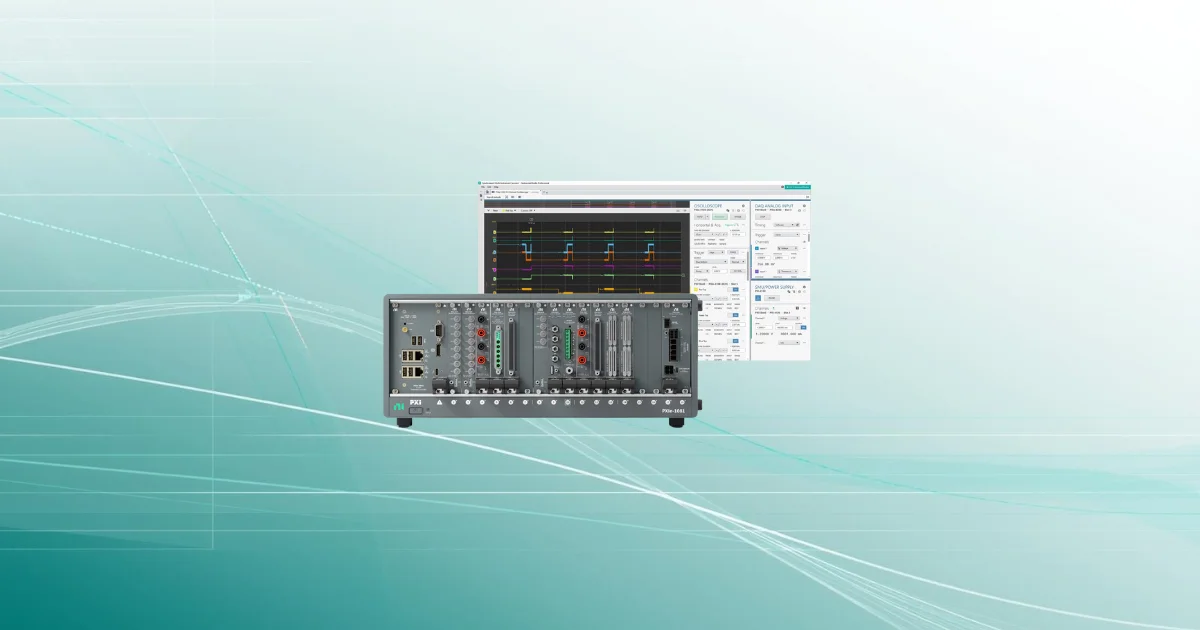
 Automated test systems are under pressure as designs become more complex and data requirements increase. Many teams want modular test hardware but struggle with the cost of building out a full PXI system. Emerson is addressing this gap by expanding the NI PXI platform with lower cost hardware that preserves the platform’s precision, synchronisation and software depth. The update brings high resolution oscilloscopes, new DAQ modules, an 18 slot hybrid chassis and modern embedded controllers into a price range that smaller engineering teams can access without sacrificing measurement quality.
PXI systems have traditionally been associated with high performance mixed signal test environments where channel density, timing alignment and long term reliability take priority. As more companies push toward software driven testing and AI supported analysis, the appeal of a common modular backbone has grown. Emerson’s update focuses on maintaining the platform’s core strengths while removing cost barriers that previously limited adoption in emerging industries and early stage product teams.
Why Scalable PXI Matters in Modern Test Environments
Many test benches start with standalone instruments. Over time, engineers need tighter synchronisation, wider channel counts and a unified timing model across different measurement types. PXI fills this gap by offering a modular, software driven approach that can scale without rewriting an entire system. The challenge has been cost. Smaller teams often want the flexibility but cannot justify high initial investment. Emerson’s updated PXI hardware lowers that threshold and makes the transition from ad hoc test setups to structured automation more achievable.
The shift toward SDVs, electrification, industrial automation and mixed signal devices has also increased pressure on measurement repeatability. When data volumes grow and test cycles need to be automated, a platform with deterministic timing and unified tooling becomes easier to justify.
What the New Hardware Enables for Engineers
The expanded lineup includes high resolution oscilloscopes, 18 bit multifunction I/O modules, embedded controllers and an all hybrid 18 slot chassis. The oscilloscopes provide up to eight channels with a 100 megahertz bandwidth and 250 mega sample per second rate. Engineers evaluating switching behaviour, waveforms or communication lines can capture more data concurrently without stacking multiple benchtop scopes. The DAQ modules offer 16 or 32 channels with 18 bit resolution and low noise voltage measurements, which is valuable for characterising sensors, supply rails or precision analog blocks. The embedded controllers remove dependence on legacy GPIB interfaces and allow engineers to run Windows or NI Linux Real Time directly in the chassis. The hybrid chassis links these modules together with 2 gigabits per second system bandwidth so that mixed domain measurements can be aligned in time without external synchronisation work.
Together, these modules form a baseline PXI system that can replace multiple instruments while keeping measurement behaviour consistent across iterations. For engineers, this reduces the integration effort that often consumes more time than the tests themselves.
Practical Considerations for Test System Integration
A major benefit of PXI is that the timing and synchronisation model is already handled by the platform. When oscilloscopes, DAQs and controllers come from different vendors, engineers sometimes spend weeks aligning triggers and reducing jitter between subsystems. With these new modules, the timing distribution is unified, which helps when testing devices that include both analog and digital functions. The high density of the oscilloscopes and DAQs reduces the physical footprint of the test bench, which matters in labs where multiple teams share the same space. Running everything through LabVIEW, InstrumentStudio and TestStand keeps the software layer consistent even as hardware configurations change.
The updated modules also create a more accessible path for teams planning to incorporate AI assisted test analysis. Real time data processing relies on consistent, well aligned measurements. The PXI platform already suits this approach, and lowering the cost of entry means more teams can explore AI supported test workflows without committing to new proprietary architectures.
How This Shapes the Future of Automated Test
Test environments are moving toward higher automation, faster updates and tighter loops between measurement and software analysis. Emerson’s expansion of the NI PXI platform acknowledges that these changes affect more than just the largest labs. Smaller engineering groups and industries that previously relied on standalone instruments can now adopt modular test systems with the same synchronisation, precision and long term scalability that PXI has offered for decades. As AI supported workflows spread across validation and production test, having a stable and consistent data backbone will matter more than individual instrument features. Emerson’s updated PXI hardware brings that capability within reach for more engineers and supports a smoother transition into next generation automated test architectures.
Learn more and read the original announcement at www.emerson.com
You may also like