
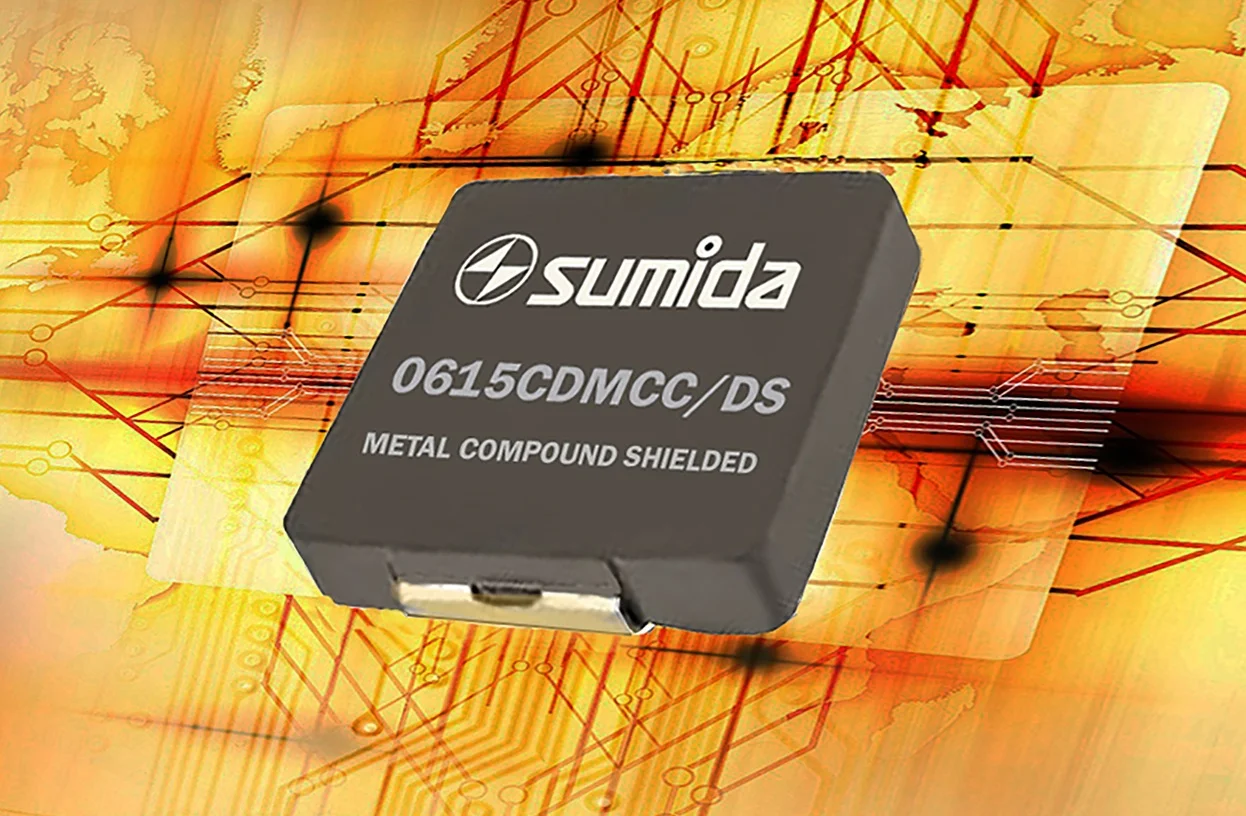
 In compact computing and embedded power systems, designers often struggle to keep thermal behavior under control while managing noise from tightly packed converters. As switching frequencies rise and current levels climb, even small inductors can introduce instability if magnetic performance shifts under load. Sumida’s new 0615CDMCC/DS series enters this space as a practical option for engineers who need high current handling, quiet operation and a footprint that fits into dense layouts without complicating thermal planning.
Why This Inductor Matters In Power Dense Architectures
Power designs inside compact servers, edge devices and high efficiency converters place unusual pressure on magnetics. A common challenge is finding an inductor that can stay stable as current swings upward without forcing a move to larger components. The 0615CDMCC/DS series uses a molded metal material that locks the winding into a solid structure. In practice, this removes internal air gaps that often lead to flux leakage and allows inductance to stay consistent when the converter transitions between light load and heavy load states. Quiet electrical behavior becomes easier to maintain when magnetic fields are contained rather than shifting under thermal stress.
Magnetic Construction That Reduces EMI And Conduction Loss
One detail worth noting is how the composite molding creates a naturally shielded magnetic profile. This matters because layouts with high speed digital logic, RF paths or sensitive analog front ends cannot tolerate stray flux. By containing the field inside the molded body, placement becomes less restrictive and routing can stay efficient. The core material also keeps DC resistance low enough to help reduce conduction loss at high current levels. When power budgets in compact equipment are tight, any reduction in wasted energy improves thermal stability and gives designers more operating margin.
Mechanical Profile That Fits Confined Enclosures
In real systems, vertical headroom can be as limiting as electrical performance. The inductor’s 7.3 by 6.8 by 1.5 mm maximum dimensions give engineers a way to maintain power integrity without relying on taller components that would interfere with enclosures or thermal shields. The operating range from minus 55 degrees Celsius to plus 125 degrees Celsius supports placement near warm processors, battery packs and industrial control boards where conditions change quickly during load events.
Use Cases Across Computing, Industrial And Low Noise Applications
The suppression of audible noise is another practical advantage of the composite structure. High frequency converters often create coil whine as vibrational energy transfers into the enclosure. By containing these vibrations, the 0615CDMCC/DS series becomes suitable for medical equipment, consumer devices and test instrumentation where quiet operation is valued. Supported inductance values from 0.12 microhenry to 1.50 microhenry make it adaptable to a broad set of current mode controllers and high efficiency power stages used in servers, edge computing, industrial automation and portable systems.
For engineers, the takeaway is that this series brings predictable behavior into layouts where both thermal and acoustic constraints limit design freedom. It narrows the gap between compact form factors and high current operation without adding noise into surrounding circuitry.
Learn more at www.sumida.com
You may also like