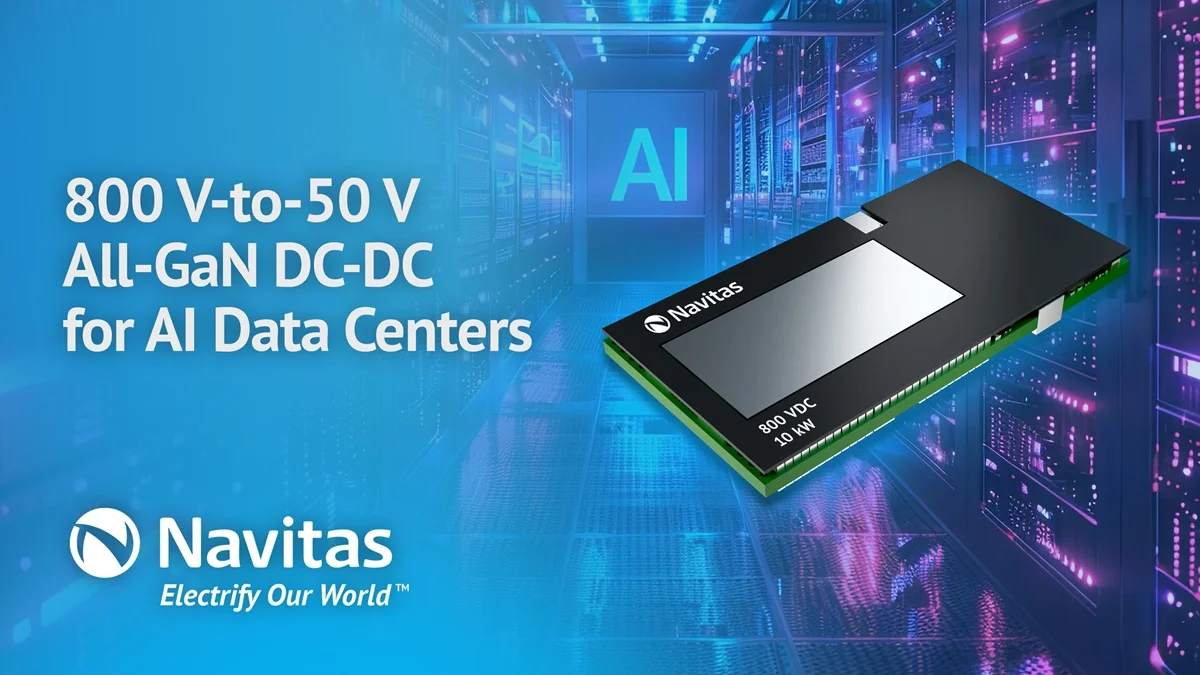
 High voltage DC distribution is becoming a real path forward for data centers trying to keep up with AI loads, but turning an 800 V bus into a clean, low voltage rail without losing half the energy to heat has always been the sticking point. Traditional bricks handle a few kilowatts but struggle once switching speed, efficiency and footprint all tighten at the same time. Navitas is pushing directly into that gap with a 10 kW converter built entirely around GaN switching behavior, aimed at systems where power density matters as much as compute density.
In practice, the converter sits in an unusual place in the architecture. It takes the 800 V bus that runs through next generation racks and pulls it down to a 50 V rail without drifting when the load suddenly changes. Large AI systems rarely sit still. They can jump between phases of a workload and pull current in ways that make slower converters stumble, so the stability here becomes as important as the efficiency number printed on the datasheet.
A Three Level Stage Geared Toward Fast Switching
Instead of a conventional hard switched bridge, the platform uses a three level half bridge combined with synchronous rectification. That combination helps the converter handle the 800 V to 50 V path and the plus minus 400 V option that some HPC racks are beginning to explore. GaN devices at 650 V handle the high side while the 100 V parts sit downstream, and together they switch at around 1 MHz. That frequency changes the shape of the design. Magnetics shrink, current loops get tighter and the converter behaves differently when load steps hit at awkward moments. It gives designers a way to trade switching frequency for density without accepting harsh efficiency penalties.
Power Density That Comes From GaN Dynamics
One detail worth noting is the mechanical form factor. Navitas packages the converter in a full brick footprint, roughly 61 by 116 by 11 millimeters, yet still reaches 2.1 kW per cubic inch. That number only becomes possible because the devices can switch quickly enough to keep conduction loss and switching loss at manageable levels even at 10 kW. Holding above 98 percent efficiency at full load is not just a bragging point. It directly affects thermal paths, cold plate sizing and whether an existing rack design can absorb another generation of compute hardware without adding new infrastructure. In environments where cooling headroom is often close to exhausted, every fraction of a percentage point has a visible impact.
Fitting Into Emerging HVDC Architectures
Moving racks toward HVDC is not just about efficiency. It reduces copper loss, simplifies distribution and can cut out entire conversion stages. The challenge is that every building block in the chain needs to behave well at high bus voltages, and very few production ready modules currently sit in this power range. Navitas frames this converter as a platform rather than a single demonstration unit. Auxiliary power, control functions and the mechanical layout push it closer to something that can drop into early deployments with minimal redesign. For teams already exploring 800 V rails, this makes the transition less disruptive.
Handling AI Driven Dynamic Loads
AI workloads have erratic power behavior. They spike, settle, spike again and rarely behave like classical computing loads. The converter’s switching frequency and GaN characteristics help control the energy in each transient, which means downstream 50 V rails see less ripple and fewer timing side effects when current swings aggressively. This helps GPU stages maintain consistent conditions even when the surrounding power environment shifts. It also reduces the dependency on very large output filters, which is helpful when board real estate is already constrained by the size of accelerator modules.
Adoption And Development Path
Navitas notes that several data center developers are already evaluating the platform through joint programs. While details remain internal, early evaluation normally signals that the converter fills an immediate need in HVDC pilot projects. With a public demonstration planned for APEC 2026, the module will likely play a role in shaping how quickly the industry commits to high voltage distribution as the default for AI infrastructure. As compute demands keep rising, these power building blocks determine how far architects can push rack efficiency before hitting thermal or electrical limits.
Learn more and read the original announcement at www.navitassemi.com
You may also like