
The Era of Aging Hardware
The era of aging hardware is truly upon us, and it is amazing to see how far technology has come in the past 50 years. What used to be massive machines taking up entire rooms are now shrunk down to the size of a small chip, and these chips are now so small that they can be integrated into all aspects of life including watches, rings, and even experimental contact lenses.
But as technology is integrated into everyday life, older systems are being replaced en-masse which is seeing large amounts of e-waste being generated. However, as technology is replaced, so is the data held on those devices, and this can be particularly problematic for older hard drives which use technologies that cannot be read by modern systems (such as legacy interfaces and addressing schemes).
Some may choose to hold onto their hardware for sentimental reasons, while others may want to keep it for its historical value. In fact, there are many around the world who actively search for old hardware just so they can play games on ancient computers and consoles.
But for those who dust off their ancient hard drives to see what content they had, trying to get files off these drives can be a near-impossible task without specialist equipment. Modern operating systems often cannot read them without appropriate controllers, adapters, or drivers; even connecting them to a modern computer can result in the OS not being able to recognise the drive.
Thus, users may have to pay significant sums to specialist data-recovery services to try and salvage whatever data remains on the drive, or accept that it is lost, until now...
ATABOY Open Source ATA Interface Saves The Day
Recognising the challenges faced with modern hardware and old drives, one maker has decided to save the day with an open-source IDE to USB bridge that will allow anyone to connect their old drives to modern computers. Most IDE to USB bridges on the market will not work with older drives as they require drives using logical block addressing, something that didn’t become a standard until the mid 1990s.
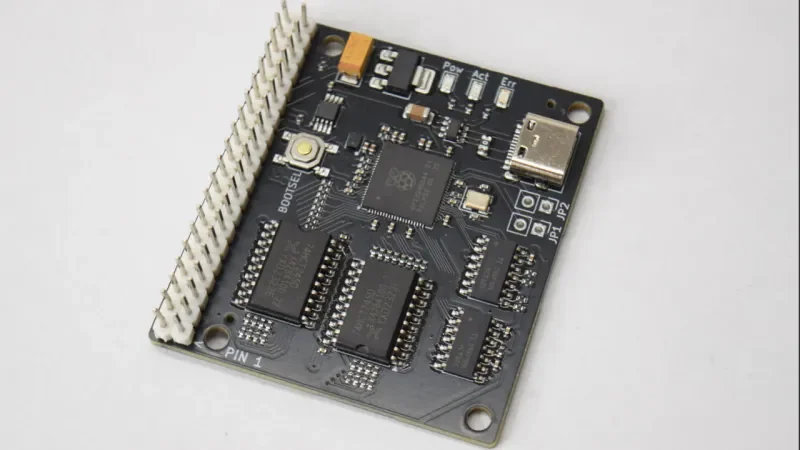
However, many older drives use a system called Cylinder-Head-Sector (CHS), meaning that these drives cannot be used with most USB bridges. Dubbed the “ATABoy”, this open-source bridge is designed to let older PATA drives be connected to modern computers via a single USB port.
The creator of the ATABoy, [JJ Dasher] (also known as [redruM0381]), noted that the ATABoy is able to handle the oldest drives that fit on the bus, and while the project is still in development, it has already been used to restore data from a 20-year-old drive. At the heart of the ATABoy is an RP2350, a microcontroller that functions as both the IDE host controller and the USB host controller and includes a dual-core ARM processor.
This device acts as both the IDE host controller and USB host controller, and after some initial setup, the drive connected to the ATABoy appears as a regular USB mass storage device. To make things even more interesting, the ATABoy also includes a BIOS-themed configuration utility that can be accessed via a serial console.
While the ATABoy itself uses a USB-C connector, it doesn’t provide power over this connection, meaning that a separate power source is needed. Fortunately, the small size of the ATABoy makes it ideal for use with USB-C powered benchtop units, and the ATABoy can be used with a Raspberry Pi by bypassing USB and using GPIO to interface PATA IDE.
What does this tell us about aging hardware?
Just because hardware is old does not mean it lacks practical purpose, especially for specific tasks or constrained environments. Some systems clearly belong in museums, such as mercury delay lines or multi-table hard drives with only a few megabytes of storage.
However, other legacy components, including older hard drives, motherboards, and RAM, may still be repurposed effectively for computing or archival tasks. As modern supply chains struggle to meet demand for RAM and GPUs in the AI era, reusing older hardware with lean operating systems like Linux may be necessary.
Although these devices consume more energy and perform more slowly than current equivalents, they remain functional and could provide value in certain workflows or research contexts. And with open-source projects like the ATAboy becoming far more common, it could very well open a new world into technology restoration.