
 Edge AI systems are beginning to collide with a very practical hardware constraint. The moment you try to add local inference to a connected device, the board fills up quickly. Application processor, AI accelerator, Wi-Fi chipset, Bluetooth radio, 802.15.4 transceiver, RF front ends, coexistence filtering, certification headaches. By the time everything is placed and routed, the compute problem has quietly turned into an RF and integration problem.
When Edge AI Hardware Starts Competing For Board Space
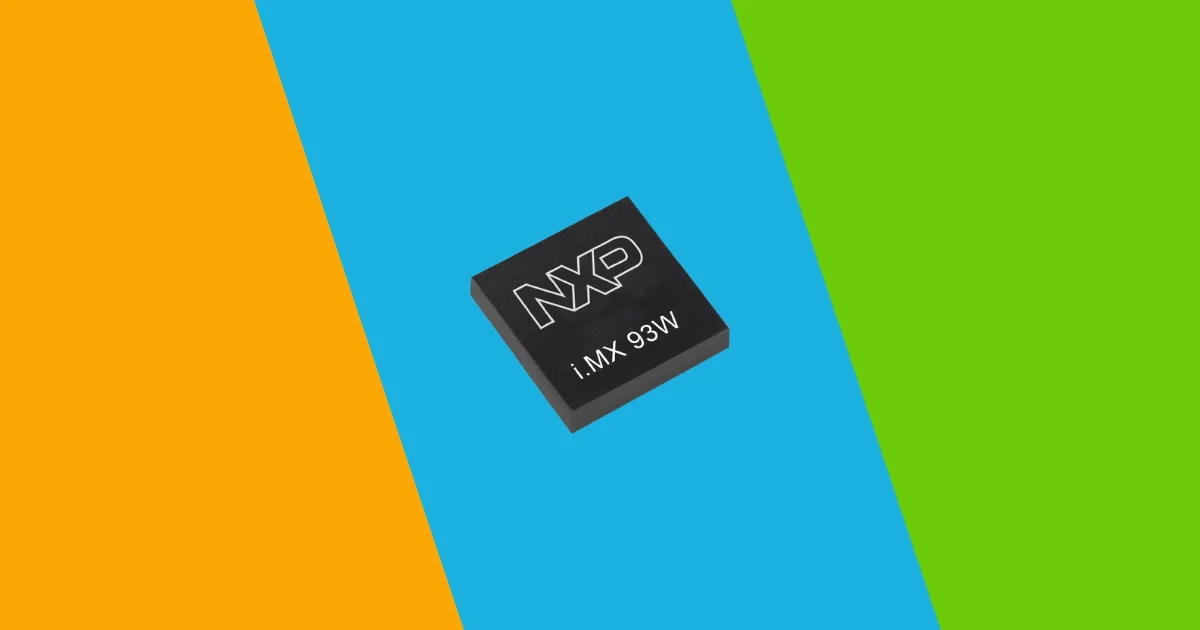
NXP’s i.MX 93W applications processor is built around a problem many embedded designers are now running into. Adding AI capability to edge devices usually means bringing in an accelerator alongside an applications processor, then attaching wireless connectivity through additional radios or modules. The i.MX 93W approaches that differently by collapsing several of those system blocks into a single device. The processor integrates a dual-core Arm Cortex-A55 subsystem alongside a dedicated Arm Ethos neural processing unit capable of reaching roughly 1.8 eTOPS of inference performance.
That compute capability is paired directly with a tri-radio wireless subsystem that combines Wi-Fi 6, Bluetooth Low Energy, and an 802.15.4 radio supporting Thread and Matter networks. Instead of building that wireless stack from multiple devices, the radios are already integrated and designed to coexist within the same package.
The RF Complexity Most Edge Systems Eventually Run Into
Wireless connectivity often becomes the quiet bottleneck in connected embedded designs. Each additional radio typically brings its own RF front end, antenna tuning requirements, and coexistence considerations once multiple protocols start operating simultaneously. By integrating the IW610 tri-radio subsystem into the processor package, the i.MX 93W avoids some of that system-level complexity. RF tuning, coexistence behavior, and regulatory certification work that would normally happen at the board level shifts closer to the silicon platform itself.
In practical terms, this allows a single device to replace a collection of processors, wireless modules, and supporting RF components that would otherwise occupy significant board space. NXP suggests the integration can remove as many as 60 discrete components from the design depending on the architecture being replaced.
Security Infrastructure Becomes Part Of The Platform
Edge devices increasingly operate in environments where security requirements are no longer optional. Regulatory pressure has been rising, particularly with frameworks like the European Cyber Resilience Act pushing vendors toward stronger device-level protections. The i.MX 93W includes NXP’s EdgeLock Secure Enclave with an advanced profile configuration. That hardware root of trust handles tasks such as secure boot, authenticated firmware updates, device identity, and controlled access to sensitive system functions.
Security provisioning can also extend beyond manufacturing through integration with NXP’s EdgeLock 2GO key management infrastructure, allowing device credentials and certificates to be managed either during production or after deployment.
Reference Designs Remove A Large Portion Of RF Work
One of the more time-consuming aspects of wireless hardware development is certification and RF tuning. Even when using well understood radio chipsets, antenna placement, enclosure effects, and coexistence behavior can stretch development schedules unexpectedly. To reduce that effort, NXP is providing pre-certified single-antenna and dual-antenna reference designs built around the i.MX 93W platform. These designs already account for regulatory compliance across multiple regions, which removes a large portion of the RF validation work that would normally occur late in the product cycle.
For system designers working on connected human-machine interfaces, industrial gateways, smart building controllers, or healthcare monitoring equipment, that level of integration shifts the development focus back toward application software and system behavior rather than low-level radio tuning.
The device is expected to begin sampling in the second half of 2026.
Learn more and read the original announcement at www.nxp.com
You may also like