
 Designing isolated power rails often looks straightforward on paper. In practice it rarely stays that way. Once isolation, transformer behavior, and switching symmetry enter the picture, small timing mismatches start to matter. Push-pull converters remain popular because they are efficient and relatively simple to implement, but they come with a familiar headache. If the switching pair drifts out of balance, even slightly, the transformer core begins to accumulate flux in one direction. Leave that long enough and saturation appears in places you did not expect.
Push-Pull Drivers Still Sit At The Center Of Many Isolated Rails
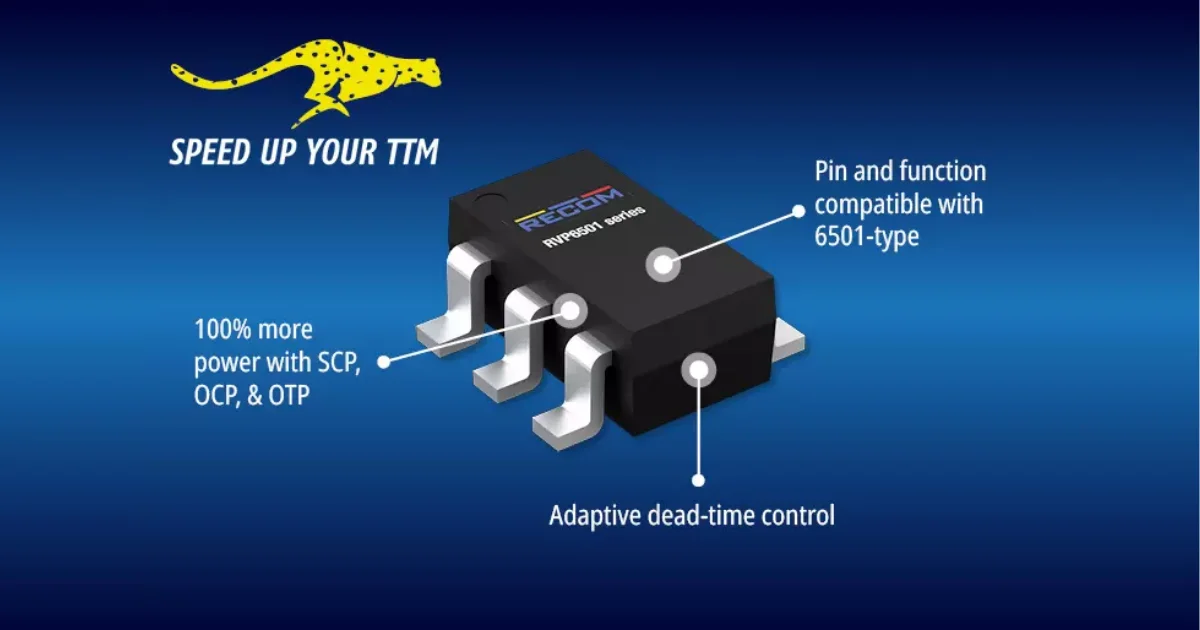
RECOM’s RVP6501 enters a design space that many engineers already recognize. The device is a transformer driver intended for discrete push-pull DC/DC converter designs where the control IC directly drives the switching transistors connected to a center-tapped transformer. The operating supply sits in the typical low voltage control range, accepting inputs from 2.8V up to 6V. That covers common logic rails and battery-powered systems, while the device is built to tolerate transient spikes reaching 10V without damage. What stands out more is the output drive capability. The RVP6501 can deliver up to 500mA of drive current across the entire supply range, which removes some of the margin compromises engineers normally make when operating push-pull drivers from lower supply rails.
That extra drive current becomes useful when switching larger MOSFETs or when transformer magnetizing currents begin to push the limits of smaller gate drivers.
Adaptive Dead-Time Control Addresses Flux Imbalance Risks
Push-pull converters are sensitive to switching overlap. If both transistors conduct simultaneously, even briefly, the result can be cross conduction through the transformer primary. That condition rarely ends well. The RVP6501 includes break-before-make switching, which is expected for this type of driver, but the implementation goes a step further. Instead of relying on fixed dead time, the device monitors the gate drive behavior and dynamically adjusts the spacing between switching transitions.
The driver watches the gate behavior and adjusts the dead time on its own. That matters more than it sounds, because transistor thresholds drift with temperature, load, and age, and fixed timing slowly stops being correct.
When Push-Pull Transformers Start To Saturate
Push-pull stages also have a habit of drifting into flux imbalance. It does not look dramatic at first. The magnetizing current just creeps up cycle by cycle until the transformer core finally gives up and saturates, and when that happens the switching devices usually take the hit.
To address this, the RVP6501 continuously monitors the current flowing through the switching transistors. When abnormal current levels appear, the device can react quickly enough to limit short-circuit or overload conditions. That protection mechanism works alongside the adaptive switching timing to reduce the likelihood of sustained flux imbalance in the transformer. It is not something most designers think about during schematic capture, but it becomes obvious during fault testing when converters behave unpredictably.
A Building Block For Discrete Isolated Converter Designs
Rather than offering a complete power module, RECOM is positioning the RVP6501 as part of a broader component set aimed at engineers who prefer to build isolated converters from discrete elements. The company is also releasing complementary SMD transformer components and related power ICs intended to work within the same design space.
For engineers who already rely on the well-known 6501-style transformer drivers, the RVP6501 serves as a pin-compatible alternative with additional current capability and integrated protection features. In practice, the improvements focus less on changing converter architectures and more on addressing the small operational problems that tend to appear once designs leave the lab and run in real systems.
Learn more and read the original announcement at www.recom-power.com
You may also like