
 Medical electronics rarely shrink in a straight line. Displays get thinner, enclosures flatten out, and suddenly the power supply that used to sit comfortably inside the chassis becomes the tallest component in the system. Engineers designing patient monitors, infusion pumps, and industrial control equipment often discover that vertical clearance becomes the real constraint long before electrical limits are reached.
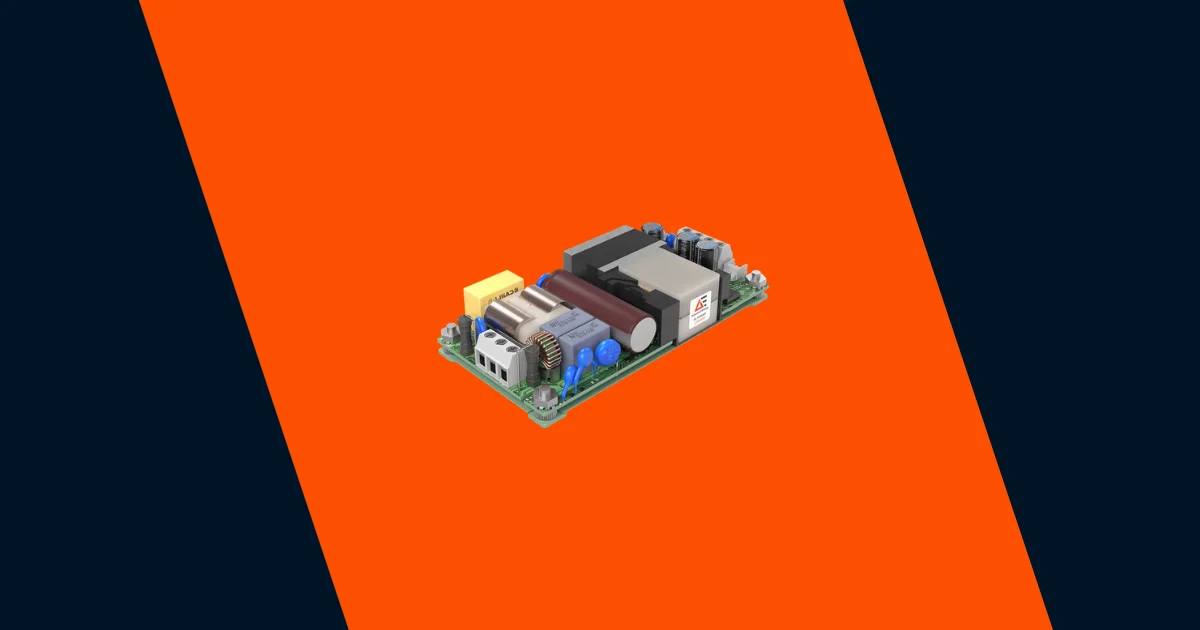
Advanced Energy’s new LPP200 series of AC-DC power supplies sits directly in that design space. The units deliver up to 200 W of output power while keeping the overall profile below three quarters of an inch, allowing the supply to fit inside systems where conventional open-frame power modules simply will not clear the enclosure.
Where Power Supplies Become the Mechanical Problem
Power modules inside medical and industrial equipment are rarely chosen purely on electrical performance. The enclosure geometry, airflow path, and safety clearances often dictate what can realistically be installed. In compact equipment this tends to create an awkward tradeoff. Designers want more output power but cannot afford additional height inside the system.
The LPP200 family attempts to solve that problem with a mechanical envelope measuring roughly two by four inches while keeping the height to about nineteen millimetres. That low profile allows the supply to sit inside thinner housings where larger open-frame supplies would interfere with displays, batteries, or mechanical assemblies.
For equipment that must remain portable or wall mounted, even a few millimetres of height reduction can determine whether a system design remains viable.
Power Density Inside a Flattened Form Factor
Shrinking the vertical dimension of a power supply often introduces a new set of thermal and electromagnetic challenges. Components move closer together, airflow becomes restricted, and magnetic structures have less physical volume to dissipate heat.
The LPP200 series reaches a power density of roughly thirty three watts per cubic inch while still delivering up to two hundred watts of output power. Output voltages span from twelve volts through forty eight volts, allowing the same platform to support a range of downstream loads such as display electronics, embedded processors, and actuator control circuits.
Compact supplies often struggle with conducted and radiated emissions once internal spacing is reduced. The series is designed with high EMI and EMC performance in mind so it can operate inside sensitive medical or industrial environments where electromagnetic compatibility requirements are strict.
Meeting Medical Safety Constraints Without Growing the Supply
Medical equipment designers rarely get the luxury of separating electrical performance from regulatory constraints. Safety isolation, leakage current limits, and insulation requirements tend to add bulk to a power supply long before engineers finish optimizing the circuit.
The LPP200 series carries certification to EN and IEC 60601-1 safety standards and supports Type BF medical applications where patient-connected equipment requires strict isolation behavior. The supplies are also certified to the EN and IEC 62368 safety standard used across industrial and information technology equipment.
In practice this means the same platform can serve both medical and industrial systems without forcing designers to redesign the power stage for different regulatory environments.
When Height Starts Dictating System Architecture
Power supplies often become the component that quietly defines the mechanical architecture of a product. Once the vertical clearance is set by the enclosure, every other subsystem ends up working around that constraint. Low-profile power modules like the LPP200 series exist largely because that mechanical boundary keeps getting pushed downward as medical and industrial systems continue to flatten out.
Learn more at www.advancedenergy.com
You may also like