
 High-speed systems rarely get held back by one dramatic failure. More often the trouble starts when bandwidth rises, board space shrinks, and the connector in the middle of the path quietly becomes the weak point. At lower speeds, designers can get away with more. Push into 56 Gbps PAM4 territory and suddenly the interconnect is no longer just a mechanical bridge between boards. It starts deciding how much margin is left in the channel before the rest of the system even gets a chance.
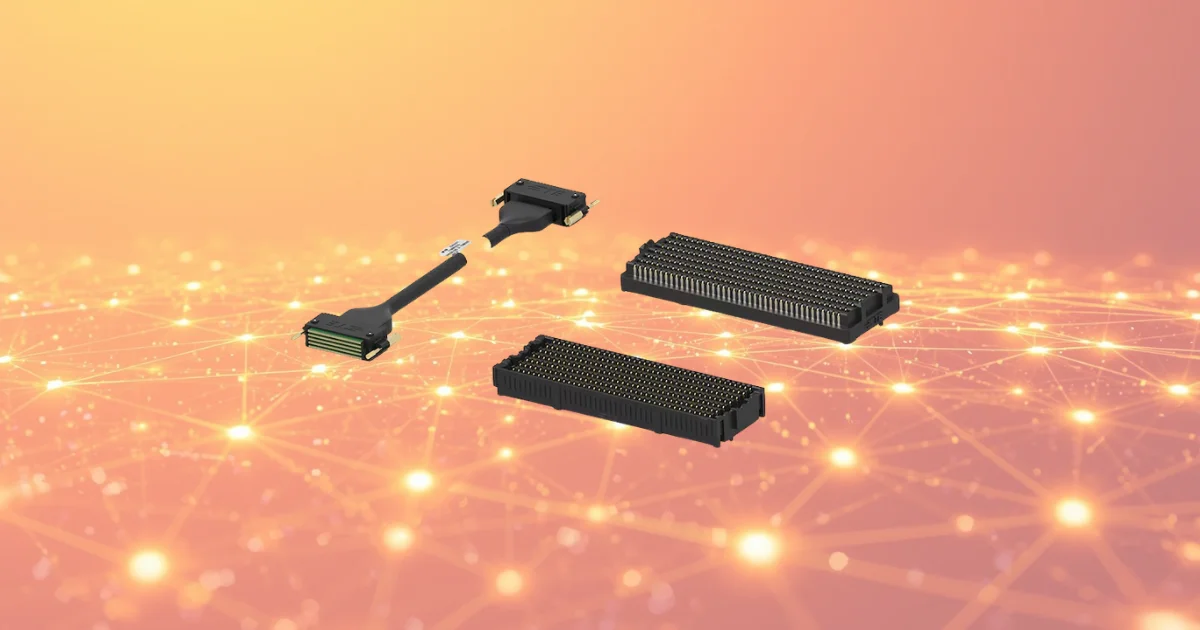
That is the space TE Connectivity is targeting with its new 56G MezzaWave connectors and cable assemblies. The 56G MezzaWave is a high-speed open-pin-field array interconnect platform used for board-to-board and cable connectivity in dense modular systems. In a typical edge AI or data center platform, these connectors sit between processing, acceleration, and I/O hardware where signal integrity starts getting harder to preserve as density increases and upgrade cycles get shorter.
What makes this launch interesting is not simply the top-line data rate. Plenty of high-speed interconnects look attractive when reduced to a spec headline. The harder question is whether the connector can keep that performance while still fitting into real systems that need routing flexibility, repeatable assembly, and some path for future upgrades without forcing a full redesign. That tends to be where connector launches either become useful or disappear into the catalog.
Signal Integrity Starts Becoming a Packaging Problem
Once systems move deeper into PAM4 signaling, the connector is no longer just passing bits along. It becomes part of the signal path in a much more sensitive way, especially in dense modular architectures where the margins are already being consumed by stack height, routing transitions, and board-to-board distance. The problem is not just speed. It is what that speed does to everything around it.
TE says the MezzaWave family is built on an open-pin-field array platform and supports data rates up to 56 Gbps PAM4. That puts it squarely in the sort of applications where designers are trying to preserve channel performance while also keeping the mechanical platform practical. The open-pin-field approach is useful here because it gives more freedom around grounding and routing, which matters when the connector itself has to help manage the electrical behavior instead of just surviving it.
The family also offers a 1.27 mm pitch, pin counts from 80 to 560, and stack heights from 7 mm to 10 mm. Those numbers matter less as isolated specs and more in how they shape board layout choices. A connector with decent signal performance but poor flexibility can create just as many problems as it solves. In dense platforms, every millimeter in stack height and every routing escape matters more than people sometimes admit during the first layout pass.
Dense Modular Systems Do Not Stay Electrically Simple for Long
There is also a broader system trend behind this release. A lot of compute and control platforms now want modularity without giving up bandwidth, which is a much harder thing to achieve than marketing copy tends to suggest. Swappable modules, upgradeable boards, and standardized form factors sound efficient until the channel budget starts collapsing under the physical realities of the interconnect.
TE is clearly leaning into that tradeoff. The company says these connectors offer drop-in compatibility, which allows direct replacement of existing components without a redesign. That sounds like a convenience feature, but in practice it can be much more than that. In platforms where redesign cycles are expensive, or qualification is painful, staying inside an established footprint can be the difference between a new connector actually being adopted and merely being admired.
This is particularly relevant in systems aligned with standards-based modular ecosystems. TE says the connectors meet VITA 57.1 FMC and VITA 57.4 FMC+ requirements, along with ANSI standards. That gives them a more obvious place in applications where interoperability matters and where engineers are not building the whole interconnect strategy from scratch every time.
Mechanical Reliability Still Matters at These Speeds
At this end of the connector market it is easy to focus only on bandwidth and ignore the mechanical side until it causes trouble later. But the mechanical details are often what decide whether a high-speed interconnect remains stable after repeated use, thermal cycling, and field servicing. Signal integrity problems are bad enough on a fresh board. They get worse when wear, alignment, and connector robustness start drifting over time.
TE says the MezzaWave family combines BGA technology with a ruggedized mechanical design, is rated for up to 1,000 mating cycles, and supports an operating temperature range from -55 °C to 125 °C. That temperature range pushes the connectors well beyond climate-controlled rack environments and into industrial and aerospace territory where the interconnect has to tolerate more than just clean digital traffic.
There is also an architectural reason cable assemblies appear alongside the board connectors in this launch. Once designers start building modular systems across multiple boards or enclosures, cable paths and mezzanine paths stop being separate conversations. They become part of the same signal-integrity problem, just expressed through different physical structures.
The Real Challenge Is Balancing Speed With Upgradeability
Perhaps the most useful part of this launch is that it reflects a connector market that is being pushed by two pressures at once. One is obvious: higher data rates. The other is more subtle: systems are increasingly expected to be modular, reusable, and upgradeable without constantly resetting the hardware platform. Those two goals do not always get along.
That is where products like MezzaWave are trying to earn their place. Not by being flashy, but by reducing the penalty that usually comes with denser interconnects and faster signaling. In high-performance systems, the connector has become part of the architecture, not just a joining feature between boards. And once that happens, small choices in pitch, grounding flexibility, and mechanical compatibility start carrying a lot more weight than they used to.
Learn more and read the original announcement at www.te.com
Technology Overview
TE’s 56G MezzaWave products are high-speed connectors and cable assemblies for dense modular systems. They support data rates up to 56 Gbps PAM4 and use an open-pin-field array platform to help maintain signal integrity while allowing routing and grounding flexibility. The family offers a 1.27 mm pitch, pin counts from 80 to 560, and stack heights from 7 mm to 10 mm.
Frequently Asked Questions
What are TE 56G MezzaWave connectors used for?
They are used for high-speed connectivity in modular systems such as edge AI, data centers, industrial automation, robotics, and aerospace and defense.
What data rate do 56G MezzaWave connectors support?
TE states that the connectors support data rates up to 56 Gbps PAM4.
You may also like