 Automotive display hardware has picked up a problem that used to feel more contained in industrial HMI design. The moment the interface gets more visually ambitious, memory stops being a background decision and starts shaping the whole board. Larger screens, smoother graphics, and heavier frame buffers all push against the limits of the small MCU mindset, but the step upward is rarely clean. External DRAM adds routing pressure, sourcing risk, and layout headaches at the exact point where teams are already trying to keep the design compact and predictable.
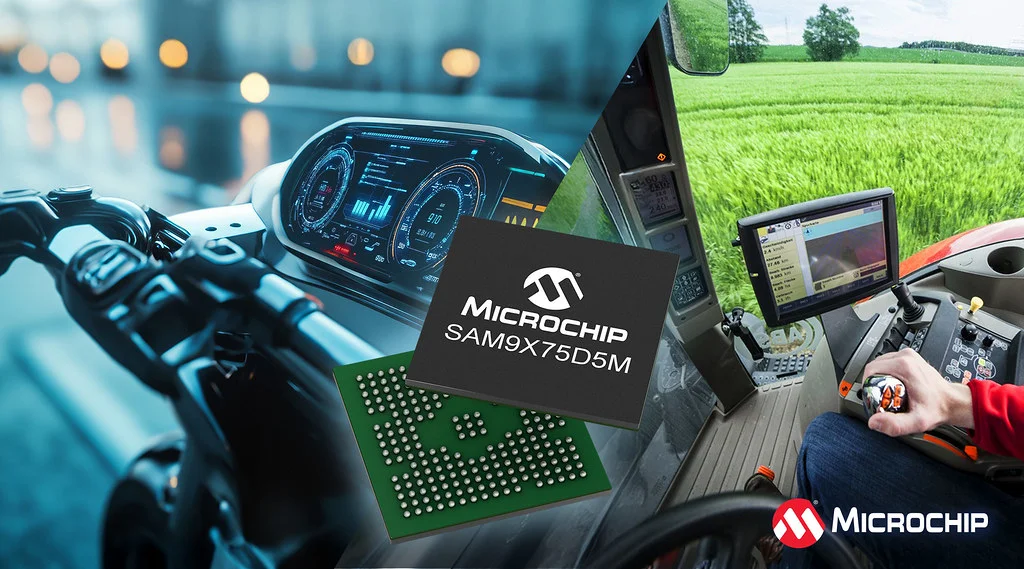
That is the territory Microchip is stepping into with the SAM9X75D5M. The SAM9X75D5M is an automotive-qualified System-in-Package hybrid MCU used for HMI applications that need MPU-class processing with integrated memory. It combines an Arm926EJ-S processor with 512 Mbit DDR2 SDRAM in a single package, which matters less as a neat packaging trick and more because it changes what the board looks like when display complexity starts climbing. In a digital cockpit cluster or EV charger display, the graphics path often ends up dictating more of the hardware architecture than teams expected at the beginning.
When External DRAM Starts To Distort The Design
There is a point in display development where the processor decision is no longer the most disruptive one. Memory is. Once a design moves beyond modest graphics and small local buffers, bringing in discrete DRAM can alter the layout, the routing density, and the supply chain all at once. That usually arrives before anyone wants it to.
Microchip’s approach here is to keep the memory inside the package, which removes one of the messier parts of the transition from a traditional MCU platform toward something closer to an MPU-class design. The SAM9X75D5M is part of the company’s hybrid MCU family, and that framing makes sense because the goal is not to drag developers into a completely different software and hardware world overnight. It is to give them more headroom without forcing a full architectural reset.
Display Demands Have Quietly Outgrown Older Assumptions
A lot of automotive HMIs no longer behave like simple embedded panels with a few static assets and a basic control loop sitting behind them. They are expected to animate smoothly, present more information at once, and hold up under the sort of visual standards users now take for granted. That is where old assumptions around memory and display bandwidth begin to crack.
Microchip says the SAM9X75D5M supports display sizes up to 10 inches at XGA resolution of 1024 × 768 pixels. That does not place it in the highest tier of cockpit computing, but it clearly moves it beyond the narrow end of the MCU display world. The device also supports MIPI DSI, LVDS, and parallel RGB interfaces, which gives designers room to work with different panel strategies instead of being forced into one route just because of the processor package.
The Board Gets Smaller, But The Architecture Gets Clearer Too
Single-package integration is often presented as a convenience feature, but in automotive hardware it usually has a more practical value than that. Simplified PCB layout is not just about making life easier for the layout engineer. It can mean fewer routing compromises, less exposure to discrete memory procurement issues, and a more stable path through long product lifecycles where availability matters just as much as raw performance.
That is a big part of this announcement. By integrating DDR2 memory directly into the SiP, Microchip is trying to insulate designers from the volatility that has affected the discrete DDR market in the past. That will resonate with anyone who has watched a memory choice create downstream sourcing trouble for a product that was otherwise technically sound. You only need to go through that once before packaging decisions start looking a lot more strategic.
Still Built For Embedded Developers, Not Just Linux Teams
What makes this part more interesting is that Microchip has not positioned it as a clean break from embedded development habits. The device is supported in MPLAB X IDE and MPLAB Harmony, with development options for FreeRTOS, Eclipse ThreadX, and bare-metal software. That keeps it close to the environment many MCU developers already know, even while the hardware itself is nudging them into a more capable display architecture.
Connectivity is fairly broad as well, with CAN FD, USB, and Gigabit Ethernet included, along with TSN support, integrated 2D graphics, and audio capability. So this is not just about fitting memory into a smaller space. It reflects a more uncomfortable truth about automotive HMIs now: once the display becomes central to the user experience, the old boundary between MCU simplicity and MPU capability starts to disappear.
Learn more and read the original announcement at www.microchip.com
Technology Overview
The Microchip SAM9X75D5M is an AEC-Q100 Grade 2-qualified System-in-Package hybrid MCU that combines an Arm926EJ-S processor with 512 Mbit DDR2 SDRAM in one package. It is designed for automotive and e-mobility HMI applications such as digital cockpit clusters, smart clusters for two- and three-wheelers, HVAC control, and EV chargers, with support for display sizes up to 10 inches at 1024 × 768 resolution.
Frequently Asked Questions
What is the SAM9X75D5M used for?
It is used for automotive and e-mobility HMI applications including digital cockpit clusters, smart clusters, HVAC controls, and EV charger interfaces.
What display interfaces does the SAM9X75D5M support?
Microchip lists MIPI DSI, LVDS, and parallel RGB as supported display interface options.
You may also like