
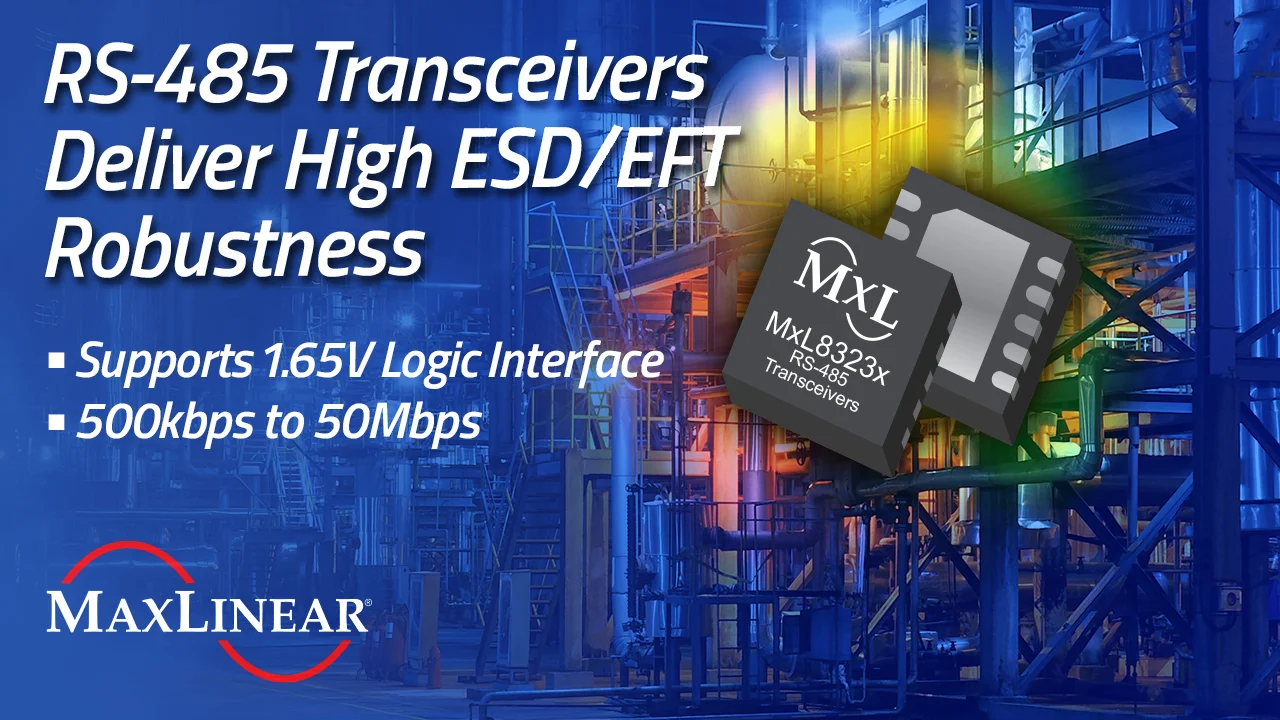
 MaxLinear has expanded its industrial serial portfolio with the MxL8323x family, a new set of RS-485 and RS-422 half-duplex transceivers that stretches from 500 kbps to 50 Mbps. That range is the part worth paying attention to first. Industrial links rarely need raw speed on its own. What they need is enough headroom to fit very different nodes, cable runs, noise conditions, and controller platforms without forcing the whole design into one compromise that only suits part of the system.
The MxL8323x family is a group of RS-485 and RS-422 half-duplex transceivers used in industrial control networks that need scalable data rates, wide logic compatibility, and stronger tolerance to electrical noise. MaxLinear is putting five parts into the range: MxL83232, MxL83233, MxL83234, MxL83235, and MxL83236. In a motor drive, factory controller, HVAC node, or building automation link, that matters because the transceiver often ends up sitting between different voltage domains, long cables, and a real-world noise environment that looks much worse than the block diagram suggested.
One Family, Several Data-Rate Choices
The most practical part of this launch is not the top-end 50 Mbps figure by itself. It is that MaxLinear is not trying to force every industrial node into the same speed grade. The family spans from 500 kbps to 50 Mbps, which gives designers room to match the transceiver to the actual job instead of overspecifying every port on the board. In industrial systems, higher speed is rarely free. Faster edges can make EMI harder to manage, cable behavior less forgiving, and layout details more noticeable than they were at lower data rates. MaxLinear is clearly pitching the family as a way to balance performance, noise immunity, and EMI reduction across different nodes while still keeping platform reuse intact.
The Real Story Is Electrical Abuse Tolerance
RS-485 parts only stay useful in industrial hardware if they keep working once the environment gets unpleasant. MaxLinear says the MxL8323x devices are designed to withstand ±4 kV IEC 61000-4-4 electrical fast transient events, ±8 kV IEC 61000-4-2 contact ESD, and ±15 kV air-gap ESD. That is the kind of specification that matters more in the field than a clean lab headline.
The extended ±15 V common-mode range is just as important. Ground offsets have a habit of turning otherwise sound serial links into intermittent faults, especially when systems are spread across cabinets, motors, sensors, and remote nodes. In a real industrial network, that common-mode margin is often what keeps communication stable when the wiring and installation are less than ideal.
Logic Compatibility Is Doing A Lot Of Work Here
The family supports a 3.0 V to 5.5 V supply range and a 1.65 V to 5.5 V logic-level interface. That may sound like a secondary detail, but it is one of the more useful ones in the whole release. Industrial designs do not all live in one logic domain anymore, and the transceiver is often where older bus standards have to meet newer low-voltage MCUs and SoCs without extra translation hardware.
That is why this range gives engineers a better chance of dropping one of these devices into mixed-voltage systems without having to build extra support circuitry around the interface. In compact control boards, that can save both PCB area and design time, which is usually a more immediate win than a headline data rate.
Network Size And Behavior Still Matter
MaxLinear also specifies 1/8-unit-load receiver input impedance, which allows support for up to 256 nodes. That keeps the family relevant for larger multidrop networks where node count still matters just as much as raw signaling performance. Features such as slew-rate control, hot-swap glitch protection, and low-power shutdown modes add to that picture in a sensible way. None of them are flashy on their own, but together they tell you these parts were built for systems that have to be installed, powered, serviced, and restarted without behaving badly on the bus.
MaxLinear is not trying to reinvent RS-485 here. It is taking a very established industrial interface and pushing it toward higher speed, broader logic compatibility, and stronger electrical tolerance without stripping away the practical safeguards that make it deployable in noisy control hardware.
Learn more and read the original announcement at www.maxlinear.com
Technology Overview
The MaxLinear MxL8323x family is a series of RS-485 and RS-422 half-duplex transceivers for industrial control networks. The devices support data rates from 500 kbps to 50 Mbps, operate from 3.0 V to 5.5 V supplies, accept 1.65 V to 5.5 V logic levels, and are designed for harsh environments with EFT, ESD, and extended common-mode tolerance.
Frequently Asked Questions
What is the MxL8323x family used for?
It is used in industrial control applications such as smart factory automation, motor drives, HVAC systems, industrial computing, building security, and smart grid infrastructure.
What data rates does the MxL8323x family support?
MaxLinear specifies speed options from 500 kbps up to 50 Mbps across the family.
You may also like