
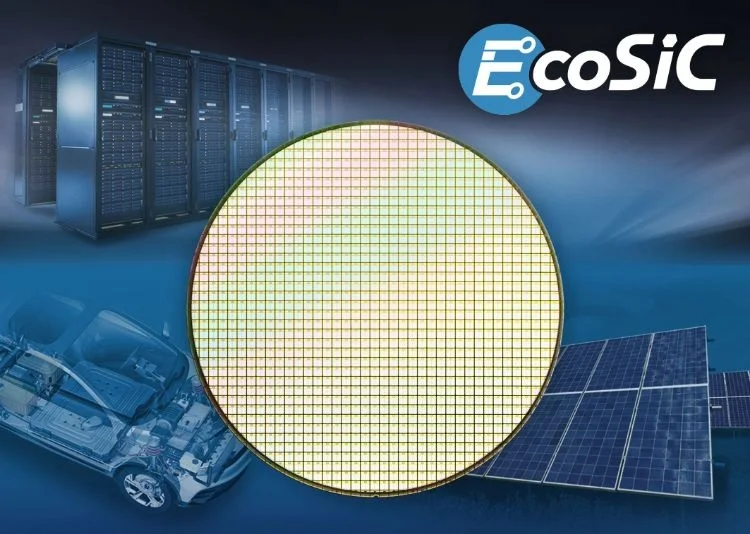
 ROHM has introduced its 5th Generation SiC MOSFETs under the EcoSiC family for high-efficiency power conversion in automotive and industrial systems. The new devices are aimed at designs where switching losses, thermal behavior, and power density all start to limit system performance, including EV traction inverters, onboard chargers, AI server power supplies, and data center infrastructure.
Built For Hot, High-Power Conversion Stages
The 5th Generation EcoSiC parts arrive in a part of the power market that is already leaning heavily toward silicon carbide. In automotive powertrains, that means traction inverters, OBCs, DC-DC converters, and electric compressors. In industrial equipment, the same device class is being pushed into server power shelves, PV inverters, energy storage systems, UPS platforms, eVTOL power units, and servo drives. ROHM’s new generation is meant for exactly that kind of high-voltage, high-temperature switching role.
ROHM’s 5th Generation SiC MOSFETs are silicon carbide power transistors used for high-efficiency switching in power conversion systems. In a traction inverter, that puts the device directly in the path between the battery pack and the three-phase motor drive, where conduction loss and thermal stability have a direct effect on efficiency, cooling demand, and available output.
Lower On-Resistance At 175°C
The main technical claim here is a reduction in ON resistance under high junction temperature conditions rather than only at room temperature. ROHM says the new structure and process improvements cut ON resistance by about 30% at Tj = 175°C compared with its 4th Generation SiC MOSFETs, assuming the same breakdown voltage and chip size. That matters for designs that don’t get to operate in ideal thermal conditions, which is most real hardware once power density starts climbing.
A lower RDS(on) under heat gives designers a more useful gain than a headline figure taken at 25°C. In practice, it can help reduce conduction loss in the inverter or converter stage, support smaller cooling hardware, or make it easier to push output higher without taking the same thermal penalty. ROHM is also tying this improvement to smaller units and higher output in applications such as xEV traction inverters, which fits the way current EV platforms are being optimized around tighter packaging and faster charging.
From Bare Die To Discretes And Modules
ROHM says it began supporting the bare die business for these 5th Generation SiC MOSFETs in 2025 and completed development in March 2026. The next step is broader product availability. Sample shipments of discrete devices and modules using the new generation are scheduled to begin in July 2026.
That rollout matters because ROHM’s SiC business has not been limited to standalone packaged parts. The company has been building out discretes, modules, and bare chip support for several years, which gives it a wider route into both automotive and industrial programs. This latest generation is expected to expand further with additional breakdown voltage options and package choices, although the initial announcement does not list specific voltages or package names yet.
Where The New Generation Fits In ROHM’s SiC Roadmap
ROHM has been in the SiC MOSFET market for a long time by power semiconductor standards, and the company ties this launch to a progression from early mass production through its 4th Generation platform and into a broader 5th Generation lineup. The company also states that its earlier SiC products were offered with automotive-grade qualification such as AEC-Q101, although the new announcement stops short of detailing individual qualification status for the newly announced 5th Generation samples.
So the release is less about introducing SiC into a new application area and more about tightening the electrical and thermal performance of a device class that is already moving into the mainstream. For engineers working on high-power conversion stages, the useful point is straightforward: ROHM is pushing lower high-temperature ON resistance into the next generation while keeping the family aimed squarely at real deployment areas such as EV powertrains, AI power infrastructure, and industrial energy conversion.
Learn more and read the original announcement at www.rohm.com
Technology Overview
ROHM’s 5th Generation EcoSiC MOSFETs are silicon carbide power devices for high-efficiency switching in automotive and industrial power conversion equipment. ROHM states that ON resistance is approximately 30% lower at a junction temperature of 175°C than its 4th Generation products under the same breakdown voltage and chip size conditions. The announced target applications include xEV traction inverters, onboard chargers, DC-DC converters, AI server power supplies, data centers, PV inverters, ESS, UPS, eVTOL, and AC servos.
Frequently Asked Questions
Are ROHM’s 5th Generation SiC MOSFETs intended for EV traction inverters?
Yes. ROHM explicitly lists xEV traction inverters among the target automotive applications for this generation.
What operating condition is behind the 30% lower ON resistance claim?
ROHM compares the new generation against its 4th Generation SiC MOSFETs at Tj = 175°C, with the same breakdown voltage and chip size conditions.
When will discrete devices and modules based on the new generation be available for sampling?
ROHM says samples of discrete devices and modules incorporating the 5th Generation SiC MOSFETs will begin in July 2026.
You may also like