
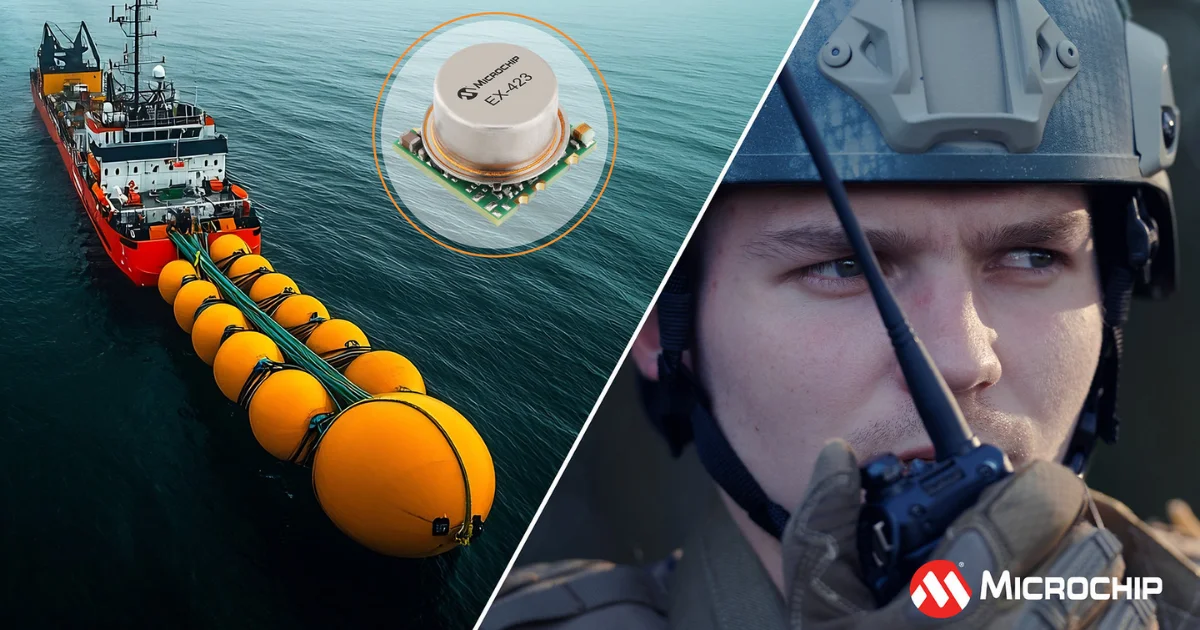
 Microchip has introduced the EX-423 Evacuated Miniature Crystal Oscillator, a compact timing reference designed for systems where frequency stability, power consumption, and environmental resilience all matter at the same time. The device builds on the company’s earlier EX-421 family but moves into a smaller 13mm × 13mm package aimed at space- and power-constrained designs.
The EX-423 is an evacuated miniature crystal oscillator used as a stable frequency reference in GPS/GNSS tracking, military radios, satellite communications, medical devices, ocean bottom node seismic systems, and test equipment. Microchip seals the device in an ultra-high vacuum to improve thermal insulation around the quartz crystal and support tighter frequency stability.
Vacuum-Sealed Design Targets Frequency Stability
The vacuum package is the main design detail here. Microchip uses the ultra-high vacuum as a way to reduce heat transfer around the crystal, so external temperature changes have less influence on frequency behavior. Temperature is one of the awkward variables in precision timing. It becomes even harder to manage in small or battery-powered equipment, where there may not be much room or power available for thermal control. The device operates across a standard 10MHz to 20MHz frequency range and combines low phase noise with tight temperature control and strong short-term stability.
Four-Point Crystal Mount Improves Shock Resistance
The quartz crystal inside the EX-423 uses a four-point mounting structure intended to improve shock survivability and reduce g-sensitivity. GNSS trackers, military radios, and ocean bottom node seismic systems can all see vibration, shock, or movement during use. Any of that can disturb the crystal and shift the reference frequency.
Lower g-sensitivity helps reduce frequency movement caused by acceleration or mechanical stress. For mobile and field-deployed systems, that can make the reference clock easier to trust when the surrounding equipment is moving or sitting in a difficult environment.
Low Power Consumption Supports Battery Systems
Microchip says the EX-423 uses 1W during warm-up and can drop to 0.2W at +25°C in steady-state operation. That is useful because stable oscillators often force a tradeoff between timing performance, heat, and battery life. The EX-423 is aimed at systems that still need low phase noise and stable frequency performance but cannot accommodate a larger timing subsystem or continuous high-power operation.
Fast warm-up behavior is also useful in systems that spend time in low-power states before returning to active operation. In portable or remote equipment, the timing system may not stay fully powered continuously, so startup time can affect how quickly the wider system becomes operational again. The EX-423 is available now through Microchip.
View the EX-423 EMXO datasheet
Learn more and read the original announcement at www.microchip.com
Technology Overview
The Microchip EX-423 is an evacuated miniature crystal oscillator designed for high-stability timing applications in low-power and rugged environments. The device operates from 10MHz to 20MHz and uses an ultra-high vacuum enclosure for improved thermal insulation and frequency stability. The oscillator consumes 1W during warm-up and as little as 0.2W during steady-state operation at +25°C.
Frequently Asked Questions
What is the Microchip EX-423 used for?
The EX-423 is used as a stable timing reference in GNSS tracking systems, military radios, satellite communications, seismic monitoring equipment, medical devices, and test and measurement systems.
Why is the EX-423 vacuum sealed?
The ultra-high vacuum enclosure improves thermal insulation around the crystal to help maintain frequency stability under changing environmental conditions.
What frequency range does the EX-423 support?
The EX-423 operates across a standard 10MHz to 20MHz frequency range.
You may also like