
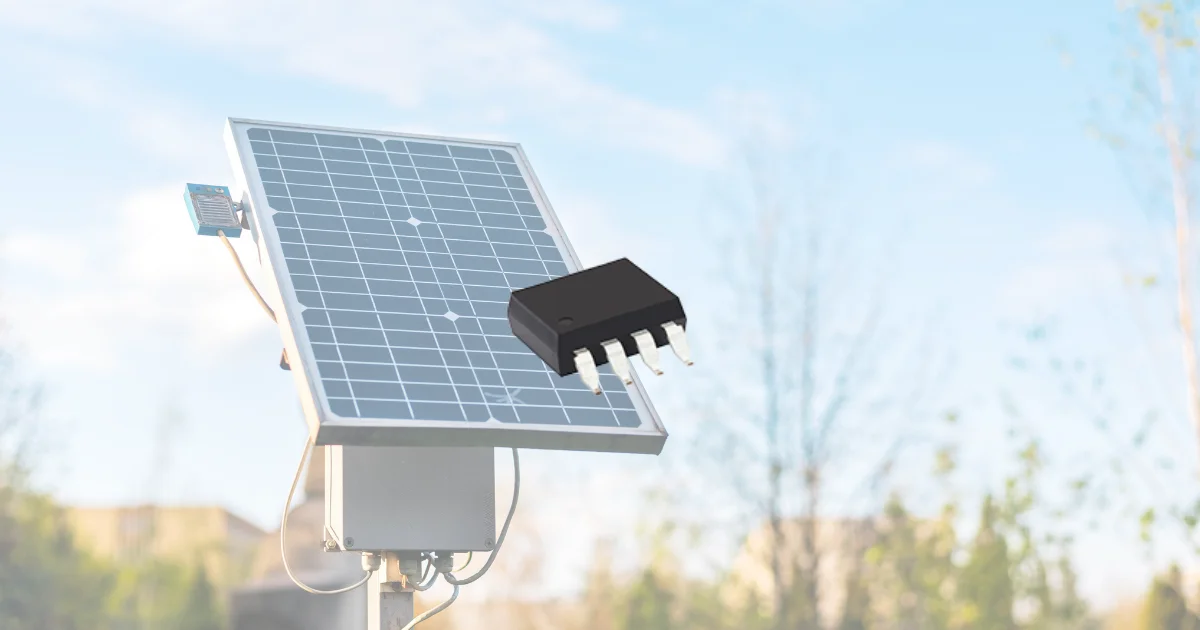
 Vishay has introduced two new Automotive Grade optocouplers designed for high-voltage isolation in electric vehicles and solar inverter systems. The VOWA617A and VOWA618A use a phototransistor output architecture inside a widebody SMD-8 package, targeting applications where creepage distance, reinforced insulation, and long-term isolation reliability are becoming increasingly important as EV voltages continue climbing.
The VOWA617A and VOWA618A are galvanically isolated optocouplers used for signal transmission between high-voltage and low-voltage sections of a system. Vishay is positioning the devices for on-board chargers, DC/DC converters, battery management systems, and solar inverter isolation stages where reinforced insulation requirements now push both electrical and physical spacing constraints harder than older automotive platforms did.
The devices provide external creepage and clearance distances of at least 11 mm, which is noticeably larger than the 8 mm spacing commonly seen in many standard optocoupler packages.
Creepage Distance Becomes More Important at Higher EV Voltages
One of the main design targets here is insulation margin. As traction battery voltages rise and charging systems move toward higher power levels, maintaining reinforced isolation inside compact automotive power electronics becomes increasingly difficult.
The VOWA617A and VOWA618A are rated for 1500 Vpeak VIORM and 1060 VRMS VIOWM. Vishay also specifies 5300 VRMS isolation voltage and 8000 Vpeak VIOTM, putting the parts in the range needed for reinforced isolation in EV and solar power hardware.
The package spacing is just as important as the voltage rating. With at least 11 mm creepage and clearance, the optocouplers give designers more physical distance across the package than typical 8 mm widebody options. That extra spacing is useful in on-board chargers, DC/DC converters, BMS isolation stages, and inverter circuits where the isolation barrier may have to deal with high voltage, heat, moisture, and board contamination over long service life.
Material Group 1 Rating Improves Tracking Resistance
Another notable specification is the comparative tracking index of 600, giving both devices a Material Group 1 classification. Many standard optocouplers operate with substantially lower CTI ratings, which can limit insulation performance once contaminants or condensation appear across the package surface. A higher CTI helps improve resistance to surface tracking under high-voltage conditions.
The optocouplers use an infrared LED optically coupled to a silicon planar phototransistor detector. Vishay also rates the collector-emitter voltage at 80 V, giving additional flexibility on the transistor output side compared to lower-voltage alternatives.
Current transfer ratio ranges from 50 % to 600 %, with operation specified at input currents as low as 5 mA for the VOWA617A and 1 mA for the VOWA618A.
Designed for Automotive Thermal Conditions
The devices are AEC-Q102 qualified and support operation from -40 °C to +125 °C, with junction temperatures reaching +145 °C. That wider thermal range is important in EV power electronics where isolation components may sit close to power semiconductors, transformers, and switching stages generating significant localized heat.
The widebody SMD-8 package is also intended to simplify reinforced insulation compliance in systems where maintaining board-level spacing can otherwise become difficult around tightly packed power conversion hardware. Vishay says samples and production quantities are already available with lead times currently listed at eight weeks.
Learn more and read the original announcement at www.vishay.com
Technology Overview
The Vishay VOWA617A and VOWA618A are Automotive Grade optocouplers with phototransistor outputs designed for reinforced isolation in EV and solar power systems. The devices provide 1500 Vpeak VIORM, 1060 VRMS working isolation voltage, and at least 11 mm creepage and clearance distance inside a widebody SMD-8 package. Both devices carry a CTI rating of 600 and are qualified to AEC-Q102.
Frequently Asked Questions
What applications are the Vishay VOWA617A and VOWA618A designed for?
The optocouplers target EV on-board chargers, DC/DC converters, battery management systems, and solar inverter isolation stages.
What creepage distance do the devices provide?
The VOWA617A and VOWA618A provide creepage and clearance distances of at least 11 mm.
What automotive qualification do the optocouplers support?
Both devices are qualified to the AEC-Q102 automotive optoelectronics standard.
You may also like