
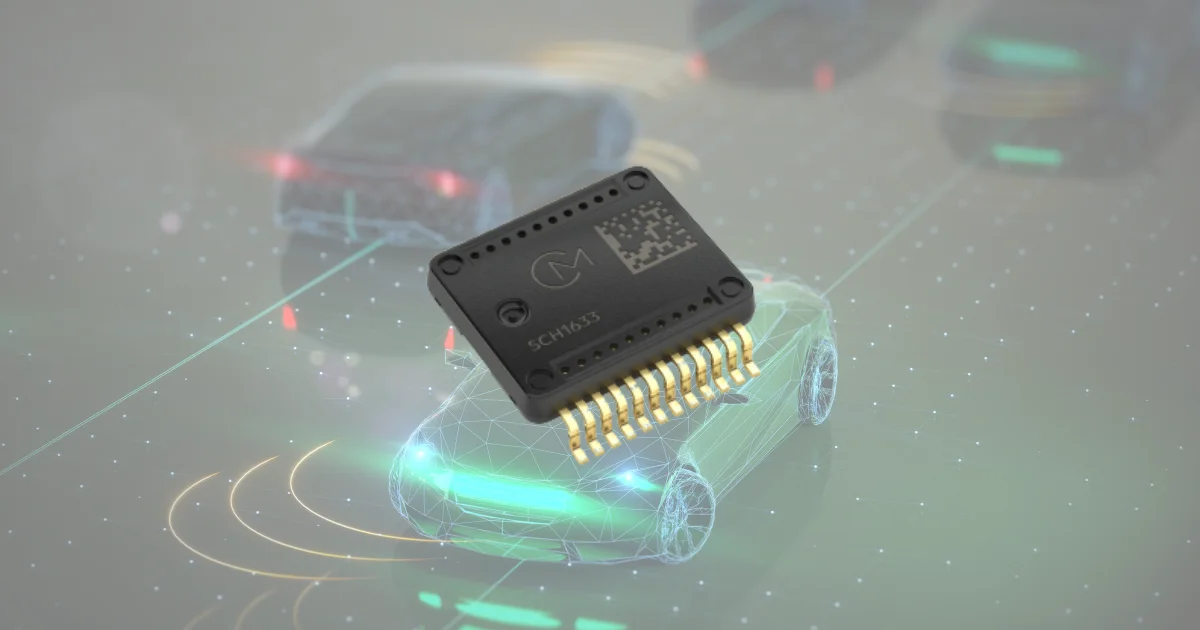
 Automotive sensor placement is starting to shift as vehicle electronics move toward zonal architectures and more centralized ECU designs. Instead of distributing sensing hardware across separate modules, more IMUs are now being mounted directly onto ECUs to reduce wiring, simplify packaging, and consolidate processing. Murata is targeting that transition with the SCH1633-D05, a new 6DoF inertial measurement unit designed for direct ECU integration in AD and ADAS systems.
The SCH1633-D05 combines a three-axis gyroscope and three-axis accelerometer into a single package for applications including automated driving, inertial navigation, vehicle stability control, dynamic leveling, and humanoid robotics. The device expands Murata’s SCH1600 family and is scheduled for mass production in June 2026. Murata says the sensor is designed specifically for situations where post-assembly ECU calibration becomes difficult or impractical.
IMU Performance Without ECU-Level Calibration
One of the larger issues with direct ECU-mounted sensors is thermal calibration. Once the IMU is integrated directly onto a larger ECU board, performing detailed customer-side calibration after assembly becomes more difficult and expensive. Murata is positioning the SCH1633-D05 as a way around that problem by pushing more of the calibration work into the component itself before shipment.
The device combines Murata’s 3D MEMS process with a new ASIC design and uses a plastic SOIC package intended to deliver temperature performance closer to ceramic-packaged alternatives. According to Murata, extended factory calibration compensates for sensor behavior across the full operating temperature range before the device leaves production, removing the need for additional customer-side temperature calibration. The company specifies total gyroscope offset performance below 0.15 °/s across all axes.
SOIC Package With Integrated EMC Shielding
The package itself is also part of the design approach here. Ceramic sensor packages are often used where thermal stability is critical, but they can introduce higher cost and mechanical rigidity concerns once mounted onto larger ECU assemblies.
Murata instead uses a low-profile plastic SOIC package with integrated EMC shielding. The lower package profile is intended for space-constrained ECU layouts, while the shielding helps reduce susceptibility to electrical noise inside dense automotive electronics environments.
As more high-speed power electronics and communication systems move into centralized ECUs, electromagnetic compatibility becomes increasingly important for inertial sensing accuracy.
Designed For ADAS And High-Integrity Motion Sensing
The SCH1633-D05 supports a gyroscope measurement range of ±300 °/s and accelerometer measurement range of ±80 m/s², with an auxiliary channel extending dynamic range up to ±260 m/s².
Murata also specifies 20-bit output resolution along with more than 200 internal monitoring signals intended to support functional safety systems developed around ISO 26262 requirements. The wider idea is to allow a single high-performance IMU to support multiple vehicle functions simultaneously, reducing overall sensor count, cabling, and PCB usage across the vehicle architecture.
Samples of the SCH1633-D05 are available now, with mass production planned for June 2026.
Learn more and read the original announcement at www.murata.com
Technology Overview
The SCH1633-D05 is a 6DoF inertial measurement unit combining a three-axis gyroscope and three-axis accelerometer for ADAS, automated driving, and motion-control systems. The device is designed for direct ECU integration in zonal automotive architectures.
The IMU supports gyroscope measurement ranges up to ±300 °/s and accelerometer ranges up to ±80 m/s², with an auxiliary channel extending dynamic range to ±260 m/s². Murata specifies total gyroscope offset below 0.15 °/s across all axes.
Frequently Asked Questions
What applications is the SCH1633-D05 intended for?
The IMU is designed for automated driving, ADAS, inertial navigation, vehicle stability control, dynamic leveling, and humanoid robotics applications.
Why is direct ECU integration important for automotive IMUs?
Direct ECU integration helps reduce wiring complexity and simplifies vehicle architecture, but it also increases the need for highly stable sensor performance without customer-side calibration.
What sensing functions are included in the SCH1633-D05?
The device combines a three-axis gyroscope and three-axis accelerometer into a single 6DoF inertial measurement unit.
You may also like