
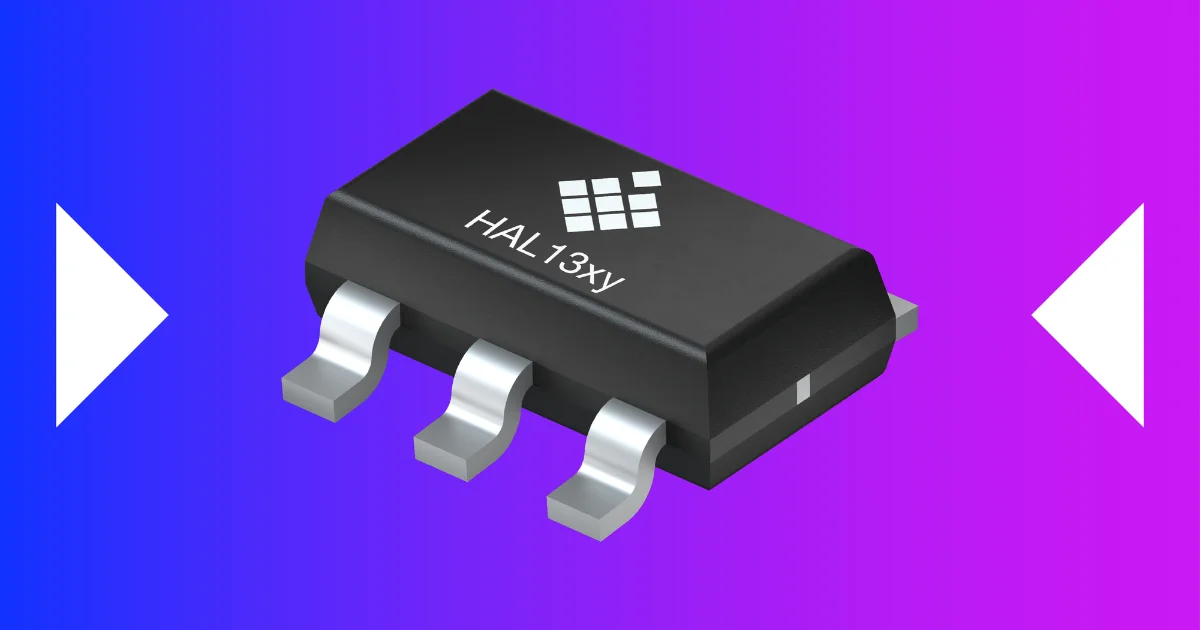
 TDK has introduced the Micronas HAL 13xy family, a factory-programmable Hall-effect switch sensor designed for motor speed and direction sensing in automotive and industrial systems. The device combines dual open-drain outputs with TDK-Micronas 3D HAL sensing technology, allowing simultaneous measurement of multiple magnetic-field components inside compact motion-control designs.
The HAL 13xy family is a 3D Hall-effect switch sensor used for rotational speed detection, direction sensing, and motor position monitoring in embedded electromechanical systems. The sensors target applications such as seat-track motors, steering column systems, sunroof drives, tailgate motors, valve positioning, and window lifters with anti-pinch functionality.
At the center of the design are three orthogonal Hall elements arranged in a single pixel cell. That allows the sensor to generate quadrature signals with a fixed 90° phase separation that does not depend on magnet pole spacing or air gap. For motor systems where packaging constraints often force awkward sensor positioning, that gives designers more flexibility around magnet alignment and mechanical layout.
3D Hall Sensing Removes Some Mechanical Constraints
The HAL 13xy sensors can be configured for either quadrature speed/speed outputs or speed/direction outputs depending on the application. Instead of relying on strict mechanical positioning between the sensor and rotating magnet structure, the 3D HAL arrangement measures multiple magnetic-field components simultaneously. That reduces sensitivity to changes in air gap and pole spacing, which are often difficult to tightly control in compact motor assemblies.
The approach is particularly useful in smaller automotive actuators where sensor placement is dictated as much by packaging and cable routing as by magnetic geometry. The sensor also supports both static and dynamic magnetic fields up to 40 kHz and can operate with different ferrite and rare-earth magnet types using selectable temperature coefficient options.
Automotive Safety And High-Temperature Operation
TDK says the HAL 13xy family is designed for automotive safety-related systems and long operating lifetimes under electrically noisy conditions. The device operates across junction temperatures from -40 °C to 170 °C and supports supply voltages from 3.0 V to 24 V. Protection features include 40 V load dump tolerance, -18 V reverse-voltage protection, short-circuit protection, and thermal shutdown functionality.
Continuous built-in self-test capability is also included as part of the design. The HAL 13xy is classified as a Safety Element out of Context and is ASIL B ready under ISO 26262 requirements. EMC performance is specified against ISO and IEC automotive standards, while ESD robustness reaches 4 kV HBM.
Compact Packaging For Embedded Motion Systems
The HAL 13xy family is housed in a 5-pin SOT23 package aimed at space-constrained embedded designs. As electric motor control continues moving into smaller distributed systems, sensor size is becoming increasingly important alongside electrical performance. Applications such as steering systems, compact actuators, and anti-pinch window lifters often leave limited room around the motor assembly itself.
TDK says samples of the HAL 13xy family are already available, with production scheduled for October 2026.
Learn more and read the original announcement at www.tdk.com
Technology Overview
The TDK Micronas HAL 13xy family is a programmable 3D Hall-effect switch sensor for motor speed and direction detection. The device uses three orthogonal Hall elements to generate quadrature outputs independent of air gap and pole spacing. It supports operation from 3.0 V to 24 V, temperatures up to 170 °C, and includes ASIL B-ready safety functionality.
Frequently Asked Questions
What is the TDK HAL 13xy used for?
The HAL 13xy family is designed for motor speed, direction, and position sensing in automotive and industrial systems including seat motors, steering systems, window lifters, sunroof drives, and valve control.
What makes the HAL 13xy different from standard Hall sensors?
The device uses three orthogonal Hall elements in a 3D sensing arrangement, allowing quadrature signal generation that is less dependent on magnet pole spacing and air gap.
Is the HAL 13xy suitable for automotive safety systems?
Yes. The sensor is ASIL B ready under ISO 26262 and includes continuous built-in self-test functionality together with automotive-qualified protection features.
You may also like