
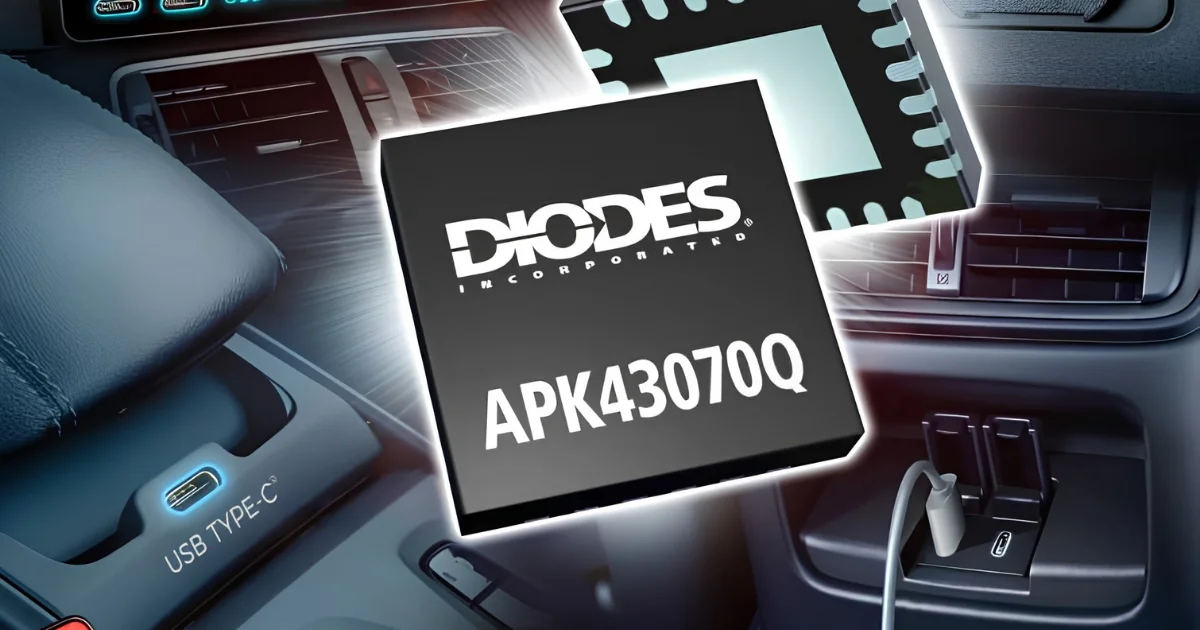
 Diodes Incorporated has introduced the APK43070Q, an automotive-qualified USB PD3.1 controller that combines a synchronous buck controller and USB Power Delivery source controller in a single device. Designed for vehicle USB-C charging systems operating from battery supplies up to 24 V, the device supports both single-port and multi-port charging architectures while delivering USB PD3.1 EPR output voltages up to 28 V.
The APK43070Q is a USB Type-C power management IC used to provide USB PD charging from automotive power systems. By integrating both the power conversion stage and USB PD control functions, the device reduces the amount of supporting circuitry typically required around each charging port.
The device supports USB PD3.1 Extended Power Range and Adjustable Voltage Supply modes up to 28 V, alongside SPR and PPS operation up to 21 V. Maximum output power reaches 140 W, allowing support for higher-power charging applications inside passenger and commercial vehicles.
Combining Power Conversion And PD Control
At the center of the APK43070Q is a constant-frequency synchronous buck controller paired with a full USB PD source controller. The buck stage uses external N-channel MOSFETs and includes features such as optimized dead-time control, elevated gate-drive voltage, and VIN pass-through operation. In pass-through mode, battery voltage can be delivered directly to VBUS when appropriate, reducing conversion losses. Integrating the PD controller and buck controller also allows the high-side MOSFET to operate as the VBUS switch. That removes additional switching components that would otherwise be required in the charging path.
The result is a more compact implementation for vehicle USB-C charging ports where board space and per-port cost are closely managed.
Power Sharing Across Multiple USB-C Ports
The APK43070Q includes an I2C interface designed for intelligent power sharing across multiple charging ports. Using resistor-selectable addresses, up to eight ports can communicate and balance available power resources without requiring a separate microcontroller. This allows vehicle manufacturers to build charging systems that dynamically allocate power between multiple USB-C connectors depending on demand. As the number of charging ports inside vehicles continues increasing, managing available power without adding another processor can simplify overall system design.
The device supports both single-port and multi-port architectures, making it suitable for a range of charging configurations from a single console outlet through to distributed charging systems throughout the cabin.
Designed For Automotive Electrical Systems
The APK43070Q is designed for operation from automotive battery systems up to 24 V and incorporates several protection mechanisms intended for vehicle environments.
Protection features include overvoltage protection, overcurrent protection, overtemperature protection, connector moisture detection, and short-circuit protection on the CC1, CC2, DP, and DN pins. The CC pins are tolerant up to 30 V to withstand accidental shorts to VBUS.
The device also includes 40 V load dump capability and reverse-voltage protection down to -18 V, helping it tolerate common automotive electrical fault conditions.
For thermal management, support for an external NTC sensor allows localized temperature monitoring and automatic output power adjustment when thermal limits are approached.
Supporting USB PD3.1 EPR Charging
Support for USB PD3.1 EPR allows output voltages up to 28 V and charging power levels up to 140 W. The device is housed in a 4 mm × 4 mm W-QFN4040-24 package and is qualified for automotive applications. Diodes states that the APK43070Q is manufactured in IATF 16949-certified facilities and supports PPAP documentation requirements.
The company is positioning the device for USB-C charging systems in modern vehicles where higher charging power, multiple ports, and reduced component count are all becoming increasingly important design considerations.
Learn more and read the original announcement at www.diodes.com
Technology Overview
The Diodes APK43070Q combines a USB PD3.1 source controller and synchronous buck controller in a single automotive-qualified IC. The device supports USB PD3.1 EPR and AVS outputs up to 28 V, delivers up to 140 W, and includes I2C-based power sharing support for up to eight USB-C ports without an external MCU.
Frequently Asked Questions
What is the APK43070Q used for?
The APK43070Q is used in automotive USB Type-C charging systems, providing USB PD3.1 power delivery and DC-DC conversion from vehicle battery supplies.
Does the APK43070Q support USB PD3.1 EPR?
Yes. The device supports USB PD3.1 Extended Power Range and Adjustable Voltage Supply operation up to 28 V, with charging power up to 140 W.
Can the APK43070Q support multiple USB-C ports?
Yes. The integrated I2C interface allows intelligent power sharing across up to eight USB-C ports without requiring an external microcontroller.
You may also like