
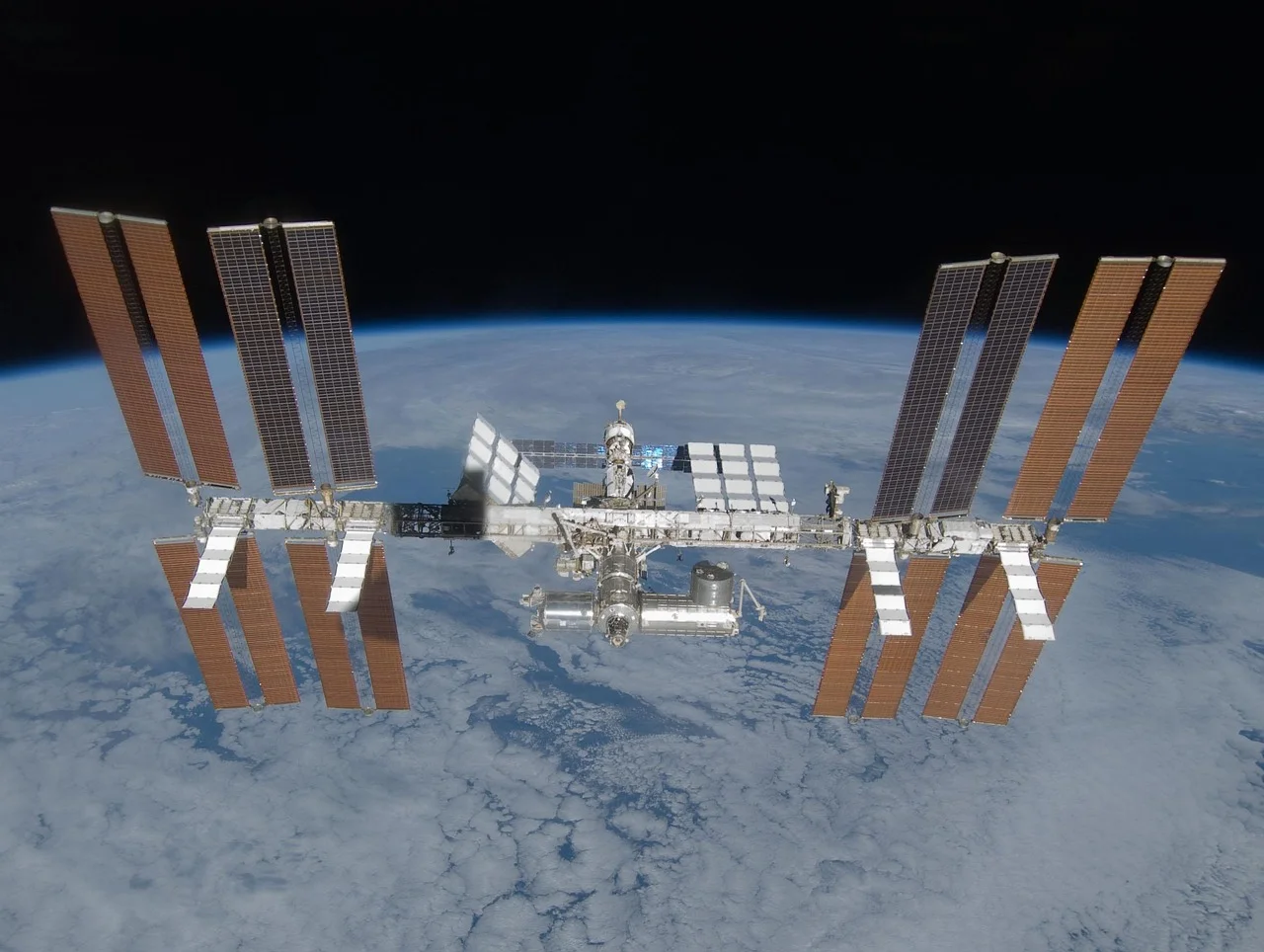
 Recently, astronauts on the ISS had to shelter from an air leak that threatened to depressurize the entire space station, but thanks to sensitive sensors and modern technology, the leak was found and patched. What exactly happened, how are air leaks detected, and how does this demonstrate the brilliance of modern sensing technologies?
ISS Air Leak Forces Crew to Shelter
Recently, astronauts aboard the International Space Station (ISS) were ordered into emergency shelter procedures after it was determined that air leakage in the Russian segment of the station had increased. Of the seven people currently on the ISS, five moved into the docked SpaceX Dragon “Freedom” spacecraft, put on their spacesuits, and prepared themselves for a potential return to Earth in the event that the air leak resulted in a catastrophic depressurization. Two Russian cosmonauts remained to attempt repairs, while the other five crew members sheltered in the Dragon spacecraft.
According to reports, the leak originated from the PrK transfer tunnel which is connected to the Zvezda service module. While it has been noted that cracks have existed in this area for around 6 years, recent pressure readings detected by sensors in the Zvezda module showed greater rates of air loss, and as such the Russian Federal Space Agency (Roscosmos) decided to undertake a more extensive repair instead of relying on previous patchwork solutions.
To perform the repair, two cosmonauts, Sergey Kud-Sverchkov and Sergei Mikaev, began a series of repair work, including the use of a saw, while their emergency escape vehicle remained the docked Soyuz spacecraft. During the repair, NASA became concerned regarding the use of power tools on a section of the ISS that could potentially result in a rapid decompression event.
Thus, NASA ordered a series of safe haven procedures which includes the sealing of the US segment of the ISS and moving the astronauts into the Dragon spacecraft. After some investigation and discussion, Roscosmos announced that it was halting its repair work, and NASA instructed the crew to leave the Dragon spacecraft and return to their daily activities.
Both NASA and Roscosmos stated that crew safety and station systems were never in immediate danger, and the ISS continues to operate safely.
How Does NASA Detect Air Leaks on the ISS?
Detecting an air leak on the International Space Station is never about dramatic “hissing wall” moments, and instead is closer to slow, layered signal detection across multiple redundant systems. The process NASA uses is deliberately conservative, cross-checking different data streams before anyone starts pulling hatches apart.
At the most fundamental level, pressure monitoring systems run continuously across all pressurised modules, and these sensors track the tiny changes in cabin pressure over days and weeks. Thus, a single reading means very little on its own, but long-term trends can reveal a gradual loss of atmosphere. Because the ISS naturally experiences small, expected losses from routine operations such as airlock use or resupply transfers, engineers compare observed trends against expected baselines before flagging a potential leak.
The Environmental Control and Life Support System (ECLSS) provides a second layer of confirmation. This system does not just measure pressure but also tracks atmospheric composition, humidity, and gas balance. By analysing how oxygen, nitrogen, and trace gases change over time, engineers can distinguish normal operational variation from an abnormal loss that suggests a breach in the pressure shell.
Once a leak is suspected, this is where the isolation procedures begin. The ISS is built from interconnected modules with internal hatches, allowing it to be segmented into smaller pressure zones. By closing hatches and monitoring which segment continues to lose pressure, engineers can progressively narrow the search area. This method is slow but highly effective, turning the station into a controllable set of pressure compartments rather than a single large volume.
Once a module has been confirmed to be the source of the leak, acoustic and ultrasonic detection systems then come into play. When air escapes into the vacuum of space, it can generate high-frequency sound signatures that are not detectable by human hearing but can be picked up by specialized ultrasonic sensors. These devices can be mounted or handheld, allowing astronauts to scan walls, hatch seals, and window interfaces while monitoring signal changes in real time.
In parallel, handheld acoustic tools allow crew members to physically inspect suspected areas. These tools are used to listen for subtle structural vibrations or airflow-induced noise patterns that change as the sensor approaches the leak site. This is often combined with visual inspection of seals, fasteners, and joints.
More advanced acoustic sensor arrays embedded within the station structure can detect how vibrations propagate through the ISS framework. Using signal processing algorithms, these systems can triangulate likely leak origins by analyzing how sound energy moves through different structural paths.
All of this data is then fed into analysis software on the ground and onboard. Engineers combine pressure decay curves, acoustic signatures, and isolation test results to produce a ranked probability map of likely leak locations. This reduces the search from “somewhere in a module” to specific panels or interfaces. Finally, inspection tools and post-repair monitoring systems confirm the issue has been resolved. After sealing a suspected site, pressure stability is tracked again over time to ensure the decay rate returns to baseline. Only when the system stabilizes is the leak considered fully resolved, closing the loop on a process that is part physics, part systems engineering, and part forensic investigation.
How Does this Demonstrate the Brilliance of Modern Sensing Technology?
The leak detection system used on the ISS is truly impressive, and clearly demonstrates the power of modern sensing systems.
However, what makes the leak detection system particularly brilliant is that it takes advantage of sensors in a distributed system. Simply put, the use of pressure sensors throughout the ISS, along with acoustic sensors, can be thought of as a sensor mesh whereby data can be streamed to a central controller to provide real-time results.
Overall, the ability to integrate numerous sensors simultaneously, combine them to create new sensing modalities, and stream all this data to remote locations is a testament to the brilliance of modern sensing systems. From the smallest IoT devices to the largest structures in space, sensors really do make modern life possible.