
 With the memory crises in full swing, South Korea’s Ministry of Trade, Industry, and Energy announced that it will be launching new partnerships and funding to double the memory manufacturing output of the country over the next five years. What exactly will be done to ensure this and why is this so desperately needed?
South Korea to Double Memory Output in Five Years
South Korea’s Ministry of Trade, Industry, and Energy announced that it will be launching new partnerships and funding to double the memory manufacturing output of the country over the next five years. This expansion plan, being led through a joint public-private framework involving the Ministry of Trade, Industry and Energy alongside key industry figures, including President Lee Jae Myung, Samsung chairman Lee Jae-yong, and SK Group chairman Chey Tae-won, has outlined a coordinated strategy to significantly increase domestic semiconductor capacity, with a particular focus on memory production.
This plan to double memory production is a significant increase when considering the country’s existing role in global supply chains, where it already accounts for a dominant share of DRAM production and a major portion of NAND flash output globally. Any expansion at this scale, therefore, has direct implications for global pricing, availability, and supply stability.
And the investment behind this initiative is equally significant. According to the Ministry of Trade, Industry and Energy, South Korean companies are expected to invest approximately $520 billion into domestic memory manufacturing infrastructure, with this capital being directed towards expanding fabrication capacity, improving packaging capabilities, and reinforcing supply chain resilience within the country.
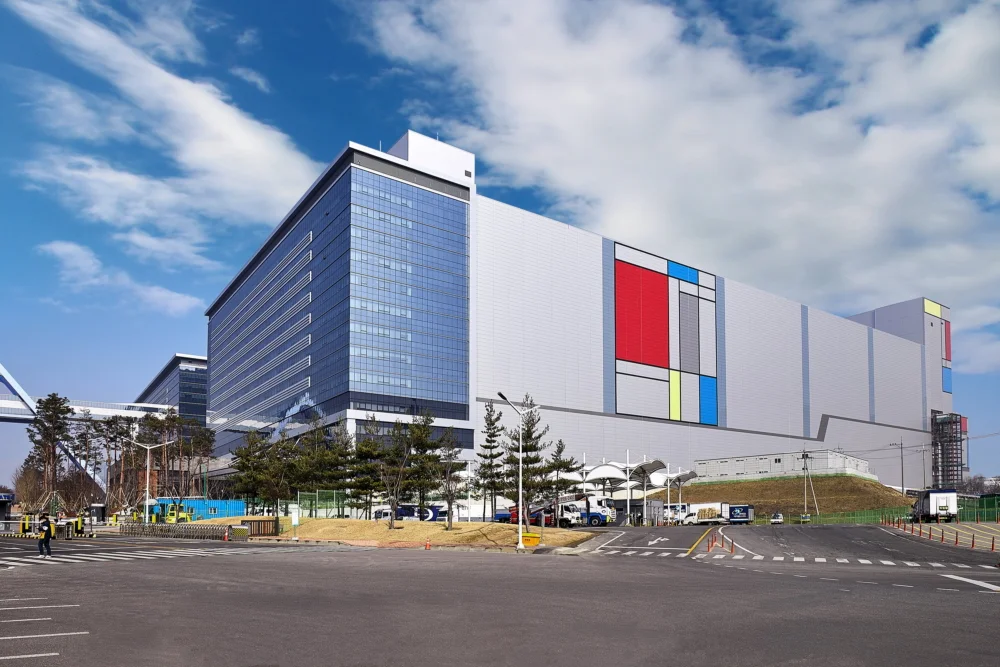
Interestingly, one of the main geographic focus areas for this expansion is the Gwangju region in the south-west of South Korea. This area is famous for hosting a large amount of semiconductor activity, but the current plans are already indicating the construction of four to five additional chip fabrication facilities, forming a concentrated production hub. Thus, this clustering approach is intended to improve efficiency, infrastructure integration, and workforce development within a single industrial zone.
Alongside this, Samsung is expected to develop additional advanced packaging facilities in South Chungcheong province, extending capabilities beyond wafer fabrication into final-stage integration and assembly. At the same time, SK Hynix is planning expanded NAND flash production in North Chungcheong, further distributing production capacity across multiple regions while maintaining national coordination.
Longer-term projections suggest that this expansion is part of an even larger investment cycle. Reports, including those from The Korea Economic Daily, indicate that South Korean semiconductor firms may be preparing investment plans reaching up to $1.4 trillion over the next decade. While these figures span multiple phases and project types, they highlight the scale of commitment being directed towards maintaining leadership in memory production. The initiative has been described as “Three Mega Projects for the Big Stride Forward”, reflecting both its industrial and regional development goals. Beyond pure production capacity, the strategy is also intended to support regional economic balancing by distributing high-value manufacturing away from already concentrated urban centres.
President Lee has also framed the program as a structural economic policy, aimed not only at strengthening semiconductor supply leadership but also at reducing regional inequality by encouraging industrial development outside of the capital region. In this sense, the memory expansion plan functions as both an industrial strategy and a national development policy.
Why Engineers Need Memory
The current memory shortage is not an isolated issue affecting only semiconductor manufacturers, but instead is being felt across the entire technology sector, from hardware engineers and product designers through to large-scale system integration and end consumers. The sudden acceleration of demand, driven largely by artificial intelligence workloads, has placed immense pressure on global supplies, exposing just how tightly constrained memory production actually is.
While higher memory prices have benefited investors and shareholders in the short term, the downstream effects are far less positive. Engineers are finding it increasingly difficult to source components for prototyping and production, which slows down development cycles and limits the ability to test new system designs. This lack of memory access has a direct impact on innovation across multiple industries, not just computing, but also automotive systems, industrial automation, telecommunications, and aerospace.
In response to shortages, some engineers have begun reverting to older memory standards such as DDR3, and in more extreme cases DDR2. However, even these legacy supply chains are now under pressure, with prices rising sharply as availability declines. Reports of DDR2 price increases of over 60% in recent months highlight just how broad the shortage has become, extending beyond cutting-edge technologies into legacy systems that were previously considered stable and abundant.
But the concern for engineers is not simply an issue of cost, but also access. Without stable access to memory components, system design becomes constrained, and product roadmaps are forced to adjust around availability rather than technical requirements. If this continues, the risk of stagnation in certain areas of computing development becomes very real, particularly in hardware-heavy sectors that rely on predictable supply chains.
However, this is also where global manufacturing dynamics become important. With such tight supplies, there is increasing expectation that additional producers, including China, will expand domestic production of DDR3 and DDR4 memory for internal markets. While this may help stabilize regional supply, it also reflects a broader fragmentation of the memory market into separate supply ecosystems, rather than a single globally balanced chain.
At the same time, the situation also shows that demand for non-server and consumer memory remains very strong. Even as AI workloads dominate headlines, a large portion of global memory consumption still comes from traditional computing devices and embedded systems. This means there is still a strong commercial case for expanding general-purpose memory production capacity, not just high-end data center supply.
For now, engineers are left working within constrained conditions, adapting designs where possible and extending the life of existing platforms. Some are shifting towards more flexible architectures such as microcontrollers, FPGAs, and programmable logic devices, which are less dependent on high-capacity external memory systems.
Ultimately, the memory shortage is much more than a supply chain issue, creating a bottleneck that directly shapes what engineers can build, how quickly they can build it, and which technologies reach production at all.
You may also like