
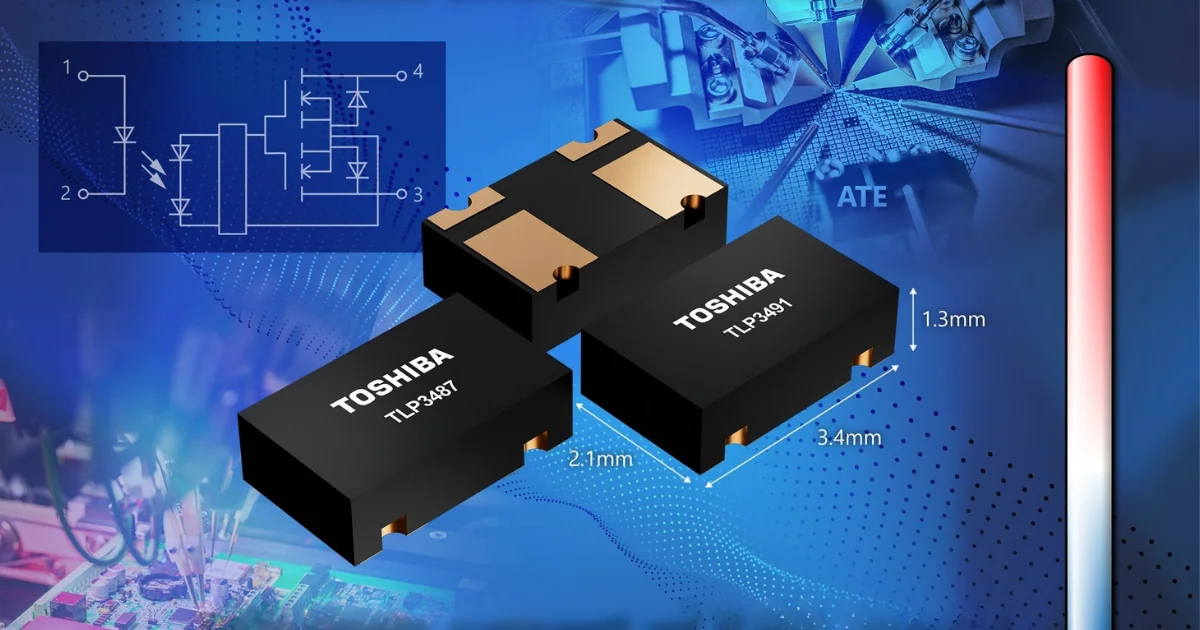
 Toshiba Electronics Europe has introduced the TLP3487 and TLP3491 photorelays, combining a 2.0 A maximum ON-state current with extremely low OFF-state leakage current in a compact P-SON4 package. Designed for semiconductor test equipment, the new devices help maintain measurement accuracy while reducing component count and PCB space.
Photorelays are widely used in automated test equipment (ATE) and semiconductor testers to switch power and signal paths connected to the device under test (DUT). While higher current capability is often required for power supply and load control, leakage current during the OFF state can influence sensitive measurements. Balancing these two requirements has traditionally been a challenge, particularly in compact packages.
High Current Switching with Low Leakage
The new TLP3491 and TLP3487 address this by delivering a maximum ON-state current of 2.0 A, while achieving OFF-state leakage currents as low as 1 nA at 40 V and 10 nA at 60 V through an optimised MOSFET output design. According to Toshiba, this level of performance was difficult to achieve with its previous TLP3481 devices housed in the same P-SON4 package.
The low leakage helps minimise unwanted current flowing through open switching paths, improving measurement accuracy in applications including high-speed logic IC, memory and SoC testers, measuring instruments, and other semiconductor test systems.
Reducing Board Space and Component Count
Designers needing higher switching current have often connected multiple photorelays in parallel, increasing PCB area as well as total OFF-state leakage. By supporting higher current in a single package, the new devices reduce the need for additional relays while simplifying circuit design.
Both photorelays are supplied in Toshiba's compact P-SON4 package, measuring 3.4 mm × 2.1 mm × 1.3 mm. Compared with conventional photorelays, this reduces the mounting footprint by approximately 74% versus 2.54SOP4 packages and around 84% compared with 2.54SOP6 devices.
The devices support operation across a temperature range of -40°C to +110°C, making them suitable for demanding semiconductor test environments.
Toshiba says it will continue expanding its photorelay portfolio with further reductions in OFF-state leakage current, higher current capability and continued package miniaturisation.
Learn more and read the original announcement at the Toshiba Electronics website.
Technology Overview
Photorelays are solid-state relays that typically use an LED to control MOSFET switching elements while providing electrical isolation between the input and output. They are commonly used where reliable, silent switching and long operating life are required, particularly in automated test equipment and precision measurement systems.
Frequently Asked Questions
What is the main advantage of the TLP3487 and TLP3491?
They combine a maximum ON-state current of 2.0 A with extremely low OFF-state leakage current, helping improve measurement accuracy while reducing the need for multiple photorelays.
Where are these photorelays intended to be used?
Typical applications include automated test equipment, semiconductor testers, measuring instruments, and peripheral equipment used in semiconductor test systems.
How small is the package?
Both devices are housed in a P-SON4 package measuring 3.4 mm × 2.1 mm × 1.3 mm, offering a significantly smaller footprint than conventional SOP packages.
You may also like