
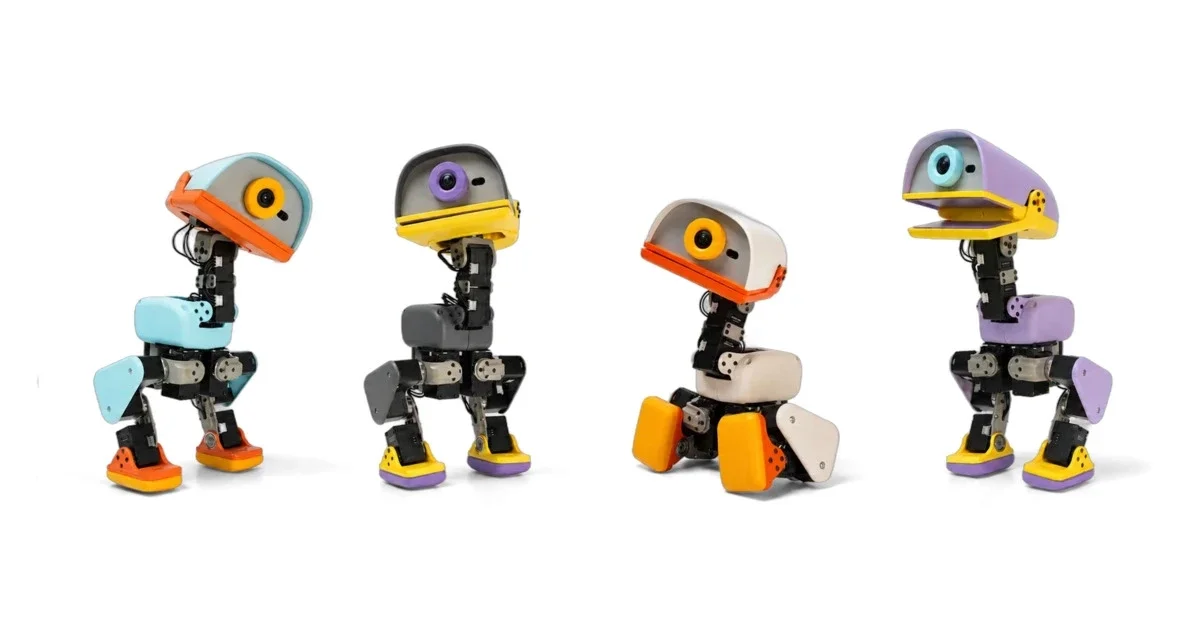
Hugging Face Launches Open-Source Microduck Robot
Recently, Pollen Robotics' open-source Microduck desktop bipedal robot surpassed 10,000 pre-orders within just four days of launch, generating approximately $4.54 million in sales. With a starting price of $399, the platform is certainly offering a lot of capability at a relatively low cost.
But what makes Microduck particularly interesting is that its brain is powered by the Rockchip RK3566, a SoC originally released in 2020 for consumer electronics including televisions, tablets and other embedded systems.
When looking into the RK3566, its use inside a modern robot initially appears somewhat unusual. The device integrates four Arm Cortex-A55 CPU cores, graphics hardware, imaging capabilities, AI acceleration and a wide selection of interfaces.
However, these features are exactly what make the processor useful for robotics. Inside Microduck, the RK3566 controls 15 motors that allow the robot to walk, crouch, pick up objects and recover after falling. At the same time, it runs a 50Hz control loop while handling data from the camera and wireless communications. In other words, hardware originally designed for consumer AIoT devices has found a completely different application as the main controller of a bipedal robot. But what really makes this story fascinating is not the use of an off-the-shelf SoC, but what has happened because the robot is open-source.
Developers have already started recreating Microduck themselves, reverse-engineering assembly drawings and CAD models from officially released simulation files and producing their own versions. Interestingly, the biggest challenge faced by these builders appears to be component availability rather than the complexity of the robot itself.
The RK3566-based Radxa Zero 3W control board reportedly increased in price from around 135 yuan to approximately 700 yuan as availability tightened, while the servo motors used by the design have also risen sharply in price.
This surge in demand demonstrates how quickly a popular open-source hardware project can influence the component market.
It also indicates another important advantage of using mature AIoT processors for robotics. Rockchip already has an established software ecosystem around its devices, including Linux and Android support, the RKNN AI deployment toolchain and open-source driver support for some hardware.
This makes it considerably easier for robotic developers to build around these processors and potentially migrate to more powerful Rockchip devices later.
And as robotics demands more computing power, Rockchip is already developing newer RK18 and RK36 platforms while also introducing combinations that pair a main processor with a dedicated AI coprocessor. Competitors including Allwinner and Amlogic are similarly looking towards robotics and AIoT applications.
Why is the Open-Source Robot Duck Critical for a Robotic World?
There is no doubt that robotics is one of the trickiest forms of engineering to tackle. One needs to consider almost every part of the system, starting with the physical design and understanding how forces between different components interact.
Then there is the movement of individual joints, choosing appropriate motors and actuators, maintaining balance and making sure the resulting robot remains safe.
Of course, this doesn't even touch on the electronics. Motors need appropriate driver circuitry, actuators need to be controlled precisely, and their angular positions must then be translated through complex mathematical models into real-world movement.
After that, all of this needs to be tied into cameras, position sensors, inertial sensors, force sensors and whatever other hardware the robot requires to understand its surroundings.
Achieving all of this as an individual engineer is absolutely possible, and many have done exactly that. But it is a technical nightmare. Every new project risks spending enormous amounts of time solving problems that another engineer has already solved somewhere else.
And this is where Microduck becomes incredibly important. By creating an open-source robotic platform, engineers, educators and makers can all work around the same fundamental design rather than starting from nothing each time.
Someone interested in AI doesn't necessarily need to design the entire mechanical platform. Likewise, someone interested in motors and control can experiment with those systems without first having to create a complete AI software stack.
More importantly, developers can create custom AI models, backend systems and control algorithms while still working with a known robotic platform. This effectively prevents the need to reinvent the wheel every time a new robotic project is started.
And because the design is open, improvements made by one engineer can potentially be used by everybody else. Better actuators, improved walking algorithms, new sensors and more efficient AI models can all become part of the wider ecosystem.
This is ultimately how open-source robotics could accelerate development. Instead of thousands of engineers individually solving the same fundamental problems, they can build on each other's work and push the technology forward collectively.
Microduck therefore demonstrates more than just how capable inexpensive AIoT processors have become. It shows what can happen when relatively mature hardware, open software and robotics are brought together into a platform that almost anyone can experiment with.