
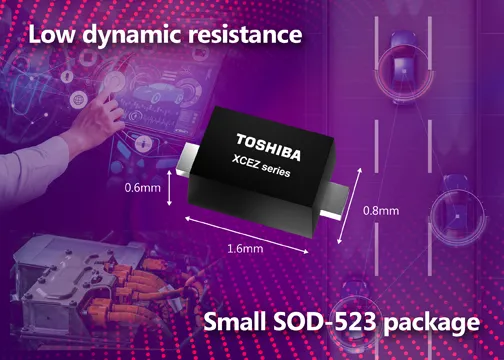
 Modern vehicles rely on a growing number of ECUs, sensors, and communication lines. Each new circuit adds another path for electrical noise to creep in. Surges from switching events or electrostatic discharge can cause glitches, and sometimes those glitches are enough to knock a system offline. Toshiba Electronics Europe has developed the XCEZ series of surge-protection Zener diodes to help engineers counter that problem in small, space-limited automotive systems.
Compact Surge Protection for Vehicle Electronics
The XCEZ series uses a SOD-523 package that measures just 1.6 × 0.8 mm. That’s around 60% smaller than the SOD-323 package used for Toshiba’s earlier XCUZ line. The small footprint means protection components can now be added to boards that previously had no space for them. In practice, that helps when designing infotainment modules, ADAS controllers, or battery management systems where every square millimetre matters.
Each diode in the range is designed to clamp transients before they reach delicate ICs. These transients can appear as nanosecond ESD spikes or longer switching surges lasting several milliseconds. Without suppression, they can cause logic faults or slowly degrade components over time.
Handling High Surges with Low Resistance
At the core of the design is Toshiba’s proprietary Zener process, which keeps dynamic resistance extremely low. A lower resistance path lets current divert quickly into the diode instead of through the circuit it protects. The XCEZ5V6, for example, shows a typical dynamic resistance of 0.16 Ω, a value that helps absorb voltage spikes more efficiently.
The devices can also handle 6 W surge pulses lasting 10 ms, giving them the capacity to survive both rapid ESD hits and longer surge events closer to DC. That mix of low resistance and high surge tolerance allows them to protect automotive lines that experience frequent load switching.
Built for Automotive Reliability
The XCEZ family covers 20 voltage ratings from 5.6 V to 36 V, covering most power and signal lines in vehicles. All devices are AEC-Q101 qualified, confirming that they meet automotive reliability and endurance standards. Because of the small package size, engineers can mount them densely on crowded boards without thermal or mechanical issues.
The diodes work as a drop-in safeguard, adding resilience without extra complexity. They give designers more flexibility when packing multiple ECUs or sensors into a single housing.
Why It Matters
As vehicle electronics expand, voltage spikes are becoming more common. They can be caused by motors, inductive loads, or even cable disconnections. Engineers have to plan for these disturbances early in the design, especially in EVs and hybrid platforms that run complex power networks. Toshiba’s XCEZ series offers an easy way to reinforce those circuits while keeping layouts compact and cost-effective.
Learn more and read the original article on www.toshiba.semicon-storage.com
You may also like