
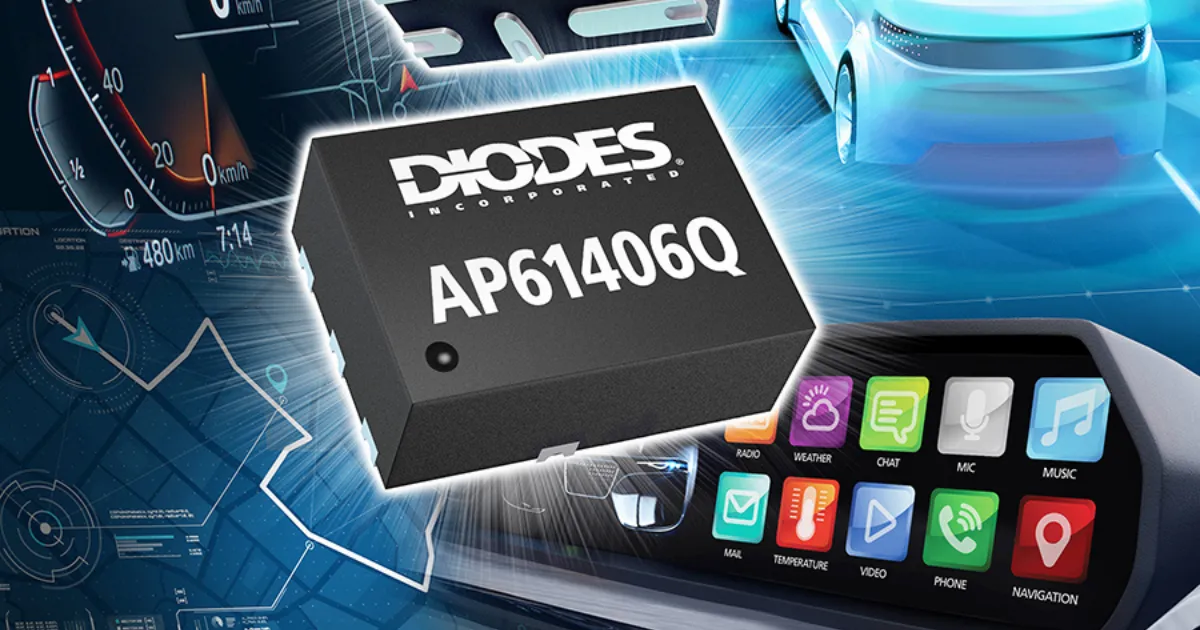
 Power designers working on modern automotive modules face tight constraints around efficiency, size and predictable behaviour across different load states. Infotainment, telematics and ADAS platforms in particular rely on multiple rails that must stay quiet, stable and adjustable as vehicle software changes state. Diodes Incorporated’s AP61406Q enters this landscape as a synchronous buck converter that brings digital configurability, low standby current and compact packaging into a single power stage suited for dense automotive boards.
Digital Control for Flexible Rail Management
Automotive electronics increasingly depend on software managed power behaviour. Rails need to shift modes without disturbing nearby logic or increasing EMI. The AP61406Q addresses that by adding an I2C 3.0 compatible interface with clock rates up to 3.4MHz, allowing designers to tune switching frequency, choose PWM or PFM behaviour and set current limits. Output voltage can be trimmed in 20mV increments, which helps align tolerance budgets when rails feed precision digital and mixed signal ICs. Fault status information is also available digitally, avoiding the need for additional monitoring components.
Integrated Power Stage and Control Performance
The converter operates from 2.3V to 5.5V while integrating a 75mΩ high side and 33mΩ low side MOSFET pair, supporting efficient operation across its load range. Its constant on time topology reduces component count and makes loop stability easier to achieve, which is valuable in quick-turn designs. Low ripple characteristics help when the rail sits close to timing sensitive processors. Switching frequencies from 1MHz to 2.5MHz allow engineers to manage the trade offs between inductor size and EMI behaviour. A proprietary gate driver structure reduces switching node ringing, providing a noticeable benefit when meeting emissions targets inside compact PCBs.
Thermal, Packaging and System Integration Factors
The AP61406Q is housed in a compact W QFN1520-8 package designed for thermally challenging environments such as infotainment head units and telematics modules. Its enable pin doubles as a mode control input, giving the option of a 20µA low IQ state for modules that spend long periods dormant. When the system wakes, PWM operation keeps ripple behaviour consistent across load. Standard protection mechanisms include undervoltage lockout, input overvoltage protection, peak and valley current limiting, thermal shutdown and short circuit sensing on both MOSFETs. These provide predictable behaviour under fault conditions and simplify safety validation for automotive use.
Implications for Next Generation Automotive Modules
Automotive architectures are moving toward highly modular, software defined subsystems. Power stages that can be adjusted digitally and monitored in real time support this trend by making it easier to tune rails for efficiency, noise, or transient response without major redesign. Devices like the AP61406Q show how compact converters can incorporate configurability while maintaining robust electrical performance. As infotainment, ADAS and connectivity electronics continue to scale in complexity, digitally tunable converters will likely become a standard design tool rather than a specialised option.
Learn more and read the original announcement at www.diodes.com
You may also like