
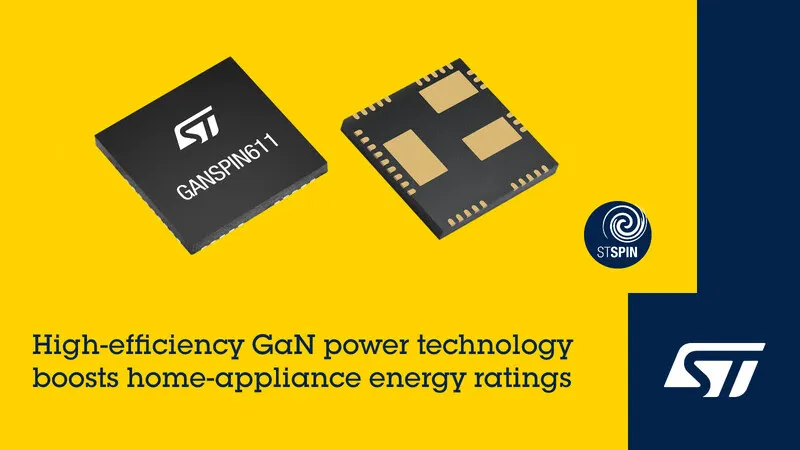
 Energy efficiency is now a first-order design constraint in both home appliances and industrial equipment. Motors consume a large share of system power, yet many designs still rely on older silicon stages that limit switching performance, raise thermal losses and add bulk through heatsinks and filtering components. STMicroelectronics is pushing GaN further into motion control with its new GaNSPIN platform, a system-in-package approach that brings wide-bandgap behaviour to BLDC motor drives in both consumer and factory environments.
A Platform Built for Real Motor-Drive Constraints
Unlike power adapters and fast chargers where GaN has already become familiar, motor-control stages face a different set of challenges. Designers must manage hard-switching behaviour, EMI limits, winding stress and the reliability expectations of long-life appliances. The GaNSPIN platform is tailored for those conditions by pairing ST’s GaN transistors with a driver optimised to shape switching edges and reduce electromagnetic noise. For engineers trying to meet energy ratings or shrink the power stage, that integration matters more than raw switching speed alone.
Performance Characteristics That Influence System Design
The first devices in the family, the GANSPIN611 and GANSPIN612, target motors up to around 400 watts, covering compressors, pumps, fans and servo drives. Both share a common pinout, making it easy to scale a design without reworking layout. The 611 version uses a 138 milliohm transistor while the 612 version uses a 270 milliohm device. These values might look modest on paper, but for BLDC motor applications they translate into meaningful thermal headroom. Lower conduction loss helps many designs eliminate the heatsink, allowing a smaller board with fewer mechanical constraints.
In the driver stage, ST has set a nominal ten volts per nanosecond slew rate, which is quick enough to capture GaN efficiency benefits while keeping EMI manageable. Designers can tune the turn-on behaviour to match the motor’s characteristics, giving more control over winding stress and switching noise. For engineers trying to comply with EMC rules such as the EU directive, this tunability is often more useful than chasing maximum switching speed.
Integration That Simplifies Appliance and Factory Designs
The GaNSPIN system-in-package integrates a half-bridge power stage with its driver and includes elements that typically sit outside the IC, such as the high-side bootstrap diode. This reduces component count and shortens the switching loop, both of which benefit efficiency and noise performance. With a supply capability up to twenty volts, the devices drop into traditional offline AC-powered appliances across the 110 to 230 volt range. ST has also included a dedicated fault-sensing comparator for fast shutdown under overcurrent conditions, combined with undervoltage, overvoltage and thermal protections to support long-term reliability.
A Step Toward Higher-Efficiency Motor Platforms
Motor-driven systems are evolving as manufacturers seek higher rotational speeds and better energy ratings in everything from washing machines to small compressors. GaN helps deliver those improvements by reducing switching and conduction losses, but only if the driver, layout and thermal design are treated as part of the same system. ST’s GaNSPIN approach reflects that thinking by offering engineers a more integrated path to wide-bandgap motor control. For appliances and industrial modules under pressure to reduce size and improve efficiency, these drivers represent a practical entry point into GaN-based motion control.
Learn more and read the original announcement at www.st.com
You may also like