
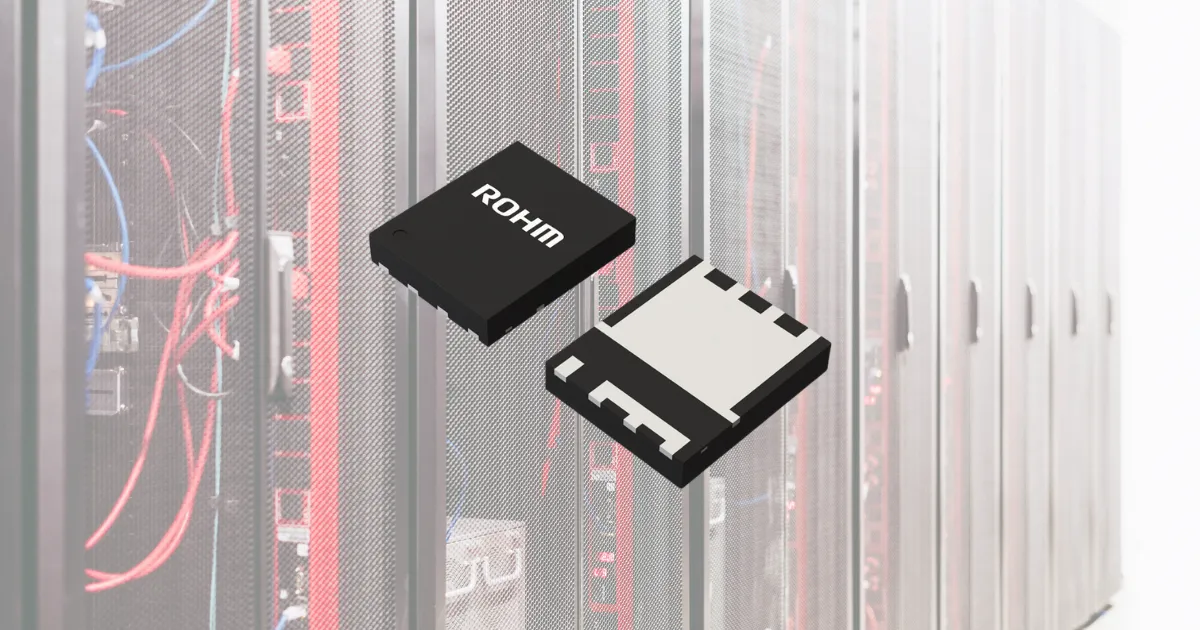
 As AI servers move toward 48 volt power architectures, the demands placed on hot swap circuitry are becoming more difficult to manage. Inrush current can reach levels that stress power stages well beyond steady state conditions, and the devices protecting those paths must balance low conduction losses with the ability to survive short duration overloads. ROHM has introduced the RS7P200BM to address this challenge with a 100 volt MOSFET that maintains a wide safe operating area in a compact 5 by 6 millimetre package intended for high density server power designs.
Wide SOA for 48 V Hot Swap Protection
Hot swap circuits used in AI servers rely on MOSFETs that can tolerate high current pulses when boards connect to a live backplane. Traditional devices often trade off on resistance for survivability, which can increase heat generation during normal operation. The RS7P200BM maintains a safe operating area capable of handling 7.5 amps for 10 milliseconds and 25 amps for 1 millisecond at a drain source voltage of 48 volts while keeping an on resistance of 4 milliohms at a gate voltage of 10 volts. This balance reduces losses during steady operation while allowing the device to manage surge events without immediate derating. For systems operating continuously near thermal limits, the ability to hold both characteristics is often more valuable than pushing either specification to the extreme.
Compact Package and Mounting Density
The device uses a DFN5060 8S package that reduces footprint compared to ROHM’s earlier RY7P250BM in the larger 8 by 8 millimetre format. Higher mounting density allows power stages to shrink in systems where real estate is already consumed by GPUs and associated cooling hardware. The reduction in package size also supports shorter current paths, which can help minimise parasitic inductance during fast transients. For data centre power designers working with tight mechanical integration, the smaller package offers another option without changing the overall voltage class or thermal strategy.
Electrical Behaviour and System Impact
Maintaining low on resistance in a 100 volt device helps suppress heat generation during continuous operation, which becomes increasingly important as server power efficiency targets tighten. Lower conduction losses can reduce the cooling load on the system and allow power stages to operate more predictably under varying workloads. In practice this can translate to lower operating costs and improved thermal headroom for other components on the board. The device is positioned for systems that prioritise stability rather than extremely high switching frequency, including hot swap modules, battery backed industrial equipment and 48 volt power conversion in data centre infrastructure.
Deployment Considerations and Use Cases
The RS7P200BM is suited to designs where the move to 48 volt distribution is driven by efficiency and cable loss reduction. Typical applications include AI server blades, rack level power modules, forklifts, automated guided vehicles and emergency backup units that require both protection and consistent conduction performance. For engineers planning future migration, the package aligns with standard DFN mounting patterns and does not require significant changes to existing assembly processes.
Learn more and read the original announcement at www.rohm.com
You may also like