
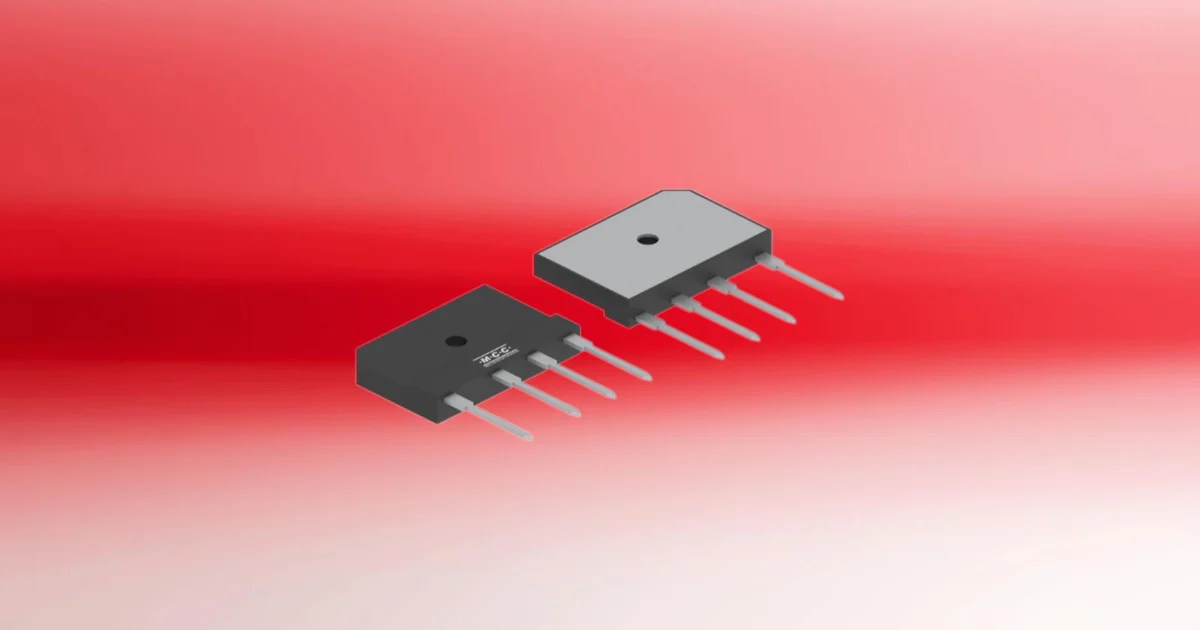
 Designing switching stages in small embedded systems often becomes a negotiation between footprint, thermal margins and how much voltage headroom you can afford to give up. As products shrink and their power paths become more distributed, engineers need MOSFETs that behave predictably in tight layouts without forcing compromises on gate drive or efficiency. MCC’s SL100N10L is built around that kind of environment, offering a 100 V N channel device in a SOT 23 3L package aimed at low power switching where space and voltage tolerance both matter.
The device sits in a category where designers often struggle to find parts that mix logic level drive, low losses and a meaningful voltage rating. By combining a 100 mΩ typical RDS(on) with a 100 V drain source limit, the SL100N10L is positioned for small systems that live near inductive loads or noisy supply rails but cannot accommodate larger packages or external drivers.
Where a Small 100 V MOSFET Makes a Difference
In compact electronics it is common for a single MOSFET to handle more than one role. It may switch a sensor rail, protect a battery, drive a relay coil or isolate a subsystem during sleep modes. Those operations benefit from logic level drive because the controlling microcontroller rarely has the overhead to run a dedicated gate driver, especially in IoT nodes and portable devices.
A 100 V rating gives a comfortable margin when switching inductive loads, even at modest currents. That helps prevent the gradual reliability issues that show up in systems exposed to transients from motors, long cables or industrial signalling. In many designs the challenge is not the steady state current but the unmanaged voltage spikes that appear during switching. A MOSFET in this class is chosen as much for that resilience as for its conduction performance.
Electrical Behavior That Supports Efficient Low Power Switching
The SL100N10L uses MCC’s Trench Power LV structure to balance low RDS(on) with modest gate charge, giving designers efficient switching without penalising battery life. Lower gate charge becomes noticeable in systems that wake frequently or run at moderate switching frequencies, where the cumulative losses in driving the MOSFET can eclipse conduction losses. A device that moves through its transitions cleanly helps reduce wasted energy and limits heating in nearby components.
At a continuous current rating of 2 A, the device is not intended to serve as a primary power switch in larger designs. Its usefulness comes from providing a controlled switching element that can sit close to the microcontroller or sensor interface without creating thermal hotspots. In practice, this helps engineers keep heat away from sensitive analog front ends or compact enclosures where airflow is restricted.
Integration in Embedded and Portable Systems
The SOT 23 3L package is a familiar building block in embedded design and lends itself to high density layouts. Being able to place a 100 V MOSFET in that footprint gives engineers more freedom to route switching elements near connectors or within sensor modules where board area is usually the limiting factor. It also simplifies multilayer designs where moving a MOSFET to a larger package would require adjusting copper, spacing or thermal flow.
Logic level drive broadens the range of small controllers that can manage the device directly. For designs that aim to minimise component count and reduce the surface area dedicated to power stages, avoiding a separate gate driver is valuable. It helps keep control paths simple and reduces the number of failure modes associated with mixed voltage domains.
What This Means for Future Compact Designs
As portable systems continue to merge sensing, control and low power actuation into tighter spaces, switching devices that deliver both voltage margin and compact packaging become more important. Engineers are increasingly asked to protect batteries, route signals and handle inductive loads without expanding the board. Devices like the SL100N10L reflect that shift by offering practical electrical headroom in a footprint suited to dense embedded applications.
For designers pushing toward smaller nodes, distributed sensing or compact industrial controls, a balanced MOSFET in this package class can simplify power paths and reduce the need for over engineered switching stages. It is a modest component on paper, but in constrained layouts it enables topologies that would otherwise require larger or more complex solutions.
Learn more and read the original announcement at www.mccsemi.com
You may also like