
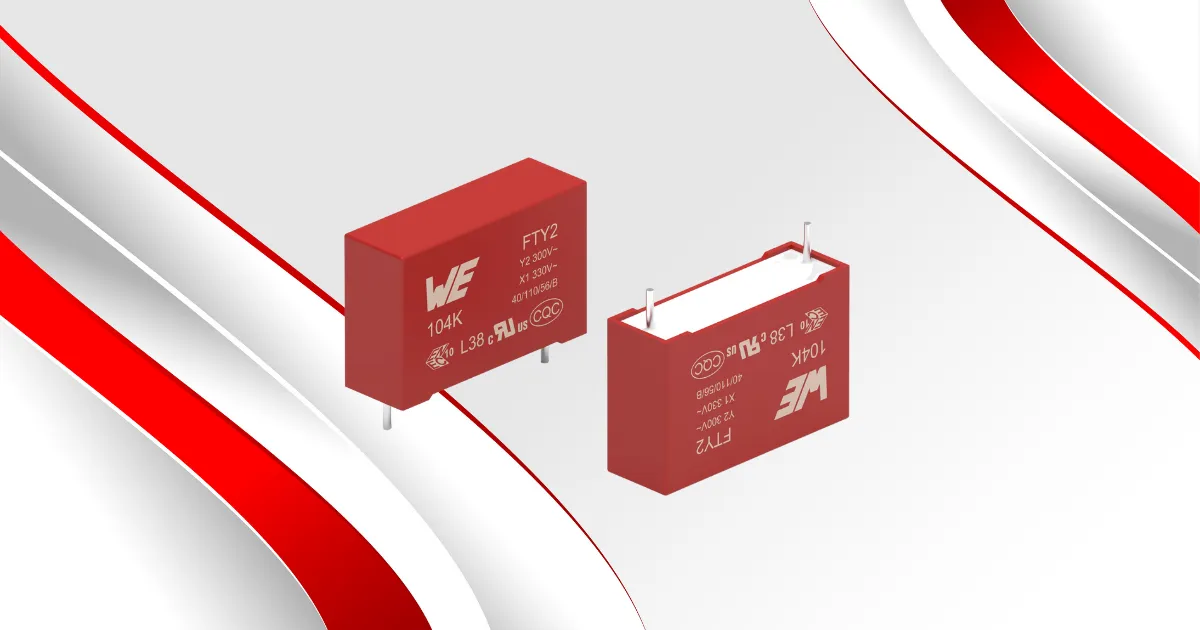
 Noise suppression on the mains side is one of those design areas that rarely gets attention until something fails compliance testing or a piece of equipment behaves unpredictably. Filters built around X and Y class capacitors play a big role in keeping conducted noise under control, especially in appliances, motor drives and industrial electronics where transients and switching edges can be harsh. Würth Elektronik’s new WCAP FTY2 series enters this space as a high impulse strength option for designs that need reliable suppression in X1 or Y2 configurations.
Why Mains Side Filtering Still Matters
Modern power supplies and inverters switch faster and harder than older designs, and that behaviour tends to leak noise back toward the AC input. Without the right suppression components the equipment can fail EMC testing or interfere with nearby devices. X class capacitors sit between line and neutral to handle differential noise, while Y capacitors connect line or neutral to earth for common mode suppression. Devices rated for X1 or Y2 duty have to withstand higher impulse voltages than the more common X2 parts, which becomes relevant in installations exposed to spikes or surge events. Würth’s series is certified to IEC 60384 14 with ENEC10 approval, which gives engineers a clearer picture of how the components behave under stress.
Technical Characteristics That Influence Suppression Behaviour
The WCAP FTY2 parts are metallised film capacitors, which means they can self heal when small dielectric faults occur. That mechanism reduces the risk of catastrophic failure and is one of the reasons film capacitors remain popular in safety critical filtering. Higher impulse dielectric strength is the standout trait of the new series, offering margin for installations with harsher mains conditions or frequent switching transients. In practical terms this can help reduce the spread of high frequency interference back onto the grid and improve the stability of the equipment under noisy conditions. The combination of film construction and X1 or Y2 certification makes the parts suitable for both household appliances and the industrial sector where motor drives, inverters or control systems generate broad noise spectra.
Placement And Integration Considerations
Engineers typically place X1 capacitors between line and neutral, while Y2 capacitors bridge line or neutral to earth. That choice dictates how the capacitor sees surge events, differential noise or common mode noise during operation. A self healing film capacitor helps maintain performance over time, even in circuits subjected to repetitive stress. Although the PR highlights the parts as general mains filters, the real benefit lies in their ability to maintain capacitance and suppression characteristics after impulse events. This contributes to longer field lifetimes and more predictable compliance behaviour over the product’s service life.
Tools That Support Component Selection
Würth’s REDEXPERT platform provides impedance curves measured from real components rather than simulated models. For engineers tuning filters this level of data can make selection more precise, especially when working with tight EMC margins. The availability of free samples and a design kit can also help speed up prototyping and give teams a clearer sense of how the parts behave in circuit. While these tools are optional, they align with how many engineers now approach mains filtering: with data driven selection rather than relying solely on catalogue specifications.
Learn more and read the original announcement at www.we-online.com
You may also like