 When engineers push higher data rates through tight connector footprints, the way the contacts meet the card edge starts to influence signal quality as much as the impedance profile on the board. Traditional edge-card sockets work well until repeated mating starts to mark the contact surfaces or shift the alignment enough to affect consistency. That is why newer high-speed designs focus heavily on how the contact engages the pad rather than just the pitch. The HSEC8 family from Samtec follows that direction with a 0.80 mm pitch and a machined contact surface that holds up differently when the connector experiences regular use.
Contact Behaviour That Supports High Signal Integrity
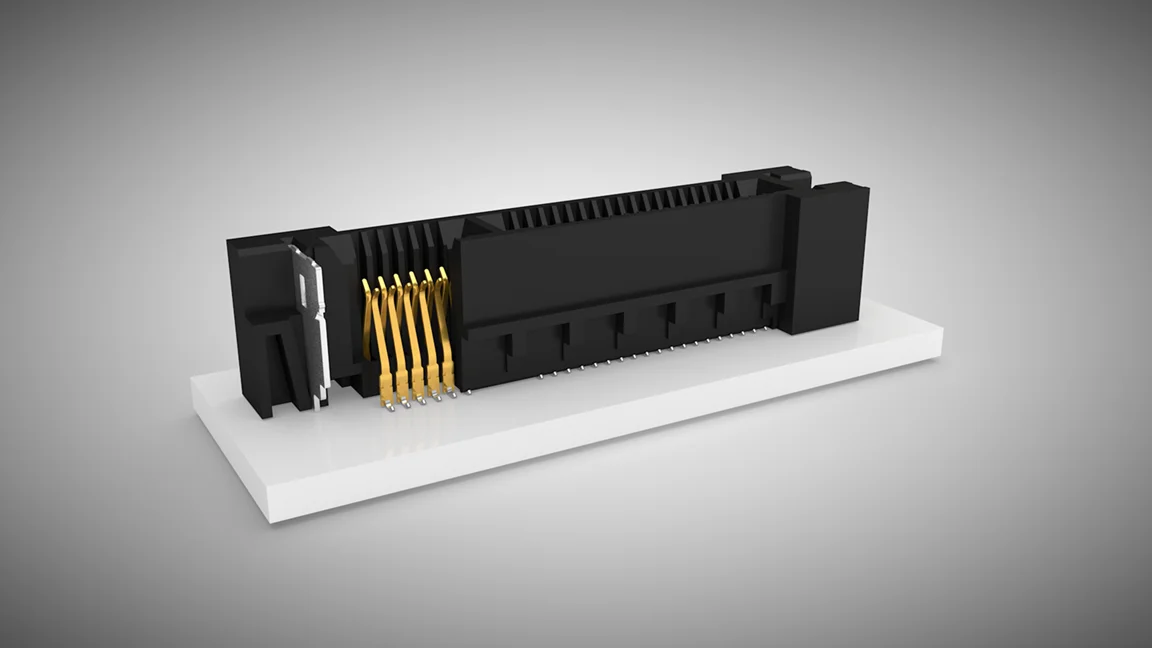
The key feature in the HSEC8 lineup is the Edge Rate contact, which uses a machined surface to meet the PCB pad instead of relying on a stamped edge. By smoothing that interface, the connector avoids the sharp wear tracks that often appear after repeated insertions and reduces the force needed to mate or unmate the card. This helps the contact maintain a consistent profile across a large number of cycles. That consistency becomes important in multi-gigabit systems where small shifts in the contact region or added resistance can erode the remaining signal margin. Connectors in datacom, telecom, and test environments often face this kind of cycling, so predictable behaviour over time becomes a practical advantage.
Mechanical Options for Different System Layouts
Mechanical constraints often dictate connector choice before signalling requirements do. The HSEC8 series addresses this by offering three orientations: vertical, right angle, and edge mount. Each configuration fits a different style of system layout. Edge-mount sockets work well when boards sit close to enclosure walls. Vertical versions suit common mezzanine stacks. Right-angle parts fit in compact designs where airflow or component height limits vertical room. Optional side latches improve retention in environments with vibration, while board locks and weld tabs add mechanical strength on heavier assemblies. Card thickness options of 0.062 inch and 0.093 inch cover most board formats used in modular equipment.
Suitability for Modular and High-Cycle Systems
Modular architectures depend on connectors that can handle frequent board swaps without mechanical drift. The fine pitch supports dense routing, but it is the machined contact surface that helps maintain repeatable mating behaviour after long periods of use. This is useful in instrumentation, industrial systems, medical hardware, and computing platforms where boards are removed for calibration, updated during product revisions, or cycled repeatedly during servicing. Power and signal combinations available in the HSEC8 family broaden its use in assemblies that route mixed rails through a single interconnect.
Position Within Samtec’s Broader Edge-Card Line
The HSEC8 family forms part of a wider edge-card lineup that spans 0.50 mm through 2.00 mm pitch products. Designers working across different board sizes can move between these pitches while keeping the same orientation options, whether vertical, right angle, or edge mount. Variants in the broader line include power and signal mixes, press-fit versions, pass-through styles, and PCI Express aligned connectors. For engineers building high-speed modular hardware, the HSEC8 combination of mechanical durability and controlled signal behaviour supports predictable long-term performance as systems scale.
Learn more and read the original announcement at www.samtec.com
You may also like