
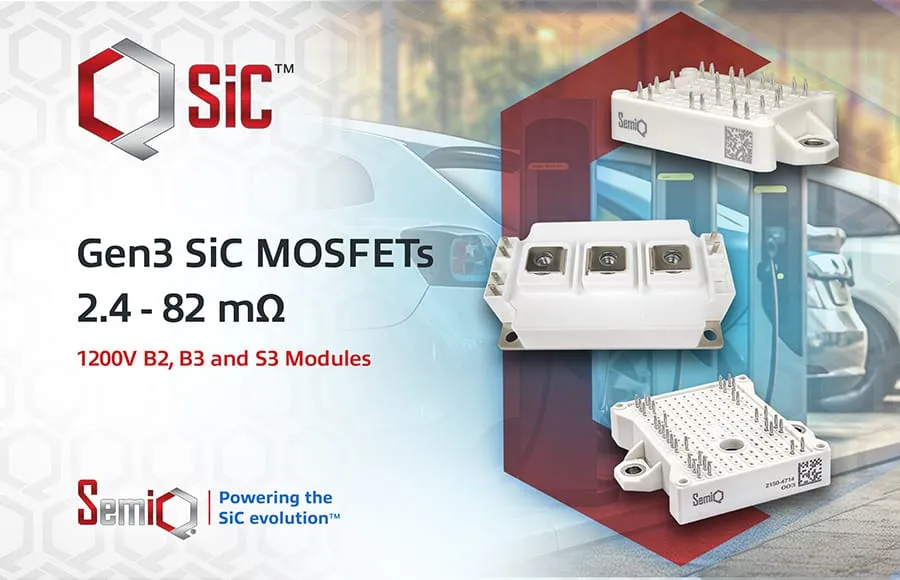
 Designers of high power converters face a familiar set of constraints. As switching frequencies increase and efficiency targets rise, thermal margins shrink and power stages begin to consume more mechanical volume than the applications they serve. EV chargers, industrial drives and energy storage platforms all push silicon carbide devices toward higher current capability while demanding lower conduction and switching losses. SemiQ’s expansion of its third generation QSiC MOSFET module family steps into this space by offering half bridge, full bridge and six pack modules with unusually high current density and low thermal resistance.
Current Density and Thermal Behaviour for Demanding Power Stages
One of the most striking characteristics of the new Gen3 family is the current capability of the S3 half bridge modules. Devices rated up to 608 A with an on resistance as low as 2.4 milliohms highlight how far packaging and die optimisation have progressed. In dense power systems, conduction losses at high current can dominate the efficiency profile, so reductions in on resistance scale directly into thermal headroom. The claimed junction to case thermal resistance of 0.07 degrees Celsius per watt in the 62 millimetre footprint is noteworthy because it allows engineers to extract more power from the same cooling infrastructure. In practice, this can simplify heatsink design or reduce coolant flow in liquid cooled assemblies, which is valuable in EV charging cabinets or industrial converters where every watt of thermal margin counts.
Module Architectures Aligned with System Integration
SemiQ has introduced the modules in several configurations that match common converter topologies. The B2T1 six pack modules integrate a full three phase bridge into a compact package, which can help reduce parasitic inductances and improve switching behaviour in motor drives or AC DC conversion. Their on resistance values, ranging from 19.5 to 82 milliohms, suggest suitability for mid power inverters where switching speed and layout optimisation influence control loop stability. The B3 full bridge modules, with current ratings up to 120 A and on resistance values down to 8.6 milliohms, target single phase inverters and high voltage DC DC converters. Their thermal resistance of 0.28 degrees Celsius per watt creates a predictable thermal pathway, which engineers can incorporate into enclosure level cooling strategies. These different module formats give system designers flexibility when choosing between consolidated power stages and discrete bridge assemblies.
Electrical Characteristics and Gate Drive Considerations
The Gen3 devices operate with gate voltages of 18 volts and minus 4.5 volts, which is lower than earlier generations. For engineers, this has two implications. First, gate drive circuits can be simplified or made more efficient. Second, lower gate voltages reduce switching losses, particularly during turn off events where energy dissipation can accumulate rapidly at high switching frequencies. SemiQ states that turn off energy and specific on resistance have been reduced by up to thirty percent compared with previous generations. When combined with the high current ratings and low on resistance figures, this improvement points toward more efficient operation under both hard switching and soft switching conditions. Devices are also tested at wafer level for gate oxide reliability and verified to breakdown voltages exceeding 1350 volts, which adds confidence for applications subject to repetitive overvoltage stress.
Broader Impact on EV Infrastructure and Industrial Platforms
The move toward higher current density in silicon carbide modules reflects broader industry trends. EV infrastructure demands compact converter stages that can deliver high charging rates without expanding cooling systems. Industrial motor drives aim to increase efficiency while reducing enclosure size. Energy storage converters need predictable thermal performance under variable load conditions. Modules that combine low thermal resistance, high current rating and improved switching behaviour give engineers a pathway to meet these demands without drastically altering system architecture. For high power designers evaluating next generation platforms, SemiQ’s Gen3 family highlights how packaging and die development continue to shift the balance between power density and thermal constraint.
Learn more and read the original announcement at www.semiq.com
You may also like