
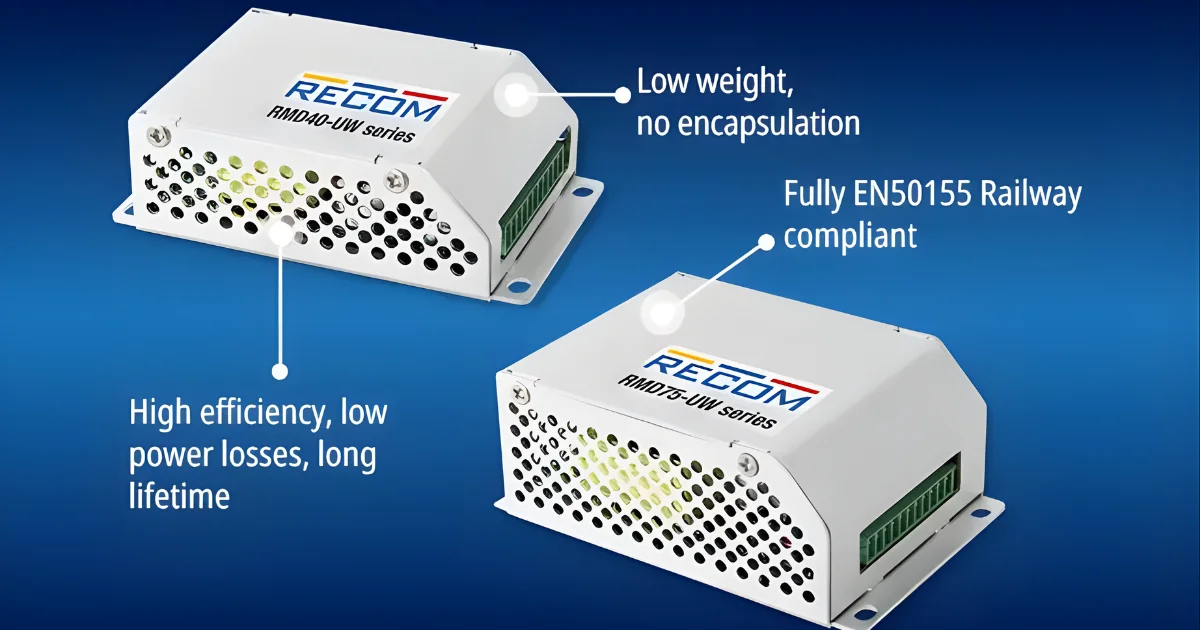
 Railway power design is rarely about achieving the highest possible efficiency or power density. More often, the challenge is surviving a wide range of supply voltages, harsh electrical noise, and demanding environmental standards without turning the power stage into a bespoke compliance project. Auxiliary power rails still need to work reliably when input conditions swing wildly, ambient temperatures are extreme, and certification requirements are non-negotiable. That is the context RECOM is targeting with its new RMD40-UW and RMD75-UW DC/DC converter modules.
These two converters are designed as fully featured, plug-and-play solutions for railway auxiliary systems, covering nominal input voltages from 24 V to 110 VDC with a single ultra-wide 11:1 input range. With a regulated 24 V output and additional 12 V and 15 V versions planned, the focus is clearly on simplifying system integration rather than optimising for a narrow operating point.
Wide Input Coverage Without External Conditioning
One of the persistent difficulties in rail applications is accommodating the variety of supply rails encountered across different vehicles and regions. Designers often end up adding front-end circuitry to handle voltage variation, surge behaviour, and EMC compliance before the DC/DC stage can even be considered.
The RMD40-UW and RMD75-UW are intended to remove much of that effort. Their 11:1 input range spans all common railway DC supplies, allowing a single converter type to be reused across platforms. Built-in reverse polarity protection, inrush current limiting, and EN50121-3-2 compliant filtering mean the modules can be connected directly to the supply without additional external conditioning components.
Power Headroom and Thermal Behaviour in Harsh Conditions
Both modules are designed to operate continuously across demanding thermal classes without forced airflow. The 40 W version supports a 60 W boost for 10 seconds, while the 75 W variant offers a 90 W boost over the same duration. That short-term headroom is useful in auxiliary systems where loads may peak during startup or fault recovery.
High conversion efficiency, exceeding 90 percent, allows the modules to deliver full rated power from minus forty degrees Celsius up to plus eighty-five degrees Celsius under OT4 and ST1 and ST2 environmental classes. Baseplate cooling and a lightweight aluminum housing mean the converters can be mounted in any orientation without additional heatsinking, which simplifies mechanical integration in confined enclosures.
Integration Features That Reduce System Complexity
A notable aspect of these converters is the breadth of functions included as standard. Remote on and off control, a power-good signal, output voltage trim, and an internal OR-ing diode for parallel or redundant operation are all built in. For designers working on safety-critical or high-availability systems, this reduces the need for external supervisory circuitry.
An active hold-up circuit provides at least ten milliseconds of ride-through across the entire input voltage range. In rail environments where brief supply interruptions are expected, that feature can prevent nuisance resets and improve overall system robustness without relying on large external capacitors.
Certification and Compliance as a Design Baseline
Railway certification is often where projects slow down. Beyond electrical performance, equipment must meet stringent EMC, safety, environmental, and fire protection standards. The RMD40-UW and RMD75-UW are certified to EN50155 and EN45545-2 at hazard level HL3, addressing both operational reliability and fire safety requirements.
The electronic assemblies are conformally coated for OV2 and PD2 environments, and the modules are rated for a 20-year design lifetime under class L4 conditions. For long-service rail assets, that lifetime classification matters as much as initial performance.
Practical Form Factors for Auxiliary Systems
Physically, the modules are compact enough for distributed auxiliary power roles. The 40 W version measures 100 by 60 by 30 millimetres, while the 75 W module is only slightly larger at 110 by 73 by 40 millimetres. Connections are available via block terminals or optional cage clamp terminals, and DIN-rail mounting options are supported for both variants.
Together, these choices point to a clear design intent. Rather than offering a bare converter core, RECOM has packaged compliance, protection, and integration features into a single module that can be treated as a finished subsystem.
Incremental Design Simplification for Rail Electronics
The RMD40-UW and RMD75-UW reflect a broader trend in railway electronics toward reducing custom engineering around auxiliary power. As certification requirements grow more complex, the value of converters that can be dropped into a design with minimal external support increases.
For engineers, the appeal is not any single specification. It is the cumulative reduction in risk, design time, and compliance effort. In railway applications, that kind of simplification can be just as important as raw electrical performance.
Learn more and read the original announcement at www.recom-power.com
You may also like