
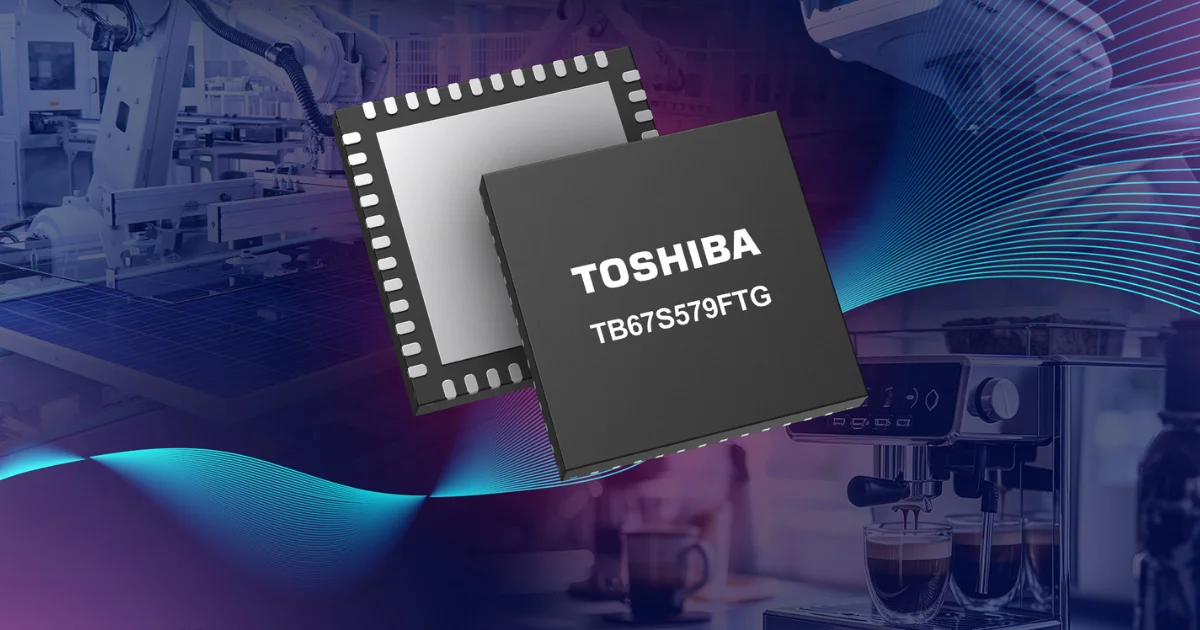
 Stepper motors show up in a lot of places where movement has to feel controlled rather than fast, and that often leaves designers juggling noise, torque, and accuracy at the same time. The problems are most obvious in small assemblies that perform short, repeated motions, since any roughness in the drive signal becomes easy to notice. Toshiba’s TB67S579FTG lands right in that area. It brings a newer microstepping approach that aims to make low speed motion feel smoother while keeping the control side straightforward.
How the Driver Handles Low Speed Motion
One issue engineers keep running into is how quickly vibration creeps in when a motor shifts from a strong initial kick into slower, controlled movement. The TB67S579FTG deals with this by shaping the current more continuously, aiming for a smoother ramp through that low speed region rather than the stepped feel you often get with basic microstepping. This continuous current shaping produces a waveform that looks much more like a clean sine, which often translates into less audible noise and better fine positioning in printers, cameras, projectors, and other compact systems.
Simplified Control Through Internal Waveform Generation
Many microstepping drivers need the MCU to juggle different clock patterns when the step resolution changes. Toshiba avoids that by generating the finer step waveform inside the device while taking only a single full step clock at its input. In practice this helps designs that rely on a quick torque boost at startup before shifting into quieter operation. Instead of rewriting the control sequence every time the mode changes, the system transitions smoothly because the driver handles the waveform shaping itself. That tends to keep both code and timing constraints simpler.
Load Adaptive Current Control for Practical Efficiency
A motor driven at its peak current all the time wastes a lot of energy during light duty cycles. The TB67S579FTG estimates load through the induced voltage and adjusts the current accordingly. In real equipment like printers or small automation modules, this often cuts down needless heating. It also tends to clean up the current profile as the motor turns. When the waveform settles into a more natural shape, the torque stops drifting around and the motor holds its position with a bit more confidence, especially during repeated movements.
Practical Design Gains in Tight Motor Assemblies
Something that stands out from a layout perspective is how much of the support circuitry has been folded into the device itself. Current sensing and the charge pump are handled internally, which frees up the space normally chewed up by small passives scattered around the driver. Designers working in cramped motion modules usually notice these savings immediately because it gives them a little more freedom to place sensors or optomechanical parts without reshuffling the whole board. The single motor supply, the wide 4.5 to 34 volt range, and the low RDS(on) output stage make the part flexible enough for mixed equipment families without causing thermal surprises.
Maintaining Detail at Higher Speeds
Mixed decay settings often decide whether a motor holds its detail once the rotation speeds up. If the decay timing is off, the waveform starts to flatten and the motor loses the crispness engineers expect during fast travel. The TB67S579FTG pushes that threshold a little higher by tuning the decay mix so the drive waveform stays recognizable even as the rotor picks up pace. Built in protections such as stall detection add another layer of safety by catching conditions where the motor locks or sees unexpected resistance.
Learn more and read the original announcement at www.toshiba.semicon-storage.com
You may also like