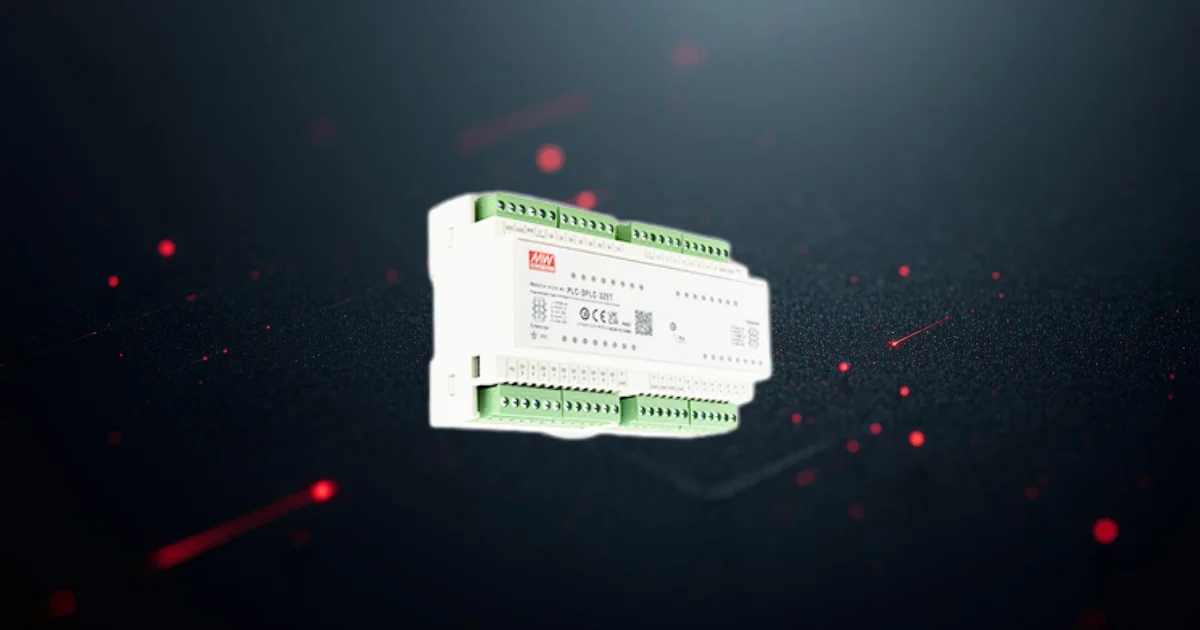
 Industrial automation has been steadily shifting toward architectures that expect more flexibility from the controller itself. Equipment that once ran fixed I/O counts or simple ladder logic now requires configurable signal paths, mixed-language programming, and a clean way to distribute control tasks across different parts of a system. The MEAN WELL PLC-DPLC-32MT/ET series fits directly into that shift by offering a controller that behaves like a compact logic core while leaving headroom for projects that need to grow their I/O count or extend control into multiple modules without redesigning the cabinet.
Why Modular Expansion Matters in Modern Control Panels
A common challenge in machine control is that the I/O requirement rarely stays fixed throughout a project. Early estimates might suggest a small digital footprint, but once sensing, motion, safety, and ancillary functions are added, designers often run out of channels. The PLC-DPLC approach addresses this through an expansion path that supports up to seven modules with a maximum of 256 inputs and outputs. This allows a single controller to scale from simple automation tasks into mid-sized systems that need additional digital points without shifting platforms. In practice, this helps prevent the late-stage redesigns that occur when fixed I/O controllers reach their limit.
Programming Behavior and How It Fits Into Real Workflows
The controller aligns with IEC 61131-3, which anchors it in a programming standard familiar to teams across industrial automation. It works with the Open PLC Editor and supports five programming languages, which makes it easier to match the control method to the task rather than forcing everything into a single style. A built-in real time clock lets time dependent logic run without external modules. One detail worth noting is the support for simultaneous high speed pulse outputs up to 100 kilohertz. This makes the controller viable in equipment that needs coordinated pulse train control for indexing, feeding, or compact motion elements. The communication path through MODBus gives it a straightforward way to tie into existing systems or to handle supervisory monitoring from a remote interface.
Integration Considerations in Field Environments
When placed inside a cabinet or control enclosure, the PLC-DPLC series works like a module designed for long operating cycles. DIN rail mounting keeps installation predictable and fits the mechanical expectations of machine builders. Input and output behavior remains stable across the full expansion range, which avoids the timing irregularities that sometimes arise when controllers mix internal and external I/O modules. The supply requirements and thermal profile suit the environments where industrial controllers commonly operate, including elevated temperatures or cabinets with limited airflow. For teams that maintain distributed control nodes across a production line, this consistency reduces field adjustments and keeps commissioning straightforward.
Role in the Broader Shift Toward Distributed Automation
Across factories, material handling systems, agricultural installations, and building control, automation nodes are becoming more modular and more distributed. Rather than relying on a central controller for every task, designers are increasingly placing smaller PLCs closer to the equipment they manage. The PLC-DPLC series fits this pattern by offering a compact footprint, an expandable I/O structure, and a programming environment that scales with system complexity. As automation spreads into applications that were previously handled by simple relays or fixed function logic boards, controllers that balance programmability with mechanical simplicity gain traction.
Learn more and read the original announcement at www.meanwell.com
You may also like