
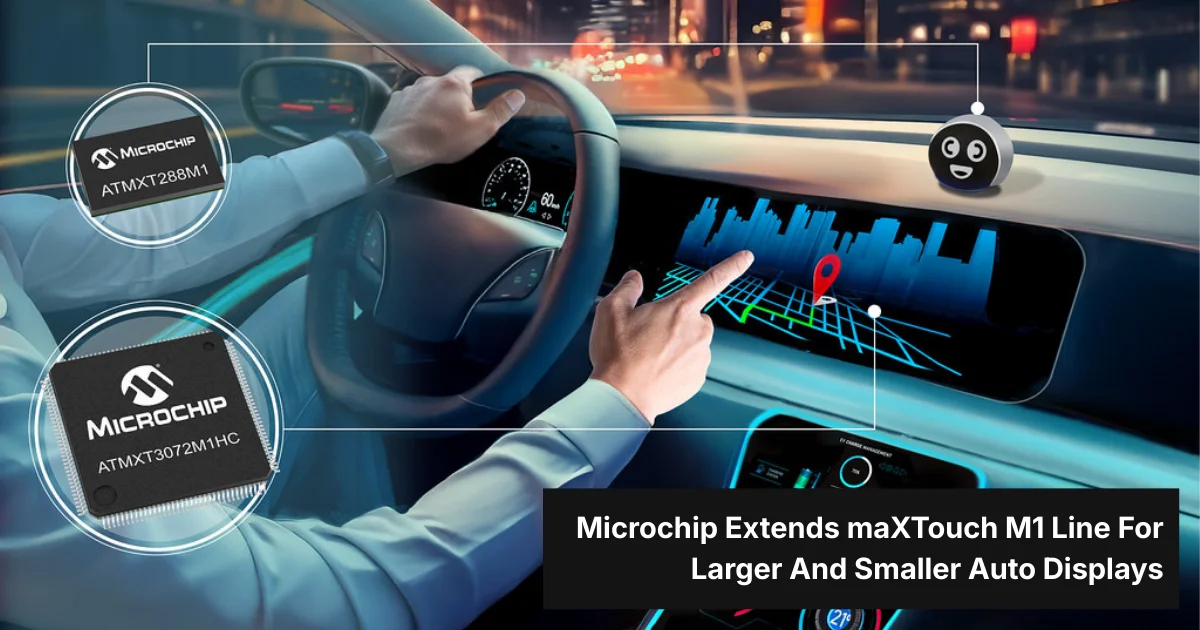
 Automotive displays have quietly become one of the most challenging sensing environments in the car. Large panels generate heavy capacitive loads, smaller modules are packed into tight spaces, and noise from power stages and display drivers often overwhelms touch electrodes. Microchip’s latest additions to the maXTouch M1 family are built around this reality. The new ATMXT3072M1-HC and ATMXT288M1 devices stretch the family in both directions, covering wide free form displays up to forty two inches as well as compact modules that fit into spaces once reserved for physical switches.
Touch Stability On Large Free Form Displays
Large automotive displays present a mix of mechanical and electrical constraints that make conventional capacitive controllers struggle. Long electrode traces pick up more noise, signal levels fall as sensor plates get thinner, and noise coupling becomes unpredictable across different display technologies. Microchip’s approach with Smart Mutual sensing focuses on improving raw signal to noise performance rather than compensating for noise after the fact. The acquisition scheme and its supporting algorithms lift the SNR by as much as fifteen decibels compared with earlier controllers, which helps keep touch detection consistent when displays integrate touch electrodes directly into thin panels. This matters for on cell OLEDs where the increased capacitive load can cause false touches or missed events if the controller does not maintain margin across temperature and noise conditions.
Coordinated Sensing Across Wide Cockpit Formats
One detail worth noting is the way Microchip addresses the growing trend of continuous display layouts. The ATMXT3072M1 HC can manage wide touch sensors that span both the driver cluster and the center information area in a single design. Engineers do not need separate controllers for left and right hand drive variants because the device appears to the host MCU as a single maXTouch interface. This reduces software integration effort and simplifies global variants where cockpit geometries differ. It also helps maintain visual uniformity because a single sensor network behaves consistently as lighting conditions shift.
Compact Module Integration For Space Constrained Designs
At the other end of the size range, the ATMXT288M1 targets applications where display modules thread into small mechanical envelopes. Traditional analog clock locations, compact auxiliary displays, and emerging driver assistant modules benefit from a reduced PCB footprint. The TFBGA60 package introduced for this device cuts board area by roughly twenty percent compared with previous automotive qualified maXTouch parts. The fine pitch grid allows the controller to sit close to display drivers without heavy routing penalties, which is useful when designers work with microLED and OLED modules that compress both the optical and electrical stack.
System Development And Long Term Support
Touch integration in automotive platforms has to survive long production windows, so development tools matter as much as the controller itself. The new devices slot into the wider maXTouch toolchain, which includes the Studio IDE for configuration and the Analyzer environment for production test workflows. Host driver support spans several real time operating systems as well as mainstream platforms used in larger infotainment stacks. For engineers, this reduces the friction of bringing a new controller into an existing architecture without losing control over calibration or tuning.
Learn more and read the original announcement at www.microchip.com
You may also like