
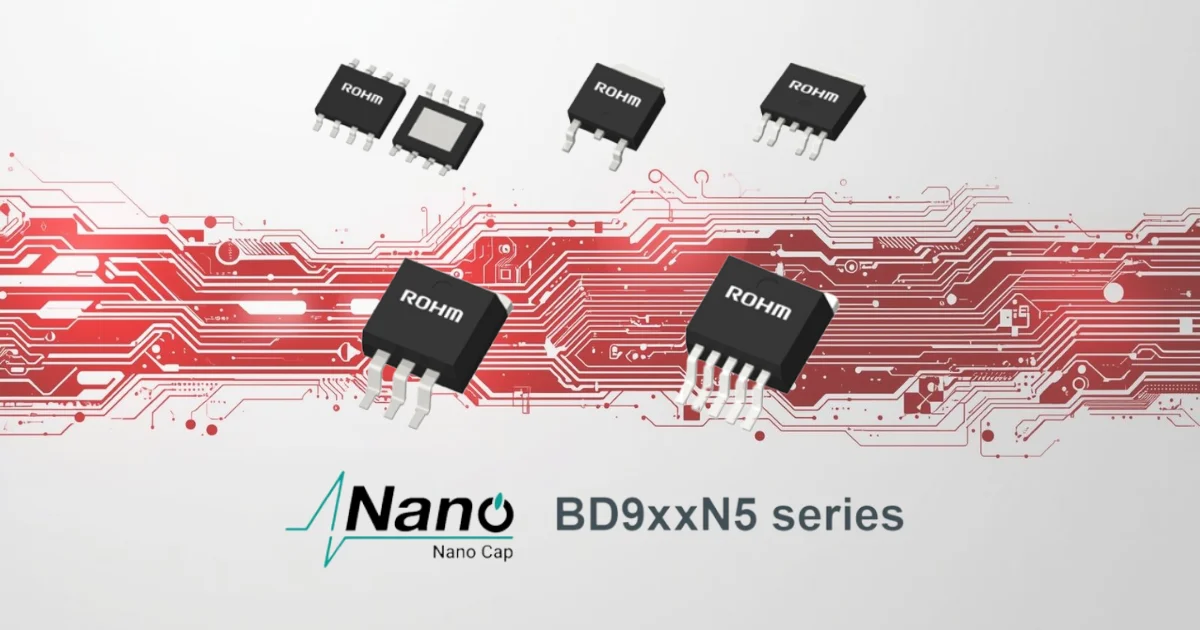
 Modern embedded systems are becoming tighter on board space at the same time that current demands continue to rise. It creates a real design tension for engineers who want clean, low noise rails without relying on the larger capacitors traditionally needed to keep an LDO stable. One outcome is that power stages end up over engineered simply to accommodate capacitor requirements rather than electrical behavior. ROHM’s new BD9xxN5 series targets this exact pain point by pushing its ultra stable Nano Cap control approach into a 500 mA class device that remains steady with capacitor values small enough for the most space constrained layouts.
Stability With Capacitors Below One Microfarad
A common challenge when working with compact boards is managing output stability when mechanical constraints force the use of tiny MLCCs. Many LDOs become sensitive when capacitance drops toward the sub microfarad region, especially under fast load steps. The BD9xxN5 family holds regulation with values as low as 470 nF, which makes it practical to use 0603 MLCCs without worrying about oscillation or long recovery times. In real systems this can simplify both the component selection stage and the PCB routing process because the capacitor no longer dictates the geometry around the power rail. The output ripple performance stands out because the device maintains roughly 250 mV variation across a rapid 1 mA to 500 mA load transition within one microsecond, which is an environment where many conventional LDOs show instability or overshoot.
How the Device Behaves Electrically
The electrical envelope places the device within a broad set of automotive and industrial contexts. Input support up to 42 V covers typical 12 V and 24 V primary rails, while the output choices range from fixed 3.3 V and 5 V versions to adjustable variants spanning 1 V to 18 V. The quiescent current sits near 25 microamps, which helps modules that spend long periods idle. The device’s temperature range stretches from forty below zero up to one hundred fifty degrees Celsius at the junction, which puts it in the territory where automotive and industrial hardware usually lives. One point engineers tend to appreciate is the availability of ROHM’s Real Model SPICE files. These models behave much closer to the silicon than many generic libraries, so early simulations do a better job predicting how the regulator will react when fast load steps or ripple conditions appear on the bench.
Packaging and Integration Considerations
From a board integration perspective, the family arrives in several package options that align with both compact modules and higher thermal dissipation needs. The lineup includes HTSOP J8 parts for compact automotive modules, while the TO252 and TO263 versions suit boards that have more room for copper and need the extra thermal path that comes with larger leadframes. Each package style leans toward a different style of layout, which helps teams match the regulator to the mechanical and thermal limits of their platform.
The ability to run with capacitor values above the 230 nF minimum gives layout teams flexibility to adapt to temperature derating, voltage bias reduction, and MLCC tolerance drift. In practice, this becomes helpful when working across wide temperature envelopes because even small MLCCs vary significantly in effective capacitance once voltage is applied. Having margin beneath one microfarad means the design stays predictable even when real world capacitance falls below nominal.
Why This Direction Matters for Future Platforms
As electronics continue to shrink, the power supply architecture becomes one of the limiting factors in system size. The rise of compact sensor modules, high density infotainment clusters, and distributed industrial control blocks all place pressure on regulators to perform well with smaller passive networks. The BD9xxN5 series shows where linear regulators are heading by treating capacitor size as a key constraint rather than an afterthought. For engineers, the takeaway is that stable low noise rails can exist in tight mechanical envelopes without resorting to over sized passives or switching architectures that add complexity. ROHM’s approach suggests a future where more primary side power stages can be simplified and where dense analog loads gain cleaner, more predictable supply behavior.
Learn more and read the original announcement at www.rohm.com
You may also like