STMicroelectronics’ Stellar P3E MCU Brings Real-Time AI Acceleration To Automotive Edge Intelligence
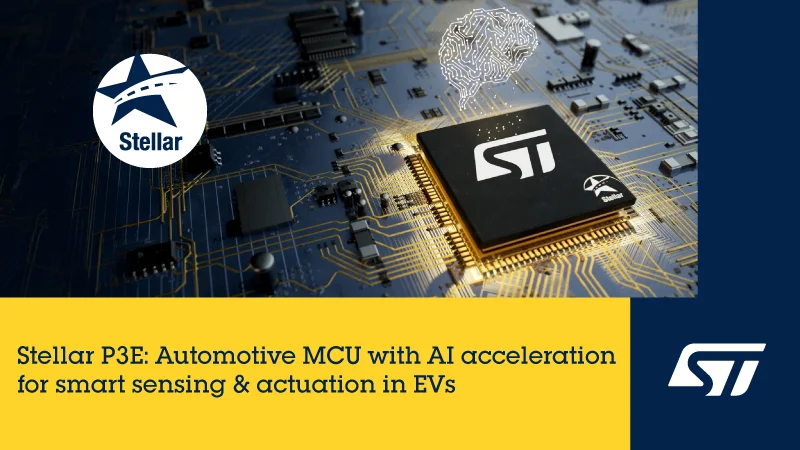 Automotive platforms are reaching a point where the traditional split between real time control on MCUs and higher level decision making on domain controllers no longer fits the latency requirements of new software defined architectures. Sensors are multiplying, motor control loops are tightening and edge decisions increasingly need to happen in microseconds, not milliseconds. That shift has created pressure on the MCU itself, since many of the actions now expected at the edge rely on inference rather than fixed logic. STMicroelectronics is stepping directly into that gap with the Stellar P3E, an automotive grade microcontroller that embeds AI acceleration inside the device normally responsible for the most timing critical workloads in a vehicle.
MCUs have traditionally been deterministic control machines. They run motor drives, manage power stages, interpret sensor readings and coordinate safety functions. The assumption has always been that AI inference belongs elsewhere. The problem is that newer EV and zonal architectures need inference at the point where the signal first appears, while still keeping the MCU’s deterministic behavior intact. That combination is difficult to achieve with software acceleration alone. ST’s approach adds a dedicated neural processing unit alongside the familiar real time architecture, giving the device a way to run lightweight models without disturbing the control loops it already handles.
AI Acceleration Integrated Directly Into The Control MCU
At the center of the device is the ST Neural ART Accelerator, a hardware block tuned for data flow oriented AI workloads. It moves inference into the MCU domain by offloading computation from the main cores and executing neural operations at microsecond scale. For engineers working on predictive maintenance, torque estimation, virtual sensing or anomaly detection, this changes what can be executed at the edge without adding processors or pushing data upstream. The hardware block also supports always on low power modes, which matters in electric platforms where energy budgets are tightly controlled.
Architecture Built For Mixed Safety And Performance Requirements
The Stellar P3E builds around 500 MHz Arm Cortex R52 plus cores arranged in a split lock configuration. This layout makes it possible to switch between lockstep for safety critical routines and independent execution for peak performance. In real systems, that flexibility allows an ECU designer to group AI tasks, motor control loops and safety functions in ways that fit regulatory and architectural constraints. The MCU also draws from an open Arm environment, which helps with toolchain compatibility and lowers the barrier for teams shifting to AI enhanced automotive software.
Memory System Designed For Software Defined Vehicles
One detail worth noting is the use of ST’s xMemory, a PCM based non volatile memory technology with higher density than traditional embedded flash. As vehicles adopt over the air update models and more of the feature set becomes software defined, memory footprint tends to grow beyond what earlier MCU generations can support. The extensibility of this PCM based storage helps avoid hardware redesigns when new AI models or control routines are introduced later in the vehicle’s lifecycle.
Smart Sensing And Virtual Sensor Support
Bringing inference closer to the sensors enables virtual sensing strategies that reduce the need for additional hardware. By interpreting raw electrical or mechanical signals with lightweight models, the MCU can output higher level information that would normally require discrete sensors. This can support EV charging optimization, thermal estimation, or noise pattern detection. Maintaining low latency between sensing, inference and actuation is important for these applications, and the addition of an NPU inside the MCU helps keep that path short.
Ecosystem And Toolchain Integration
The device integrates into the ST Edge AI Suite and Stellar Studio, which simplifies the workflow from model creation to deployment. NanoEdge AI Studio is now available across the Stellar family, allowing teams to generate models tailored to embedded constraints. In practice, this means developers can begin with existing control firmware, add inference blocks and evaluate latency without switching environments or restructuring the entire application. For automotive engineering groups balancing safety, timing analysis and AI workloads, that ecosystem support can be a significant reduction in development friction.
Learn more and read the original announcement at www.st.com
You may also like