
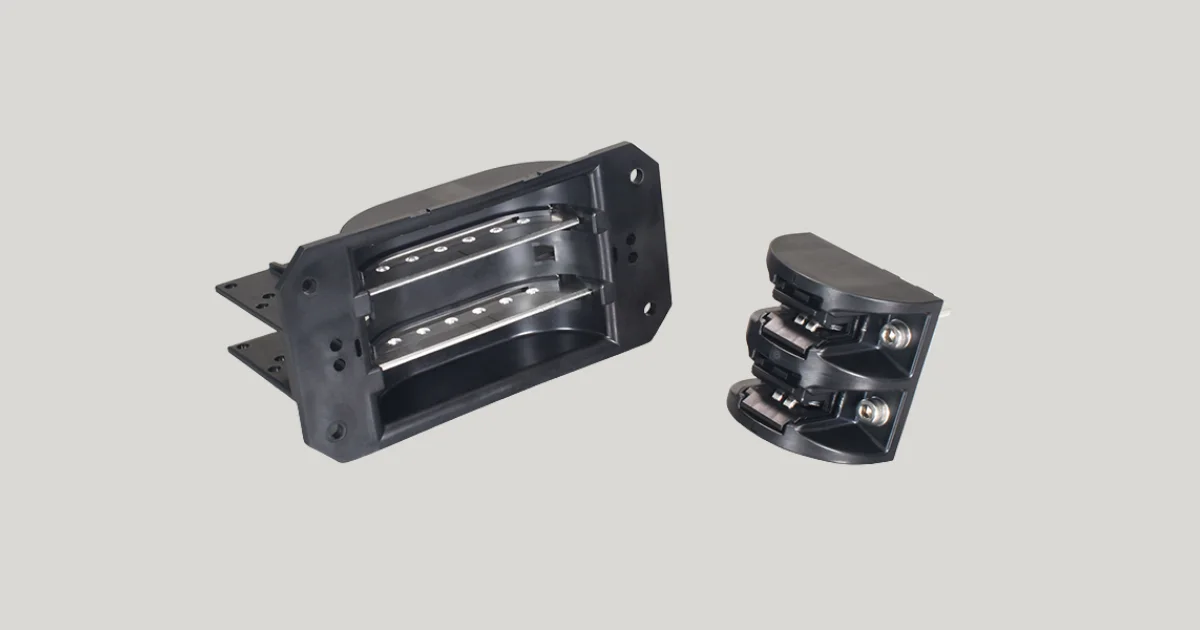
 Autonomous mobile robots rarely dock perfectly. Floor tolerance shifts, wheel wear, sensor drift, and mechanical vibration all accumulate. Over time, even a few millimeters of positional error can turn charging contacts into a reliability bottleneck. The challenge is not simply delivering current. It is absorbing misalignment without adding fragile mechanics to the robot or the dock. JAE’s DW15 Series connector approaches that problem by allowing the connector itself to move instead of demanding perfect alignment from the system around it.
Double-Floating Architecture For Misalignment Compensation
The DW15 uses what JAE describes as a double-floating structure. Both the insulator body on the socket side and the internal contact within that insulator are allowed controlled movement. That layered freedom of motion compensates for vertical, horizontal, diagonal, and oblique approach errors during docking. Rather than forcing a rigid pin to enter a fixed cavity, the connector adapts its geometry during engagement.
The contact interface relies on busbar-style conductors rather than traditional round pins. A wide contact surface tolerates angular misalignment that would otherwise concentrate stress on a small mating point. In practice, this spreads current density and reduces localized wear. For charging systems handling up to 60A at 250V DC, contact geometry directly influences long-term reliability.
Busbar Contact Design And Power Delivery Stability
Busbars are typically associated with power distribution panels, not mobile robots. Bringing that flat, plate-like interface into a docking connector changes how current transfer behaves during imperfect engagement. Instead of depending on precision pin insertion depth, the mating surface provides broader contact engagement. That helps maintain stable conduction even if approach angle varies slightly from cycle to cycle.
Direct fastening of a crimp ring terminal to the busbar simplifies internal wiring. There is no intermediate harness geometry that must flex or float independently. The electrical path remains short and mechanically secure, which matters when robots dock thousands of times over their service life.
Simplified Mounting Without External Floating Hardware
One detail that shifts system design is the four-point screw mounting approach. Many robotic charging docks rely on springs or bearing-mounted plates to create mechanical float. Those parts wear, collect debris, and complicate service access. By integrating float inside the connector body itself, the equipment side can remain rigid. That reduces mechanical stack-up and simplifies enclosure design.
Durability is specified at over 10,000 mating cycles. In warehouse or manufacturing environments where robots may dock multiple times per shift, that number becomes practical rather than theoretical. An optional surface treatment aimed at reducing silver wear is available for extended lifetime applications, addressing one of the common failure modes in high-current sliding contacts.
Where Floating Power Connectors Fit In Automation
As automation expands across logistics and manufacturing, charging reliability increasingly defines uptime. A robot that navigates accurately but fails to charge consistently creates operational friction. The DW15 Series targets transport robots, cleaning units, security platforms, and modular battery systems where autonomous docking cannot assume perfect alignment.
Mechanical forgiveness combined with high-current DC capability changes how charging stations are architected. Instead of building complex floating docks to compensate for robot variability, designers can shift that tolerance inside the connector interface itself. In systems scaling across large fleets, that simplification can reduce maintenance overhead and unplanned downtime.
Learn more and read the original announcement at www.jae.com
You may also like