
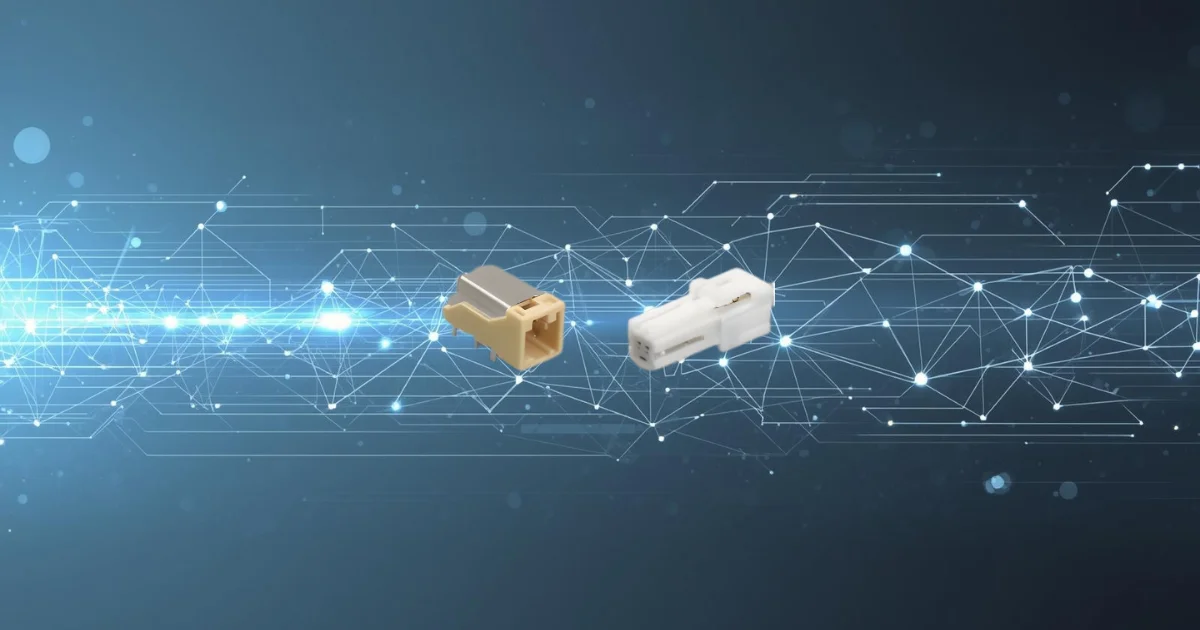
 Automotive networks are changing as vehicles become more software driven. Higher resolution sensors, increasingly complex ADAS pipelines and a growing number of ECUs all push data rates far beyond what the earlier 100BASE-T1 links can comfortably handle. Connector size and EMI performance then become just as important as bandwidth, because packaging density inside modern vehicle architectures leaves little room for bulky interfaces. JAE’s latest expansion to the MX74 Series introduces 1000BASE-T1 compliant models aimed at these constraints, giving designers a way to move 1 Gbps data across a single twisted pair in places where space and shielding margin are limited.
The MX74A models build on the existing 100BASE-T1 lineup but push both speed and mechanical optimisation. As more ADAS units, telematics modules and zonal controllers rely on high throughput Ethernet, the physical connectors become part of the system’s overall reliability envelope. Small shifts in shielding or terminal design can influence signal integrity, crosstalk and susceptibility to external noise, especially when long harnesses and dense ECU layouts are involved.
Why 1 Gbps Single Pair Links Matter in SDV Architectures
The move toward SDVs introduces new electrical and data requirements that did not exist when 100 Mbps Ethernet first appeared in automotive. Vehicles now stream LiDAR point clouds, high resolution radar data and camera feeds around the network, often in real time. The links between sensors and high performance ECUs must handle significantly more traffic without increasing wiring complexity. That is where 1000BASE-T1 fits. It delivers 1 Gbps signalling over a single twisted pair, making it viable for both short and long harness runs.
The MX74A connector targets exactly these scenarios. It provides compact pin header and socket dimensions that help with packaging in areas already crowded by thermal management hardware, insulation foams and bracket structures. Widths around 10 mm and heights in the 11 to 12 mm range are small enough to fit on high density control boards without sacrificing mechanical robustness. Shielding compliance with the Open Alliance Class 1 requirements also helps ensure predictable behaviour across the link segment, which becomes important when designing around sensor level jitter or sensitive timing paths.
Mechanical and Electrical Design Choices That Influence Link Performance
JAE’s design uses a simple two position layout, which aligns with the single pair requirement. Rated current at 3 A and a 30 V rating provide enough margin for typical automotive Ethernet PHY designs, and the dielectric strength ensures isolation in environments that see voltage spikes or rapid transients. The -40 to 105 degree operating range is standard for in-vehicle components but still notable given the small mechanical footprint. Material choices such as PPS GF40 for housings and copper alloy for shields contribute to consistent grounding behaviour.
The connectors are intended for shielded twisted pair cables with a 4.1 mm outer diameter. This is important because true 1 Gbps performance in automotive environments depends heavily on both the shielding and the uniformity of the cable geometry. The retention, insertion force and insulation resistance values all reflect the conditions these connectors will see in zonal architectures where harnesses might run close to high current paths or inverter wiring.
How These Connectors Fit Into Next Generation In-Vehicle Networks
As automakers consolidate ECUs into zonal architectures, connectors must take on a larger role in maintaining signal integrity. When multiple Ethernet links share limited routing space, shielding and mechanical layout are no longer peripheral concerns. The MX74A models support the tighter spatial constraints found in these designs, especially where 1 Gbps links are used to move sensor data into a central compute domain or across domain controllers.
The update also gives designers continuity. Existing MX74 users can step from 100BASE-T1 to 1000BASE-T1 without adopting a new connector system, which simplifies both harness design and PCB layout. It reduces the risk associated with switching suppliers or connector platforms at a time when vehicle networking standards are still evolving. As the demand for higher communication speeds continues to grow, having a connector family that scales with the network architecture helps maintain stability across development cycles.
Learn more and read the original announcement at www.jae.com
You may also like