
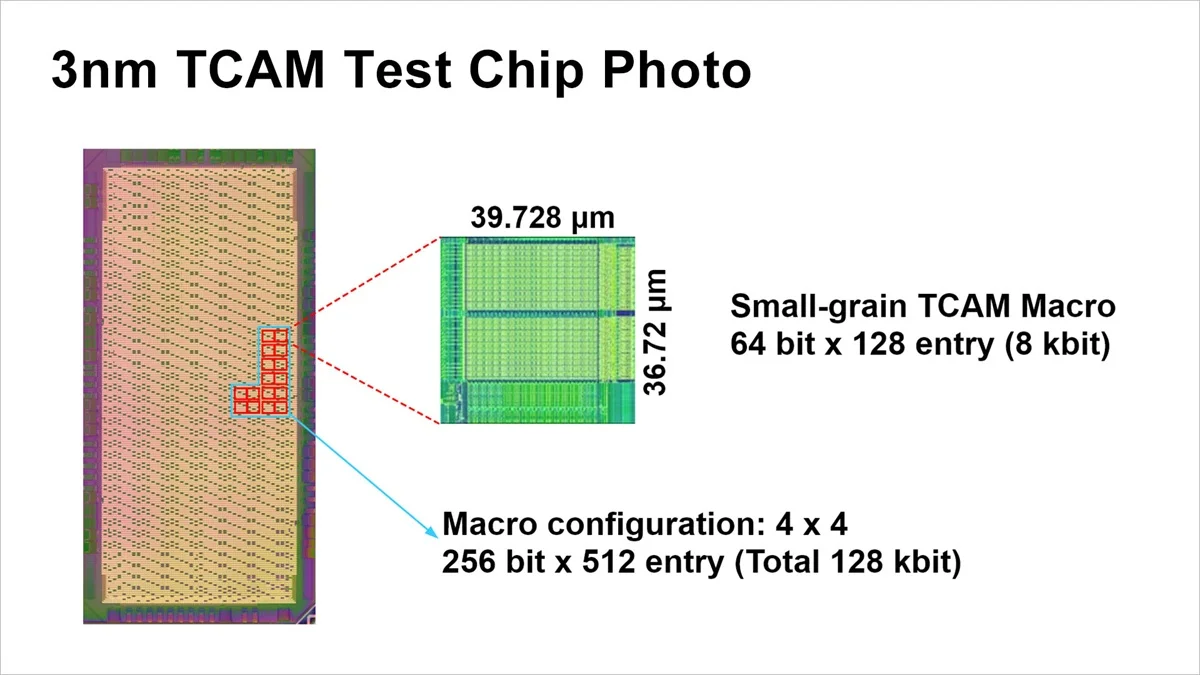
 At advanced nodes, TCAM scaling stops being about just fitting more bits into a smaller footprint. The peripheral circuitry starts to dominate. Repeaters multiply. Banks stack up. Timing margins tighten in ways that do not show up in the abstract diagrams. In networking silicon that overhead is tolerated because throughput demands it. Inside an automotive SoC, where safety islands and sensor fusion blocks share the same die, that overhead becomes harder to justify. Renesas’ 3nm TCAM work looks less like a shrink and more like a rework of how the macro is assembled.
Configurable 3nm TCAM Without Bank Proliferation
Conventional TCAM scaling relies on hard macros that grow in number as key widths and entry counts increase. Wider keys and deeper tables push designers toward more banks, and that brings extra peripheral area and repeater chains that complicate timing closure. Renesas combines fine-granularity hard macros with tool-driven soft macro generation, allowing search key widths from 8 to 64 bits and entry depths from 32 to 128 entries to be composed into larger arrays such as 256-bit by 4096-entry structures without treating each expansion as a separate macro block.
The reported density reaches 5.27 Mb per square millimeter on a 3nm FinFET process, which makes integration inside a crowded SoC floorplan more realistic, especially when TCAM is only one part of a larger compute and safety fabric.
Search Energy at 0.167 fJ per Bit and 1.7 GHz Operation
Search power scales with width, and wide keys can make TCAM arrays power hungry. Each Renesas hard macro integrates an all-mismatch detection circuit and uses a two-stage pipelined search. The first stage determines whether continuation is necessary. If the key comparison already fails, the second stage does not proceed. In configurations such as 256-bit by 512 entries, search energy is reported at 0.167 femtojoules per bit while supporting a 1.7 GHz search clock. Partitioning strategies influence savings, with substantial reductions observed in both column-wise and row-wise search approaches. The figure of merit that combines density, speed, and energy is reported at 53.8, suggesting the trade-offs were balanced rather than pushed in a single direction.
Functional Safety Mechanisms Beyond Conventional ECC
In networking environments, soft errors are inconvenient. In automotive contexts, they are a certification problem. TCAM bitcells associated with a single address tend to be physically adjacent, which increases the likelihood that a radiation-induced disturbance affects more than one bit at once. Conventional single-error correction and double-error detection coding cannot correct a true double-bit upset when both bits sit side by side.
Renesas addresses this by splitting odd and even data buses for user data and parity, increasing physical separation between bits that would otherwise share proximity. In addition, parity is stored in dedicated SRAM with an independent address decoder, improving detectability if an incorrect address is written during TCAM operations. These architectural adjustments raise safety coverage in a way that aligns with ISO 26262 expectations for automotive SoCs, where TCAM may sit alongside perception, control, or communication logic that cannot tolerate silent corruption.
Automotive SoC Integration and Architectural Direction
Flexible key widths and entry depths allow TCAM capacity to be matched more closely to workload requirements instead of overprovisioning large fixed arrays. In automotive SoCs handling sensor data, networking stacks, and internal routing tables, that flexibility reduces wasted silicon and unnecessary search energy. At 3nm, memory architecture decisions increasingly influence overall system behavior, sometimes more than transistor performance alone. TCAM that can be configured in smaller building blocks and composed into larger structures gives SoC designers another lever when balancing area, power, and safety coverage.
Learn more and read the original announcement at www.renesas.com
You may also like