
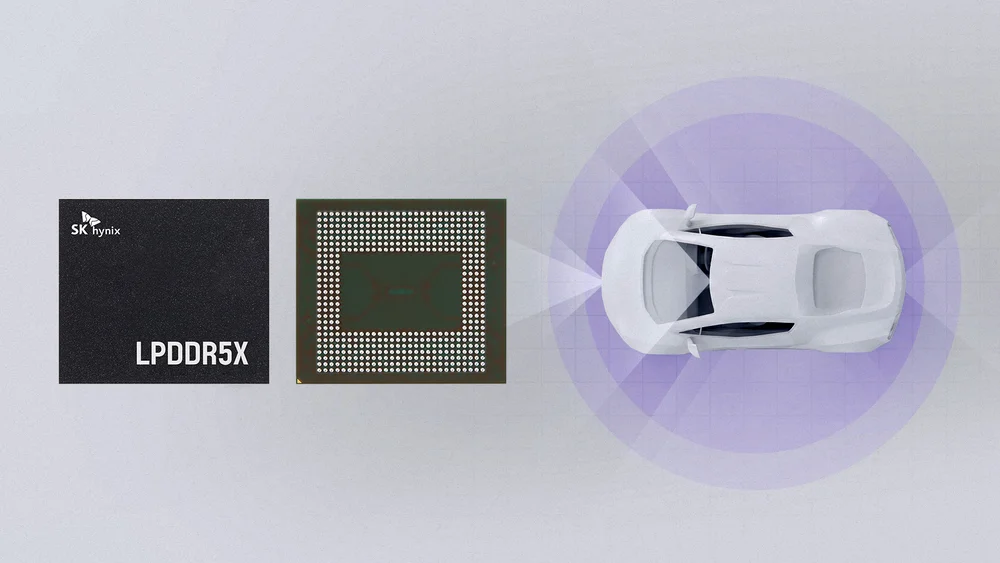
 The shift toward software defined vehicles is changing how engineers think about reliability. It is no longer enough for memory to be fast or power efficient. As more perception, planning, monitoring, and logging workloads move into DRAM, the memory subsystem becomes part of the vehicle’s safety envelope rather than a supporting component. SK hynix’s LPDDR5X automotive DRAM earning ASIL D approval under ISO 26262 reflects this new reality and highlights how memory now carries direct responsibility for system level behaviour.
ASIL D is the point where a device is trusted not just to run code but to withstand faults that would otherwise put a vehicle into an unsafe condition. That expectation extends across the entire lifecycle, from design through verification and quality control. For a high bandwidth memory device to meet that threshold, it has to do more than achieve low defect rates. It needs to predict, identify, and respond to faults in ways that limit the chance of bad data influencing safety critical logic.
Why Functional Safety Matters More for Modern DRAM
As vehicles collect and process more sensor data, the amount of information held temporarily in memory becomes enormous. Autonomous driving stacks depend on DRAM for buffering camera frames, radar outputs, LiDAR clouds, and fused perception data. When that memory misbehaves, the system often cannot recover gracefully. That makes DRAM behaviour part of the safety case, especially in platforms targeting Level 2 plus and beyond.
The LPDDR5X device SK hynix put through certification is intended for those workloads. It aims to maintain data integrity under harsh electrical and thermal conditions while keeping latency predictable. Engineers working on ADAS or high resolution camera systems recognise that memory faults rarely show themselves as immediate failures. They tend to appear as subtle corruption or intermittent instability, which are far more difficult to diagnose once the design is fixed. Introducing functional safety into the memory layer helps surface these issues earlier.
The Technical Foundations Behind Meeting ASIL D
To pass ASIL D, the device must show resilience against both systematic and random failures. Systematic failures stem from development choices, design flaws, or process variation. Random failures emerge during normal operation as devices age or experience stress. SK hynix built its case around a mix of architectural techniques and lifecycle controls designed to catch both classes of problems.
ECC sits at the centre of the strategy, correcting single bit errors and detecting multi bit errors before they propagate. Additional diagnostic behaviour monitors internal conditions so that the system can be alerted when an error crosses a severity threshold. The device also uses a dual fuse mechanism to manage defects identified during testing or field operation. None of these features are unusual on their own, but the strength lies in the consistency of the safety mechanisms from design through validation.
The company also had to demonstrate that the broader development process meets ISO 26262 expectations. That includes documenting design decisions, verification results, test coverage, and quality management protocols. TÜV SÜD assessed both the device and the process around it, ensuring the safety architecture, diagnostic coverage, and error handling meet the strict SPFM, LFM, and PMHF limits required for ASIL D. For engineers selecting memory for long term automotive platforms, the process evidence is often as important as the silicon itself.
What This Means for Future Automotive Memory Platforms
The certification signals a shift in how memory devices are evaluated in vehicle programs. As ADAS pipelines become more complex, memory is no longer considered passive infrastructure. It becomes an active participant in the safety strategy. That changes buying criteria. A device with high bandwidth but no defined safety mechanisms may no longer meet OEM requirements for next generation platforms.
SK hynix is positioning its LPDDR5X family to align with this transition. The certification suggests that functional safety will continue to influence memory roadmaps and that diagnostic capability, data integrity, and fault response will matter as much as raw performance. For engineers, the broader lesson is that choosing memory for SDV architectures now involves questions that previously sat with microcontrollers and safety processors. The safety case reaches further into the hardware stack than it once did.
Learn more and read the original announcement at www.skhynix.com
You may also like