
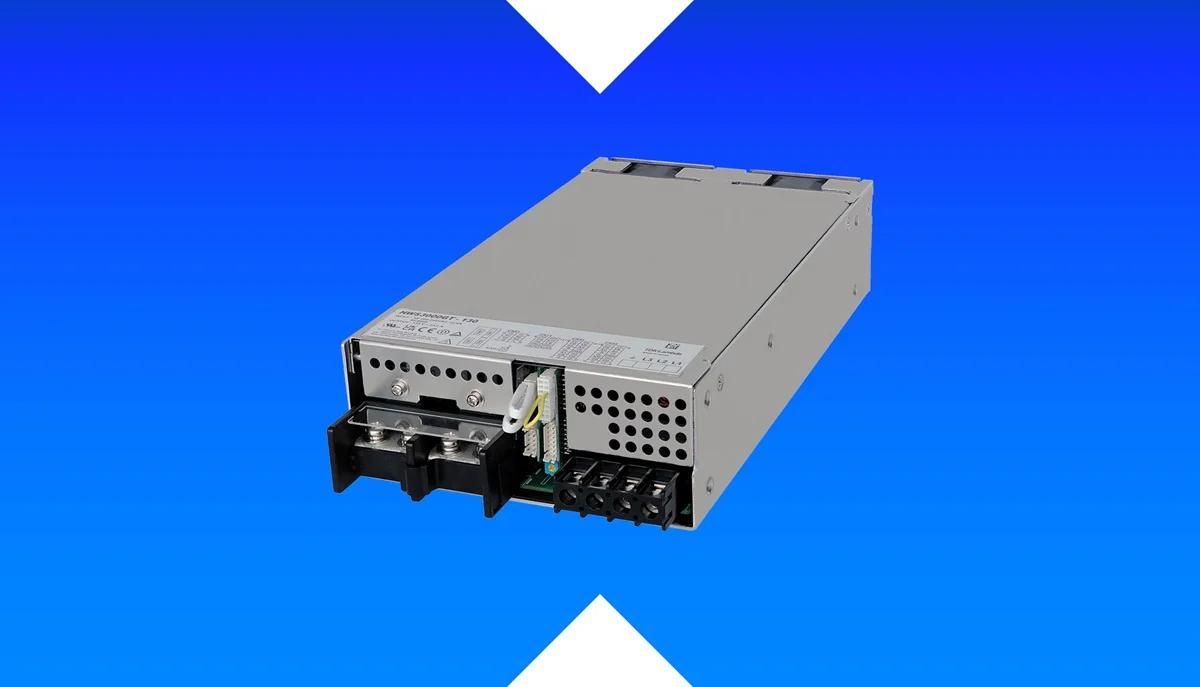
 Engineers working on high power industrial equipment usually discover the limits of their supply long before the rest of the system reaches its own edge. As load profiles shift, as automation gear gets denser and as RF or laser hardware demands cleaner voltage transitions, the supply often becomes the point where integration slows down. That is the context where the HWS3000GT4 from TDK Corporation begins to feel different because it allows a system to pull full power from a wide range three phase input without surrounding it with converters or extra distribution hardware. It turns the supply into something that adapts to the installation rather than the installation having to adapt to it.
Wide Range Three Phase Input That Eases Integration In Global Installations
The new model accepts 340 to 528 Vac three phase, which covers the bulk of industrial power grids without special transformers or region specific wiring. That matters when equipment is shipped across regions that use different voltage classes and the design has to remain stable in each environment. The supply draws consistently enough that performance does not rely on the cleaner edges or tighter tolerances found in lab setups. This gives designers space to treat the incoming power as a variable rather than a fixed constraint. It also keeps the unit tolerant to electrical noise and load disturbances that often appear in semiconductor tools, industrial drives and large automation racks.
Programmable Output That Can Shape Itself Around The Application
The supply supports full CV and CC programmability from zero to the rated limits, which means the system does not need extra shaping stages to dial in target voltages or currents when load behavior changes. The interface choices, RS485 with MODBus or analog control signals, let the supply sit comfortably inside PLC controlled environments or test stands that rely on mixed control domains. Slew rate programming helps tune how the output responds during fast transitions so downstream equipment does not see large overshoots or slow settling curves. The ability to program these characteristics digitally without powering the unit makes installation less risky because configuration does not require energizing a partially wired system.
Compact Power Delivery That Supports High Density Equipment
A 3000 W unit at 270 by 150 by 61 mm changes how much power can sit inside an enclosure that already accommodates drives, controllers and RF stages. When multiple units can run in series or parallel, the supply becomes part of a scalable structure rather than a fixed building block. That kind of scaling matters for laser machines, RF amplifiers and semiconductor tools where the design may require higher voltage in one revision and higher current in the next. The variable speed fan keeps acoustic noise manageable while balancing thermal load, which affects long term reliability in enclosures where air channels tend to get partially obstructed over time.
Monitoring And Diagnostics That Support Predictable Operation
The supply tracks operating time, stores fault logs and provides identification data so it can integrate into predictive maintenance frameworks or automated test systems. These details help pinpoint whether a failure comes from the load, the wiring or the supply itself. Reliable isolation ratings allow the supply to sit near sensitive measurement equipment without leaking unwanted current into ground or compromising the integrity of signal references. The ability to configure output terminals horizontally or vertically gives installers more control when they need to fit the supply into tight racks where cable access is limited to one direction.
Rugged Options For Environments That Challenge Electronics
Some industrial and defense environments introduce vibration and shock loads that gradually degrade components not designed for them. The HWS3000 /HD variant coats the boards and reinforces the structure so the unit can withstand conditions aligned with MIL STD 810G. This becomes important for machinery that moves aggressively or for systems mounted on vehicles where the power supply sees more motion than the equipment it powers. Meanwhile the /RF variant reverses airflow so the thermal path can follow the enclosure’s architecture rather than forcing the enclosure to match the supply.
Learn more and read the original announcement at www.tdk.com
You may also like