
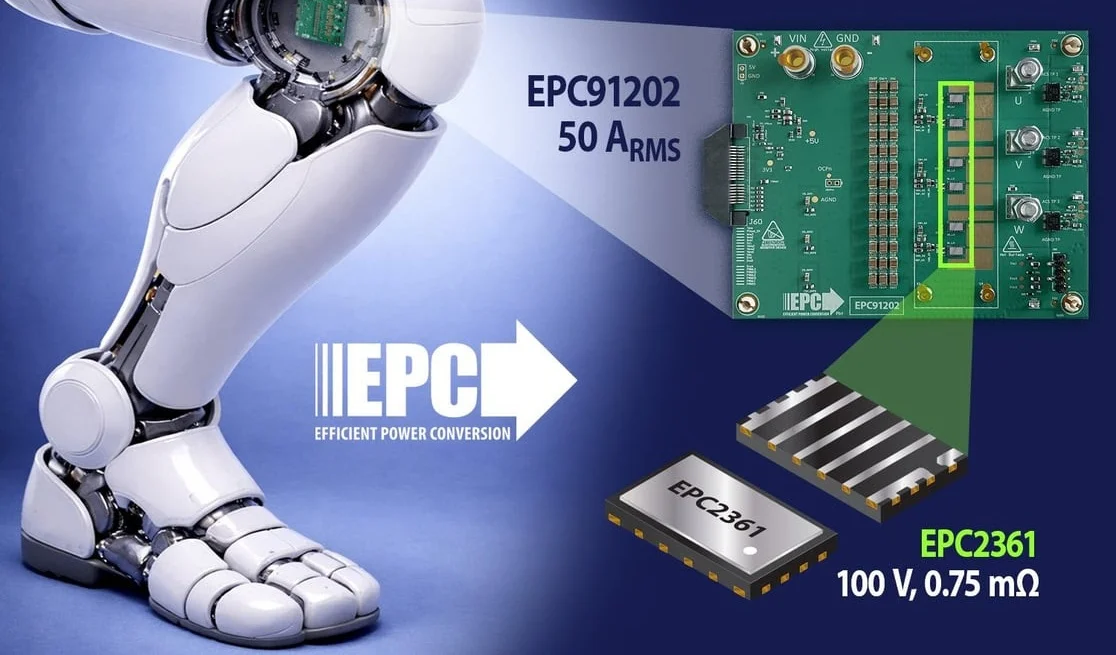
 Motor control engineers tend to run into the same constraint sooner or later. Higher switching frequency improves current control and reduces motor ripple, but silicon power stages start to lose efficiency long before the control loop reaches the speeds designers would like. Thermal limits appear, switching losses rise, and the inverter begins to dictate the limits of the entire drive system rather than the motor or the control algorithm.
The EPC91202 from Efficient Power Conversion addresses that limitation. The EPC91202 is a three-phase BLDC inverter evaluation board built around EPC’s EPC2361 100 V eGaN FET. Replacing the traditional silicon MOSFET power stage with GaN allows the inverter to operate at switching speeds that are difficult to sustain in conventional motor drive hardware.
In a typical robotic joint or drone propulsion system the inverter is responsible for translating PWM control signals from the MCU into phase currents that drive the motor windings. That stage has to handle large transient currents while switching fast enough to keep torque ripple low and acoustic noise under control. Once switching frequency climbs, the power stage itself becomes the limiting factor.
Where GaN Starts Changing Motor Drive Behavior
The EPC91202 evaluation platform demonstrates how GaN power devices begin to change the operating envelope of small motor inverters. Instead of treating switching frequency as something that must remain conservative to protect efficiency, the power stage can operate well into higher PWM regions without the same penalty normally seen with silicon.
The board supports switching frequencies up to 150 kHz while delivering phase currents up to 70 A peak, or 50 ARMS. That combination immediately affects several parts of the motor system at once. Higher PWM frequencies reduce audible motor noise and allow tighter current control, which in turn improves torque response in precision motion systems.
Power Stage Layout and Integrated Drive Hardware
Unlike many evaluation boards that focus only on the transistor stage, the EPC91202 integrates most of the circuitry needed for a working inverter. Gate drivers, housekeeping supplies, sensing circuits, and protection hardware are already on the board. Phase current sensing and voltage monitoring are implemented directly on the platform so developers can evaluate advanced control strategies without building a complete inverter from scratch. Over-current and under-voltage protection are also included, which makes early testing less risky when experimenting with high switching speeds.
Input voltage ranges from 14 V to 76 V, which places the board squarely in the range used by battery-powered systems such as drones, mobile robotics, and light electric vehicles.
Control Loop Compatibility and Motion Algorithms
Motor drives rarely operate as isolated power stages. They normally sit underneath a microcontroller running control algorithms that translate position or torque commands into PWM signals. The EPC91202 is designed to work with multiple controller platforms, allowing engineers to connect the inverter to existing MCU development environments. Accurate sensing of phase current and voltage allows the controller to implement techniques such as field-oriented control and space-vector PWM, both of which rely on precise feedback to maintain stable motor operation.
For engineers experimenting with high-performance motion systems, these feedback signals are often where development time disappears. Having them already integrated on the inverter board shortens the path between hardware testing and closed-loop control experiments.
GaN Motor Drives Moving Toward Higher Density Systems
Motor drive hardware has gradually been moving toward higher switching frequencies and smaller passive components as wide-bandgap devices become more practical. Higher switching speed reduces the size of magnetics and DC link capacitors, while faster current control improves the dynamic behavior of the motor itself. Platforms like the EPC91202 are intended to let engineers explore that transition without designing a full GaN inverter from scratch. The combination of GaN switching devices, integrated sensing, and a complete inverter topology makes it easier to experiment with compact motor drives used in robotics, drones, and battery powered mobility systems.
Once the control firmware is tuned and the inverter behavior is understood, the reference design becomes a starting point for production hardware rather than just a demonstration platform.
Learn more and read the original announcement at www.epc-co.com
Technology Overview
The EPC91202 is a three-phase BLDC motor inverter evaluation board based on the EPC2361 100 V eGaN FET. It supports phase currents up to 70 A peak (50 ARMS) and PWM switching frequencies up to 150 kHz. The board integrates gate drivers, sensing circuits, and protection hardware to support development of GaN-based motor drive systems.
Frequently Asked Questions
What is the EPC91202 used for?
The EPC91202 is used as a development platform for three-phase BLDC motor drives in systems such as robotics, drones, industrial automation, and battery-powered motion platforms.
What switching frequency does the EPC91202 support?
The EPC91202 supports PWM switching frequencies up to 150 kHz.
You may also like