
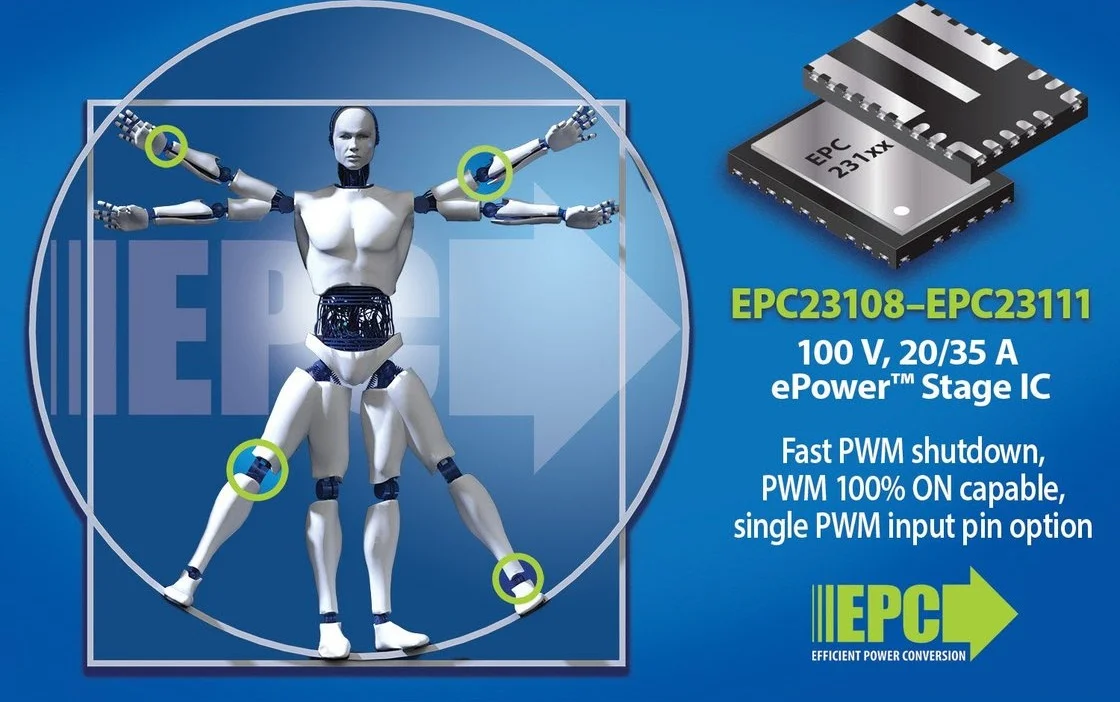
 Motor drives have been getting squeezed from both sides for a while now. Designers want higher switching speeds, better efficiency, less wasted board space, and tighter control over fault behavior, but they are still expected to make all of that work inside compact battery-powered platforms that do not forgive messy layouts or unpredictable gate drive behavior. EPC’s latest 100 V integrated GaN stages are clearly positioned for that kind of design pressure. The EPC23108, EPC23109, EPC23110, and EPC23111 are monolithic half-bridge power stages built for systems where board density and control behavior matter just as much as raw switching performance.
The EPC23108 family is a group of 100 V integrated GaN power-stage ICs used for motor drives, power conversion, and other high-frequency switching applications. In a humanoid robot joint or a drone propulsion stage, that means the power stage sits close to the motor and has to switch hard, stay controlled under fault conditions, and not burden the rest of the design with extra glue circuitry.
What stands out here is not just that EPC has integrated the high-side and low-side eGaN FETs with the gate driver and level shifting circuitry. Integrated GaN is not new in itself. The more relevant point is that EPC is pushing harder on the parts of the design engineers actually end up wrestling with late in development, especially shutdown behavior, duty-cycle limitations, and control interface simplicity.
Fault Behavior Matters More Than Marketing Claims
A lot of power devices look great until something goes wrong. Then the real design quality shows up very quickly. EPC is putting real emphasis on deterministic shutdown behavior in these parts, and that is probably the most useful part of the launch. The devices include an active-low fast-shutdown and standby input with a built-in 65 kΩ pull-up, so they can interface directly with standard industrial logic without extra signal conditioning. That sounds minor until you are trying to standardize control across multiple boards or motor axes and realize you do not want another layer of logic cleanup just to make the power stage behave consistently.
Loss of the driver supply also triggers an active gate pull-down that keeps both the high-side and low-side FETs off. That is the sort of protection behavior that matters because it closes off one of the more unpleasant failure paths in compact high-density systems. You do not appreciate that until you are debugging a fault event and trying to work out whether the power stage stayed under control when the rest of the system did not.
100% Duty Cycle Is Not a Small Detail
Continuous 100% duty-cycle operation is another important point here. Many motion systems, precision regulation platforms, and full-torque operating modes do not benefit from artificial control limitations imposed by the power stage. If the architecture needs uninterrupted conduction, then the device should support it without caveats.
EPC says these parts can do that, and for real motor control systems that removes one more awkward boundary between the control scheme the engineer wants and the one the hardware will tolerate. That gap is often where supposedly advanced hardware starts becoming annoying.
Two Control Paths for Different Design Philosophies
The split across the family is sensible. EPC23109 and EPC23111 use a single-pin PWM input with enable logic and fixed dead time, which is clearly intended to reduce control complexity in multi-axis systems. If you are dealing with a robot arm packed with motors, that starts to matter fast.
EPC23108 and EPC23110 take the more flexible route with dual PWM inputs, allowing online adaptive dead time modulation. That will appeal more to designers who want tighter control over switching behavior instead of accepting a fixed timing scheme. Neither approach is universally better. It depends whether the design is trying to reduce firmware overhead or squeeze more control authority out of the switching stage.
Current Ratings, Package Density, and Where These Fit
The family supports operation up to 100 V, with 35 A devices in the EPC23108 and EPC23109 and 20 A devices in the EPC23110 and EPC23111. All four parts are packaged in thermally enhanced QFN packages, which fits the kind of compact layouts these applications demand, even if thermal design will still need careful handling because compact motor systems rarely give away free cooling.
EPC is clearly targeting robotics, drones, medical systems, DC-DC converters, synchronous rectification stages, and Class-D audio. That range makes sense because all of those applications reward faster switching and reduced external component count, but the stronger fit still feels like dense motion platforms where the control architecture and protection behavior matter as much as the GaN efficiency story.
Learn more and read the original announcement at www.epc-co.com
Technology Overview
The EPC23108, EPC23109, EPC23110, and EPC23111 are 100 V integrated GaN power-stage ICs that combine high-side and low-side eGaN FETs with a gate driver and level shifting circuitry in a thermally enhanced QFN package. They are used in motor drives, power converters, and other compact high-frequency switching systems. The family includes 35 A and 20 A variants, supports continuous 100% duty-cycle operation, and includes fast shutdown behavior for fault handling.
Frequently Asked Questions
What are the EPC23108, EPC23109, EPC23110, and EPC23111 used for?
They are used for motor drives, robotics, drones, medical equipment, DC-DC converters, synchronous rectification stages, and Class-D audio systems.
What current ratings are available in the EPC23108 family?
EPC23108 and EPC23109 support 35 A load current capability, while EPC23110 and EPC23111 support 20 A.
You may also like