
 Isolated power has a habit of expanding into whatever space a board leaves available. The transformer wants room, the isolation barrier wants margin, and the rest of the circuit would quite like the module to stop growing now that power trees in data centers and EVs are already fighting for every square millimeter. That gets worse when the rail itself is not very large, because the overhead around isolated power can start feeling disproportionate to the wattage being delivered.
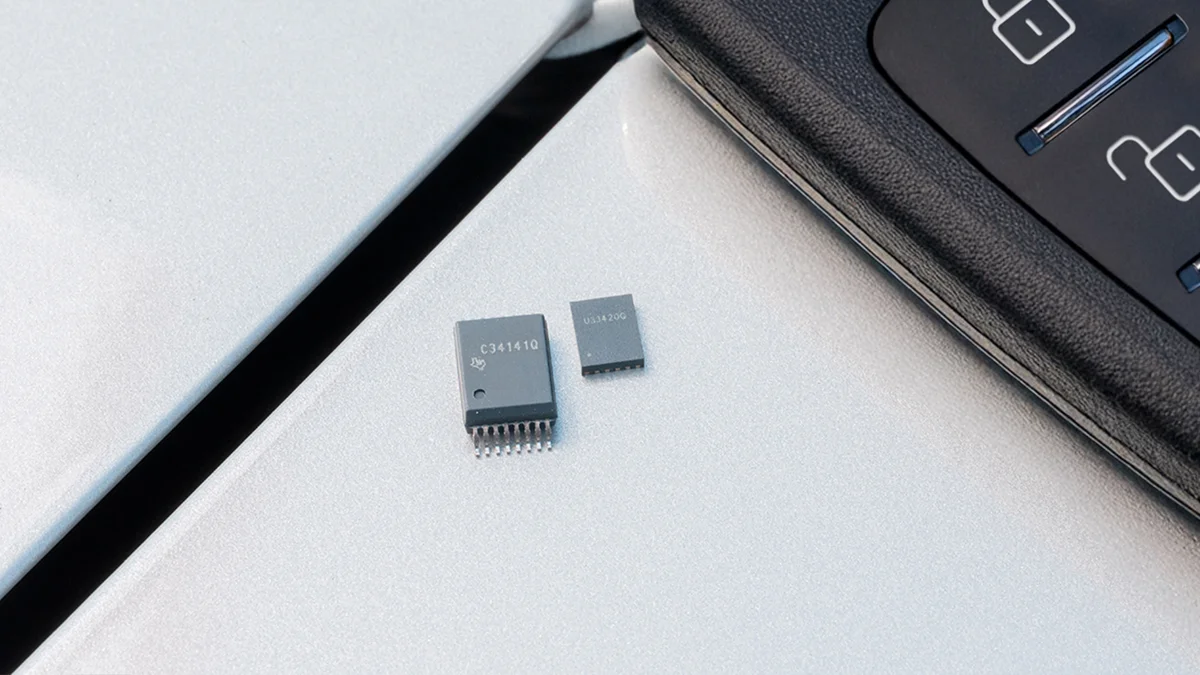
Those constraints are exactly what TI is trying to address with the new UCC34141-Q1 and UCC33420 modules. The new launches are isolated power modules used to generate compact isolated supply rails in automotive, industrial, and data center systems. In a typical traction inverter control board, server power distribution stage, or industrial gate-drive supply, a part like this is there to create an isolated bias rail without forcing the designer back into a larger discrete transformer-based implementation.
The interesting part is the packaging more than the output power. TI is using what it calls IsoShield, a multichip approach that copackages a planar transformer and isolated power stage inside the same module. That matters because isolated supply circuits are often limited less by clever control than by how much physical volume the isolation function consumes once the board is real.
Packaging Is Starting To Decide Isolated Power Density
A lot of isolated power designs still end up looking bulkier than they should, not because the power level is especially high, but because the transformer, switching stage, and safety spacing all take turns demanding their own territory. TI’s pitch here is that IsoShield pulls more of that into one package so the overhead drops with it.
The company says the new modules can deliver up to three times higher power density than discrete isolated solutions while shrinking solution size by as much as 70 percent. Those are strong claims, but the broader engineering point makes sense even without leaning too hard on the comparison. Once the transformer and power stage are copackaged, the isolated rail stops behaving like a small side project and starts looking more like a normal board-level power block again.
That is especially useful in distributed power architectures, where isolated rails show up repeatedly across the system. In those environments, any reduction in isolation overhead can multiply quickly across the full design rather than saving space only once.
Small Isolated Rails Still Carry A Lot Of Weight
The output power here is modest, up to 2 W according to TI, but these parts are not trying to run the whole system. They are aimed at the smaller isolated rails that keep critical sections alive and separated. Those rails often sit around gate drivers, sensing domains, communication islands, and local control sections where reinforced or basic isolation is needed but board space is already gone. TI positions the UCC34141-Q1 in a 5.85 mm by 7.5 mm by 2.6 mm package for mid-voltage applications in the 6 V to 20 V range, while the UCC33420 comes in a 4 mm by 5 mm by 1 mm package for low-voltage 5 V rails. Those are the sort of dimensions that become useful when the isolated supply has to fit near dense compute hardware or inside automotive systems where the mechanical envelope is already under pressure from everything else nearby.
There is a second effect here too. Smaller isolated modules do not just free PCB area. They can reduce material use and shorten the amount of custom work needed to get the rail running, which is often where discrete isolation circuits become more annoying than their schematic originally suggested.
Data Centers And EVs Both Reward Compact Isolation
TI is tying the launch to both data centers and EVs, which is sensible because both are leaning harder on compact distributed power. In server and AI hardware, isolated rails support increasingly dense control and conversion stages where volume and thermal headroom are both under strain. In EV systems, lighter and smaller auxiliary power structures are always welcome, especially where safety boundaries and harsh operating conditions are involved.
The real story is not that isolated power suddenly became important. It always was. The change is that the packaging around it is being forced to get much more efficient. Once reinforced isolation has to coexist with shrinking board area and rising power density, even a 2 W rail can become a packaging problem first and a power problem second. That is the corner TI seems to be targeting with these new modules.
Learn more and read the original announcement at www.ti.com
Technology Overview
The UCC34141-Q1 and UCC33420 are isolated power modules from TI for compact isolated supply rails in automotive, industrial, and data center systems. They use TI’s IsoShield packaging technology, which copackages a planar transformer and isolated power stage, and support up to 2 W output power with functional, basic, and reinforced isolation capabilities. The UCC34141-Q1 targets 6 V to 20 V applications, while the UCC33420 is designed for 5 V applications.
Frequently Asked Questions
What are the TI UCC34141-Q1 and UCC33420 used for?
They are used to generate compact isolated power rails in automotive, industrial, and data center systems.
What voltage ranges do the new TI isolated power modules support?
TI lists the UCC34141-Q1 for 6 V to 20 V applications and the UCC33420 for 5 V applications.
You may also like